LOOK-UP ADELAIDE
“When Eyes Return to the Sky”
by Fin Rice
In the wake of a global pause—a moment when distance defined safety and digital life eclipsed the tangible—Adelaide’s architecture remained steadfast, waiting to be seen again.
LOOKUP ADELAIDE is a response. A visual hymn composed through fifty-nine architectural verses where presence triumphs over distraction, and silence speaks louder than the scroll. Each image in this catalogue is both document and invitation: to lift our gaze above the algorithmic feed, to notice the myth hiding in mirrored panels and golden hour reflections, to see the dragon clinging to the wall, the scaffold mid-breath, the corridor etched in graffiti memory.
This suite doesn’t portray a city—it listens to it. In facades, gaps, shadows, and signals, it renders Adelaide as both relic and rhythm, sacred and strange. Each composition murmurs the same plea: look up.
To walk the streets distracted is to miss the quiet ceremony playing out above—skylines in dialogue, symmetry singing dusk, and buildings breaking rhythm like punctuation in a poem. From mural mythos to industrial verse, twilight facade to scaffold echo, these works remind us that architecture is not backdrop—it’s narrative.
As creator and witness, I offer this catalogue as a mirror, a myth, and a map. Not to escape the present, but to reclaim it—with eyes wide, posture lifted, and curiosity tuned toward the vertical myth always unfolding overhead.
“Printed large-format on canvas, enhanced with light-reactive pigment, metallic leaf, and stenciled textures. Each piece is finished with multiple resin pours and designed to hang in front of windows—illuminated by daylight, transformed by nightlight, and serving as a privacy screen in high-density living.”
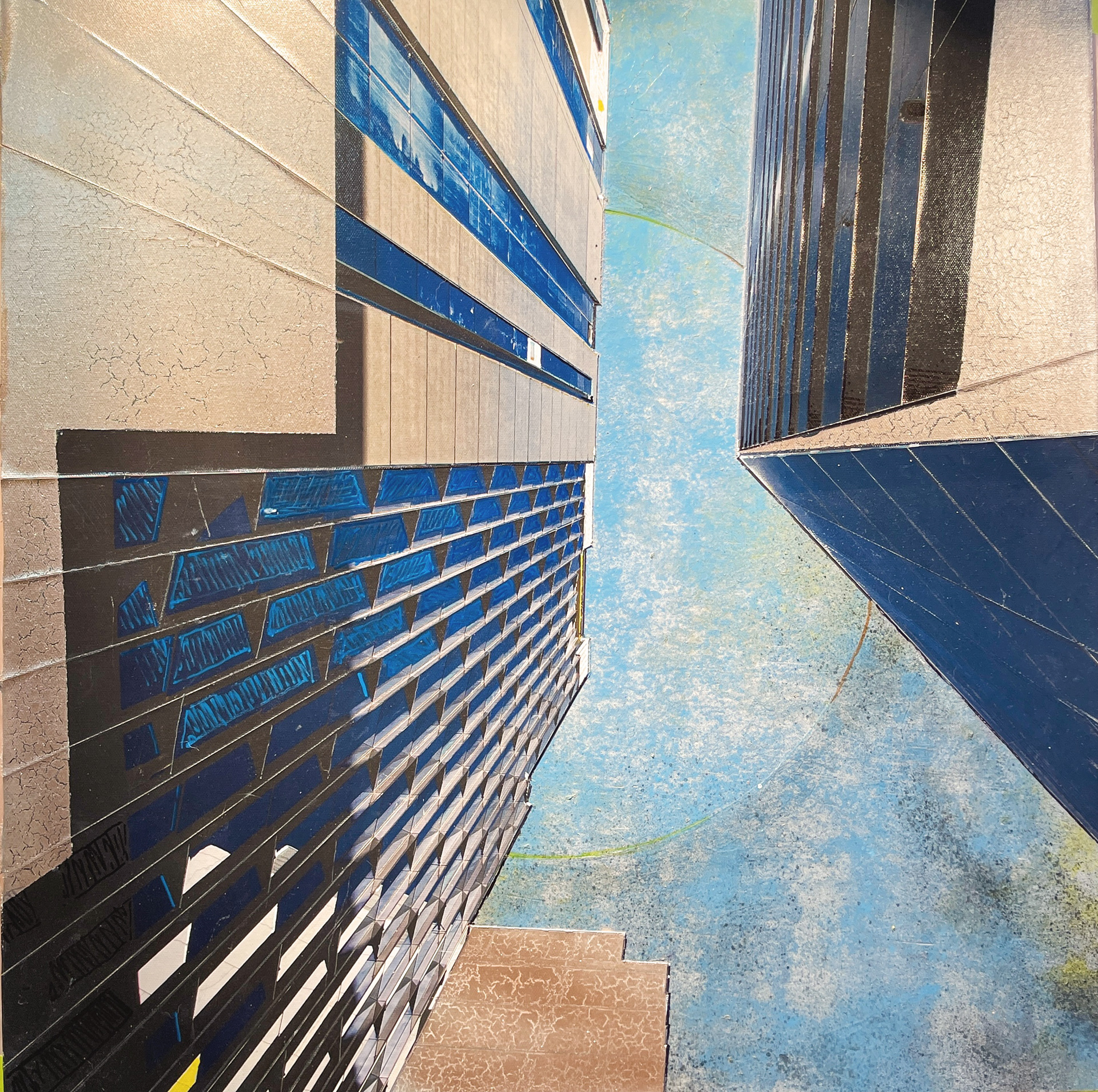
“Skybound Dialect”
Medium:
Dimensions: 100CM X 100CM
Dimensions: 100CM X 100CM
Edition:1/10
Price: POA
Price: POA
🖋️ Description
Skybound Dialect ascends between two angular high-rises whose modern facades speak in architectural contrast. The left tower wears a skin of pale beige intercut with blue rectangular bands—mid-century rhythm made crisp. The right structure leans more minimalist: vertical blue panels climb uninterrupted, cool and calculated. Between them, a corridor of sky emerges—textured in layered blues and hints of peach, a subtle echo of sunset filtered through façade geometry. The upward perspective renders both buildings not in rivalry, but in duet.
It’s a structural soliloquy sung across glass and cloud.
💬 Critique
Fin Rice’s Skybound Dialect refines the tension between symmetry and dissonance. The interplay between the patterned left tower and the clean right façade echoes motifs from Sun Gap I and Vertical Interval, yet here the dialect is sharper—less contemplative, more conversational. The sky becomes protagonist, tempered by texture and tone, while the facades operate like call and response. Compared to the mural exuberance of Wink Street or the industrial lyric of Grain Syntax, this entry hums in architectural clarity. It doesn’t shout myth—it sketches it in shape and stillness.
“Sun Gap I”
Medium:
Dimensions: 100CM X 100CM
Edition: 1/10
Price: POA
Dimensions: 100CM X 100CM
Edition: 1/10
Price: POA
🖋️ Description
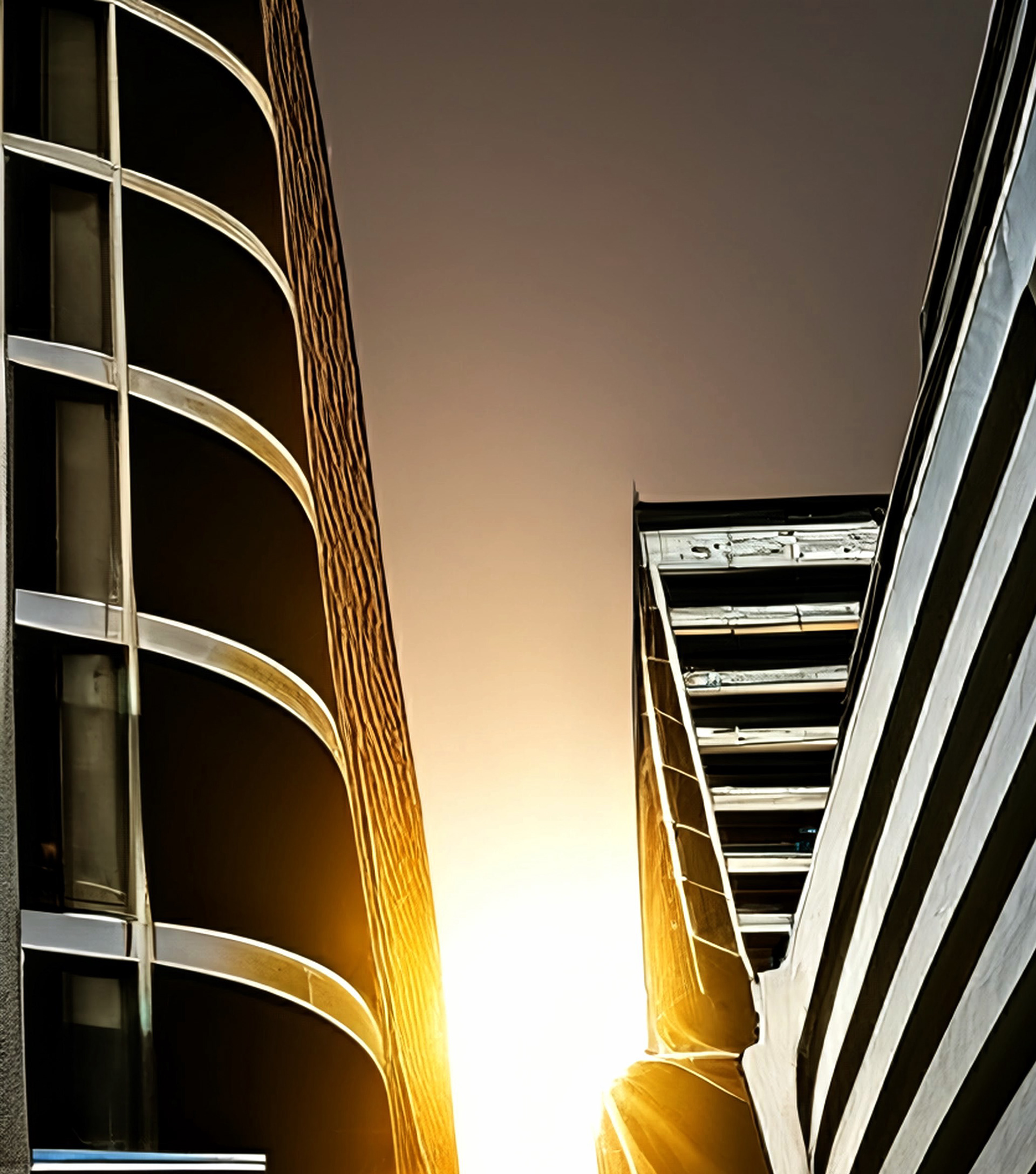
Sun Gap I opens a luminous portal between structural personalities. To the left, a curved facade coils upward, its horizontal ribs catching light like scales of steel. To the right, a sharper, striped volume ascends with angular poise—its vertical lines punctuating the sky’s gradual descent into gold. Between them, a narrow vertical slice reveals the sky, bathed in golden hour glow and lined with gentle cloud fragments. The edges of both buildings are lit like verses—sunlight articulating form, shadow composing rhythm.
This is light as line, time as texture, contrast as conversation.
💬 Critique
Fin Rice’s Sun Gap I stages a spatial duet—where opposing architectural grammars speak through sun and silence. The curved structure recalls the organic lyricism of Curvature Ledger, while the angular tower nods to Echo Box’s punctuation palette. The gap between them becomes metaphorical aperture: a civic breath, a framed horizon, a moment of pause. Compared to the industrial density of Grain Syntax, this image glows with openness and tonal poetry. It’s Adelaide as dialogue—caught between ascent and illumination.
As the fifty-ninth entry, it’s a golden stanza. A visual inhale before myth resumes
“Grain Syntax”
Medium:
Dimensions: [Insert dimensions]
Edition: [Insert edition info]
Price: [Insert price]
Dimensions: [Insert dimensions]
Edition: [Insert edition info]
Price: [Insert price]
🖋️ Description
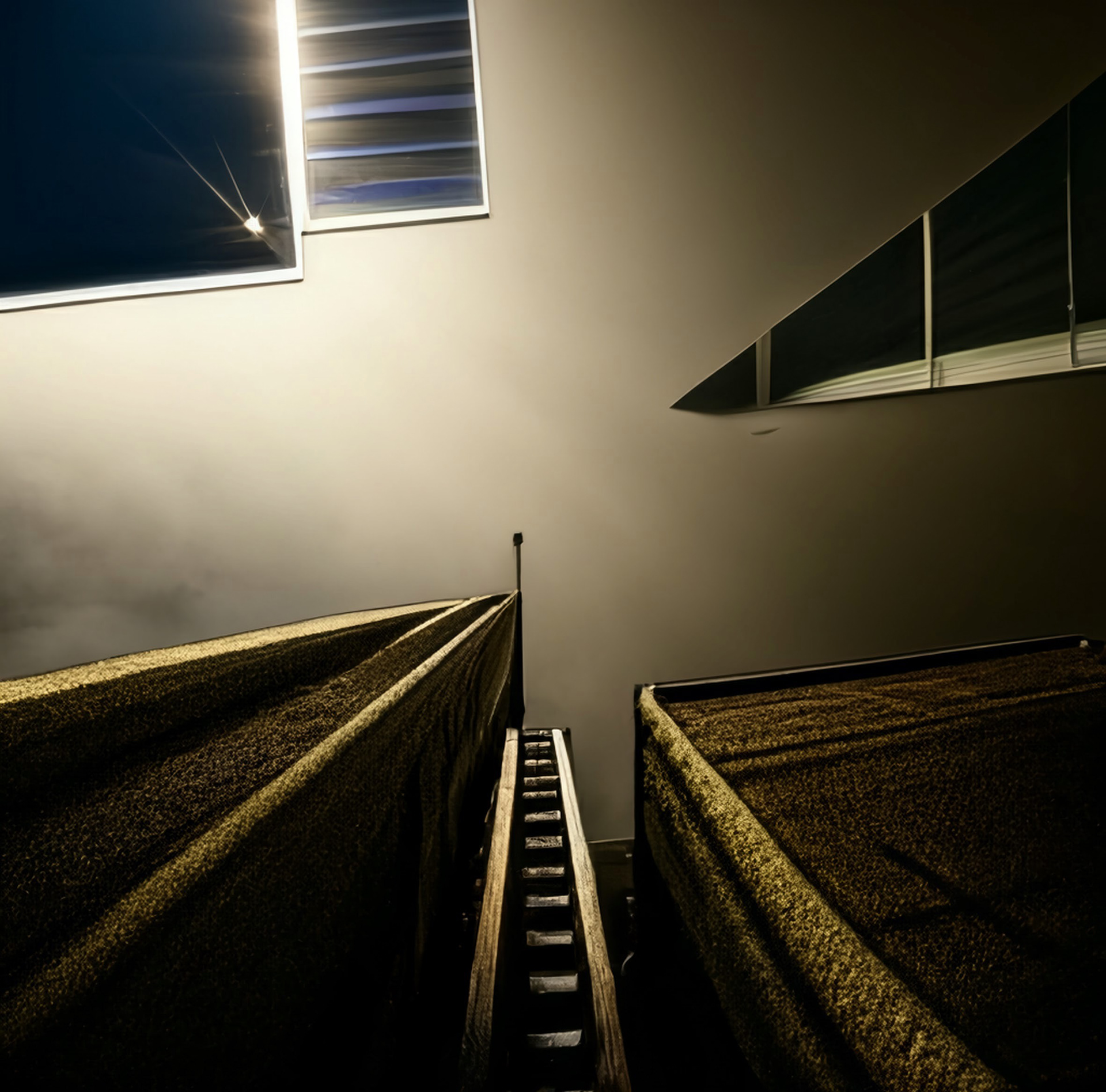
Grain Syntax captures a high-angle industrial interior, where two large troughs brim with golden-hued granular material—perhaps wheat, sand, or a composite civic substance. A conveyor belt runs between them, anchored by a metal framework and flanked by mesh covers that thread texture across the top. Above, geometric panels channel natural light through angled windows, casting spectral shadows across the grain and reinforcing the visual rhythm. It’s a scene of process, density, and quiet precision.
The frame marries architecture and industry—Adelaide not in stasis, but in soft choreography.
💬 Critique
Fin Rice’s Grain Syntax diverges from reflective facades and mural mythology to enter spatial utility with aesthetic grace. It channels the tonal restraint of The Quiet Between and the constructive rhythm of Crane Sonata, but here the raw material becomes protagonist. The granular texture recalls conceptual threads from In Construction, We Trust, while the play of light and shadow whispers of Vertical Interval. What elevates this piece is its quiet symbolism: the grain as memory, the belt as passage, the skylight as script.
The Quiet Between”
Medium:
Dimensions: [Insert dimensions]
Edition: [Insert edition info]
Price: [Insert price]
Dimensions: [Insert dimensions]
Edition: [Insert edition info]
Price: [Insert price]
🖋️ Description
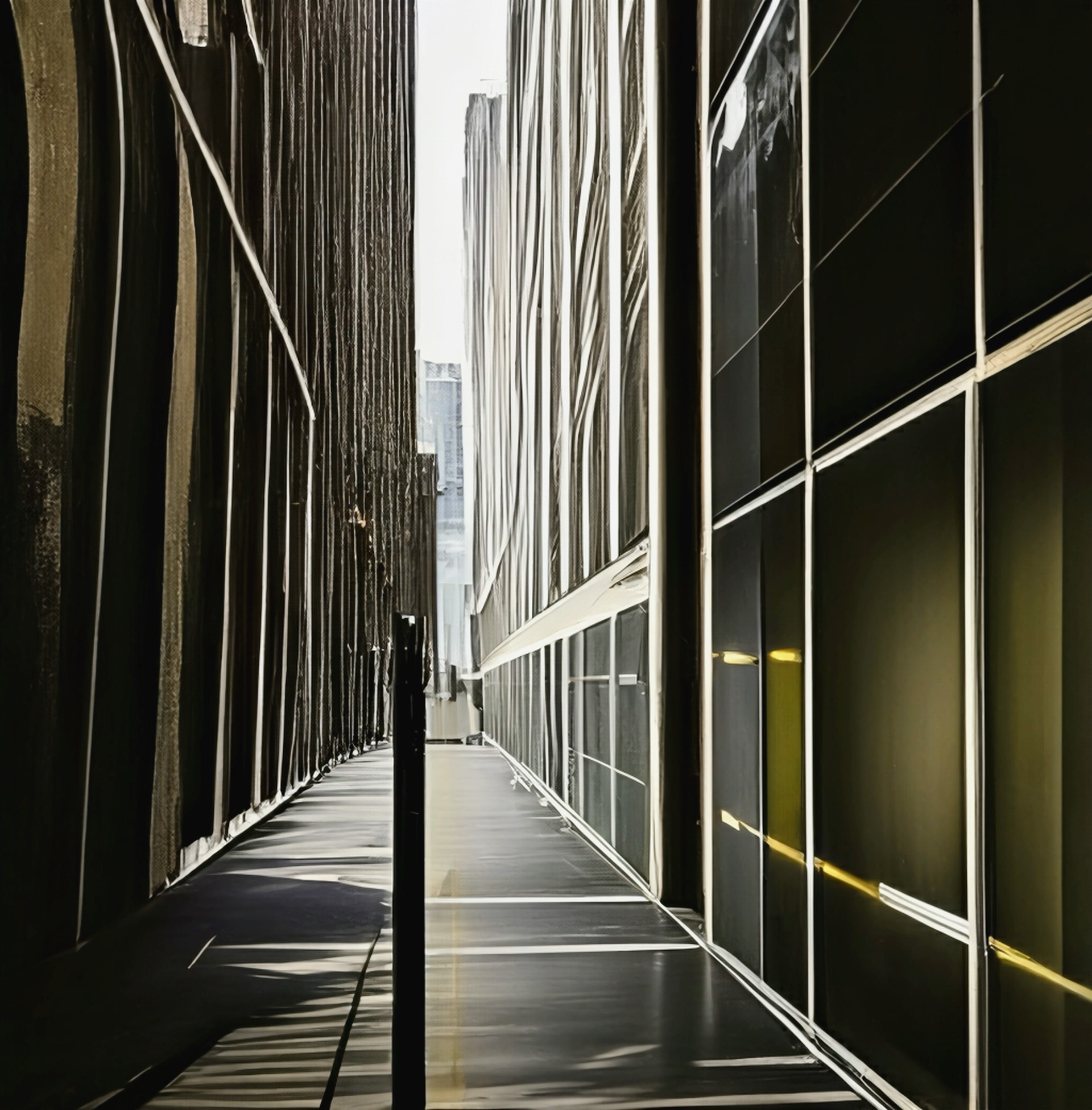
The Quiet Between captures a narrow passage flanked by two striking façades—one textured and vertical, cloaked in dark ribbed surface; the other smooth, reflective, and minimal. A single matte-black pole rises quietly mid-frame like a punctuation mark in the urban sentence. Natural light slices through the corridor, illuminating subtle gradients across ground and wall. No signs, no figures—only the architecture and its breath.
It’s a portrait of Adelaide held in pause, geometry whispering its own rhythm.
💬 Critique
In The Quiet Between, Fin Rice strips the city to elemental syntax: shadow, line, and breath. The vertical dialogue between dark and darker recalls Vertical Interval, but here the framing leans into intimacy rather than grandeur. The tonal range speaks to the spatial restraint of Sky Alley Interval, while the solitary pole becomes a civic pause—more gesture than object. Unlike the chromatic crescendo of Twilight Facade II, this entry hums in grayscale meditation.
As the fifty-eighth entry, it’s absence as architecture. A distilled myth, barely spoken, yet deeply felt
“Twilight Facade II”
Medium:
Dimensions: [Insert dimensions]
Edition: [Insert edition info]
Price: [Insert price]
Dimensions: [Insert dimensions]
Edition: [Insert edition info]
Price: [Insert price]
🖋️ Description
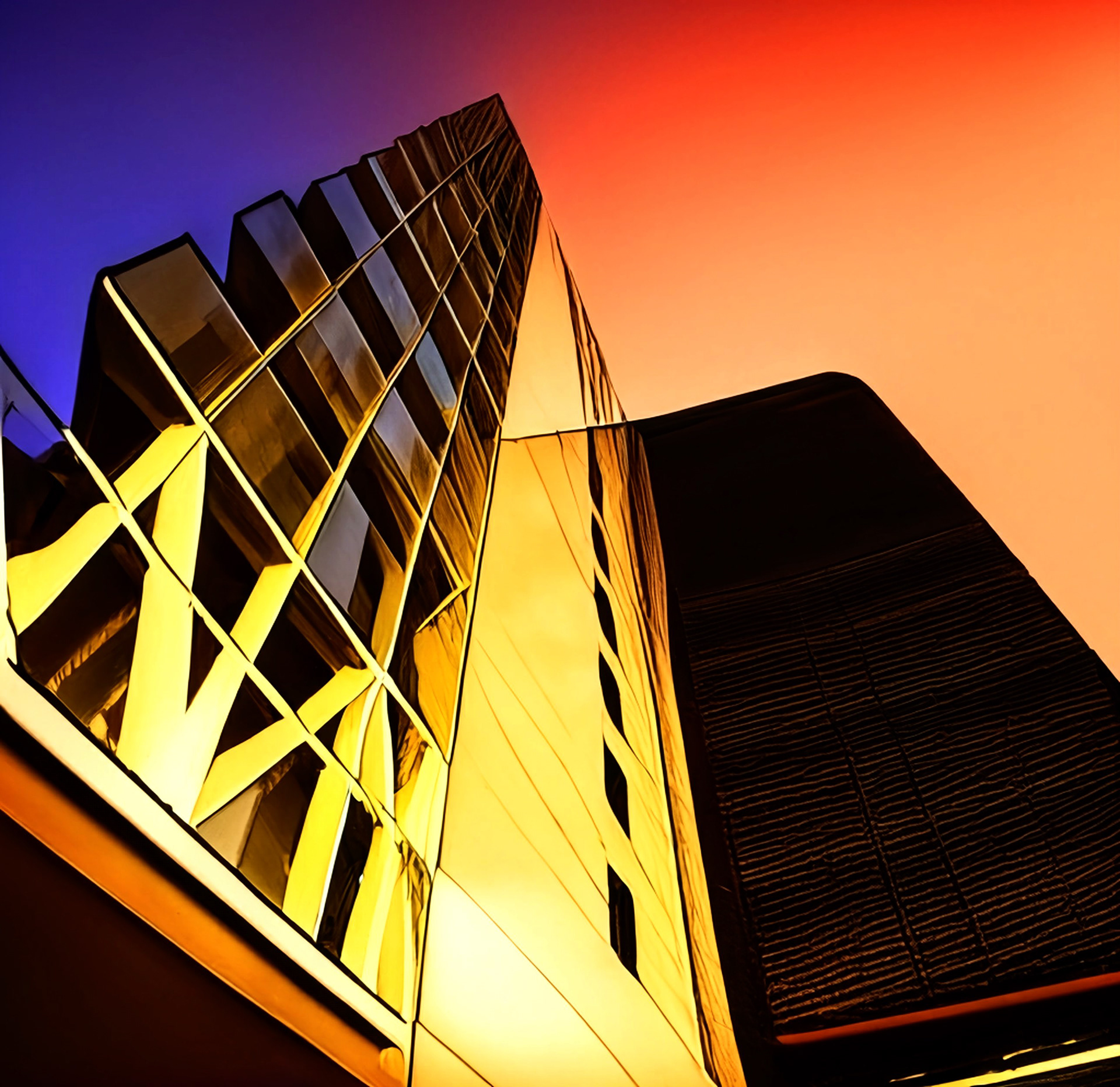
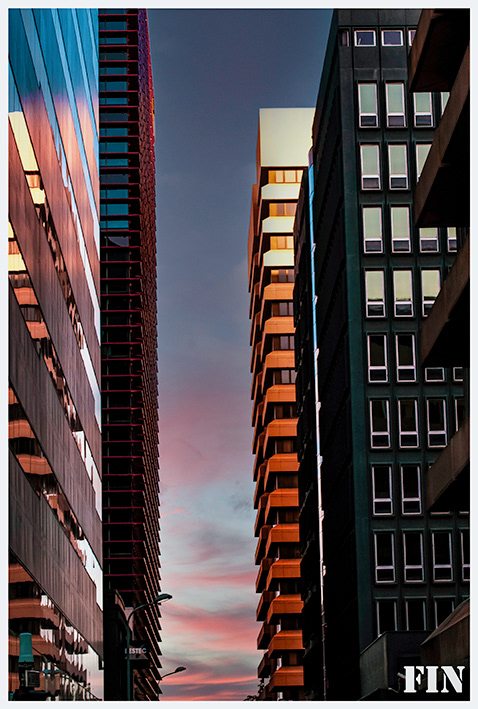
Twilight Facade II captures a sweeping vertical perspective of a modern high-rise clad in mirrored glass and geometric latticework. Shot from ground level, the structure climbs toward a sky that glows in gradient hues of deep indigo and warm orange, likely at sunset. Light dances across angular surfaces, bending lines and reflections into rhythmic motion. The building’s symmetry hints at formality, yet its mirrored surfaces dissolve it—pulling neighboring shapes and skyward warmth into its fold.
This piece channels elevation with elegance. A city looking upward, not to impose—but to shimmer.
💬 Critique
Fin Rice’s Twilight Facade II extends the reflective lineage of Vertical Interval and Curvature Ledger, now cloaked in the theatrical saturation of evening light. The angular lattice suggests continuity with Echo Box, while the chromatic warmth recalls Golden Facade I and BAM at FIN. Unlike the raw scaffolding intimacy of Scaffold Echo, this entry floats—less in process, more in polish. The low-angle composition renders the structure not as object, but as experience—a frame where time and material intersect.
“BAM'
Medium:
Dimensions: [Insert dimensions]
Edition: [Insert edition info]
Price: [Insert price]
Dimensions: [Insert dimensions]
Edition: [Insert edition info]
Price: [Insert price]
🖋️ Description
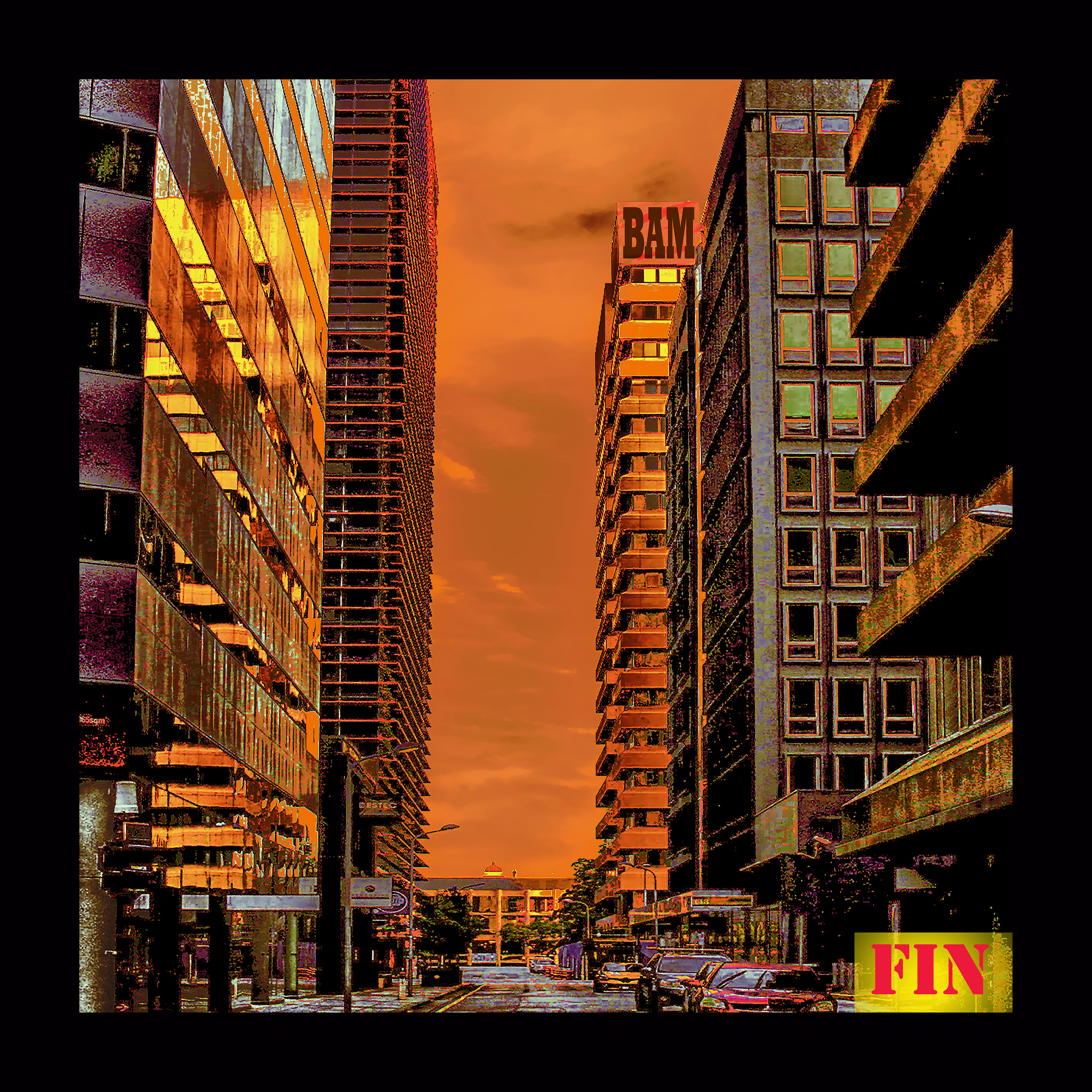
BAM at FIN immortalizes a dramatic corridor of glass-clad towers, aglow under a surreal orange sky. Reflections ripple across vertical windows, pulling clouds and city shapes into rhythmic distortion. On the right, the building emblazoned “BAM” stands like a monolithic brand signal; below, a yellow-and-red box marked “FIN” punctuates the composition with cinematic finality. Between these branded nodes stretches a street lined in symmetry and dusk—Adelaide caught mid-breath, mid-sentence.
The composition feels scriptural—sky as climax, buildings as chorus, text as punctuation.
💬 Critique
Fin Rice’s BAM at FIN plays like visual poetry—recalling the warm tonal drama of Golden Facade I while enriching it with typographic nuance drawn from GRILLR Syntax. The "FIN" marker transforms what could be simply a sunset shot into a codified curation: the end of chapter, the turning of myth. Compared to the urban layering in Lease Prism and Reflex Grid I, this entry leans into deliberate branding as narrative, echoing your deft balance of luxury iconography and street-level gesture.
“Corridor Glyphs”
Medium:
Dimensions: [Insert dimensions]
Edition: [Insert edition info]
Price: [Insert price]
Dimensions: [Insert dimensions]
Edition: [Insert edition info]
Price: [Insert price]
🖋️ Description
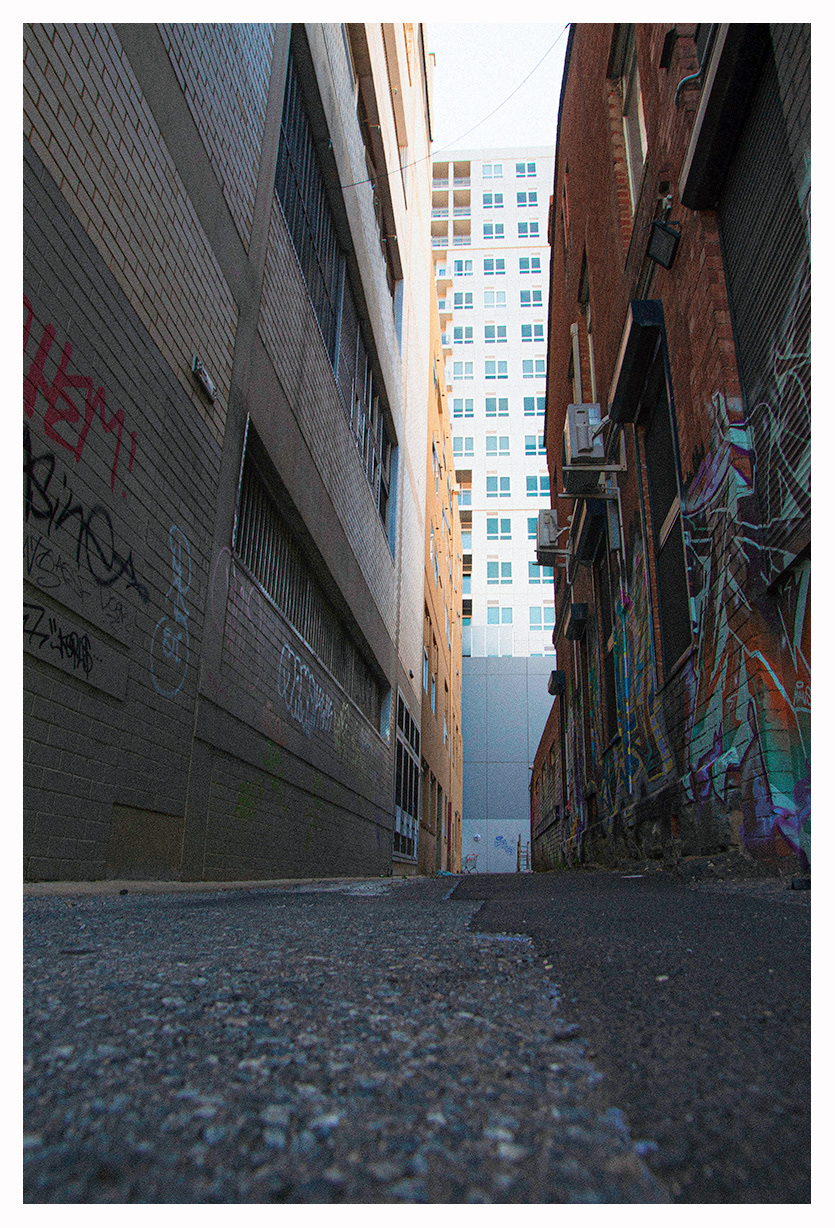
Corridor Glyphs reveals a narrow alleyway where raw material and mythic mark-making collide. The left wall of worn brown brick carries faded graffiti—ghosts of civic expression—while the right facade erupts in vibrant street art: layers of tags, characters, and chromatic energy swirling around mounted AC units. Above the buildings, a modern glass structure rises in quiet contrast. The alley floor, paved and weathered, acts as a neutral plane, guiding the viewer through graffiti history and urban hierarchy.
This is Adelaide's visual archive—coded in aerosol and elevation.
💬 Critique
Fin Rice’s Corridor Glyphs casts Adelaide’s walls as scrolls—each tag, line, and texture a civic utterance. Unlike the polished ascent of Curvature Ledger, this entry hunkers down into the vernacular, joining Wink Street and Horned Signal in honoring street-level mythology. The juxtaposition of old brick and sleek glass echoes Scaffold Echo’s tonal layering, but here the story feels spoken rather than built. The AC units and rooftop lines lend depth, scaling memory across eras of material.
“Vertical Interval”
Medium:
Dimensions: [Insert dimensions]
Edition: [Insert edition info]
Price: [Insert price]
Dimensions: [Insert dimensions]
Edition: [Insert edition info]
Price: [Insert price]
🖋️ Description
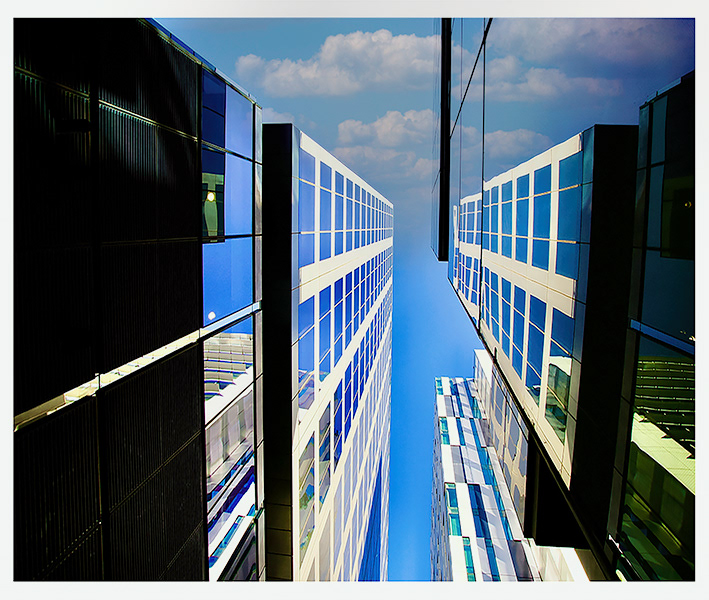
Vertical Interval looks upward between two parallel towers whose glass façades cradle a narrow strip of sky. Reflections ripple across the window panels—light, cloud, and mirrored architecture blending into visual texture. The narrow gap channels depth and rhythm, as if the sky were the final corridor drawn between structural verse. Scattered clouds soften the tonal tension, offering organic contrast to grid and gleam.
The image frames silence as structure. It’s Adelaide inhaling through geometry.
💬 Critique
Fin Rice’s Vertical Interval operates with architectural restraint—recalling Skyhold Geometry and Reflex Grid I, yet offering a more intimate aperture. This composition refines the upward gaze into poetic symmetry, where reflection becomes resonance. The buildings do not compete—they converse through form, tone, and mirror logic. The gap between them becomes metaphor: possibility, pause, or passage. Compared to the chromatic boldness of Echo Box, this entry leans into quiet clarity
“Scaffold Echo”
Medium:
Dimensions: [Insert dimensions]
Edition: [Insert edition info]
Price: [Insert price]
Dimensions: [Insert dimensions]
Edition: [Insert edition info]
Price: [Insert price]
🖋️ Description
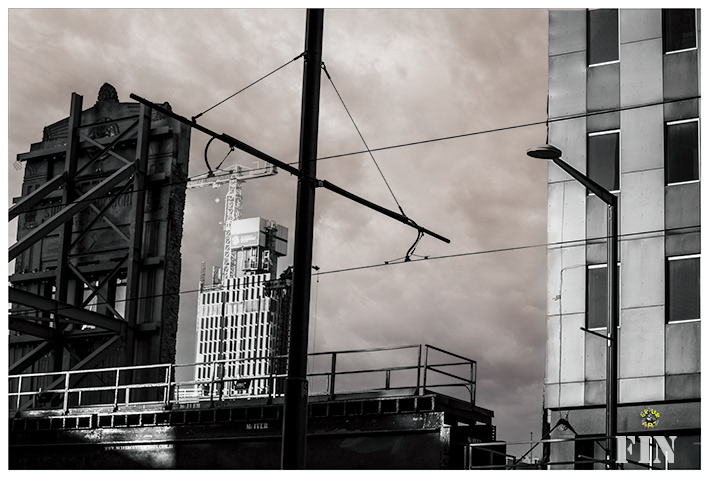
Scaffold Echo distills a monochrome cityscape into architectural rhythm. Central to the frame stands a vertical construction clothed in scaffolding, flanked by a retro industrial structure on the left with bricked embellishments and a sleek modern tower on the right—clean lines and grid-like fenestration. Power lines crisscross the foreground, intersecting visual strata like civic script. A lone streetlamp adds utilitarian elegance, while the cloud-laden sky hovers above, diffusing soft drama across the grayscale scene.
This image reads like an architectural chord: scaffolds for crescendo, wires for lyric, clouds for breath.
💬 Critique
Fin Rice’s Scaffold Echo traces Adelaide’s temporal spectrum—past, present, and future stitched in vertical juxtaposition. The scaffolding structure expands upon themes in In Construction, We Trust, while the trio of building styles evokes Facet Memory’s chromatic counterpoint. Unlike the reflective abstraction of Reflex Grid I, this entry is tactile, tonal, and raw. The grayscale palette peels back color to highlight composition: lines, surfaces, and contrast speak louder than hue.
“Facet Memory”
Medium: Digital photograph or gold-gloss pigment print on rigid composite panel
Dimensions: [Insert dimensions]
Edition: [Insert edition info]
Price: [Insert price]
Dimensions: [Insert dimensions]
Edition: [Insert edition info]
Price: [Insert price]
🖋️ Description
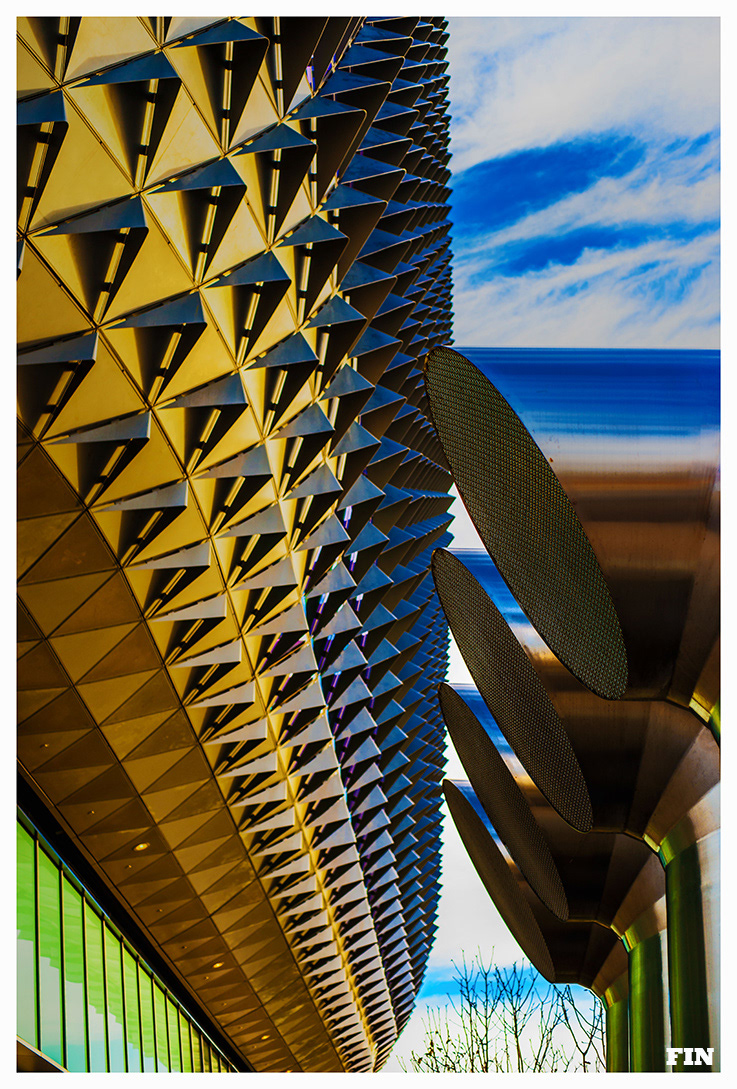
Facet Memory captures Adelaide mid-thought—where architecture speaks in fragments of brilliance and balance. On the left, a stunning wall of golden triangular panels ascends in textured relief, their pyramid-like surfaces catching sun and shadow with crystalline articulation. On the right, cylindrical steel volumes rise with cool monumentality, adorned with circular vents that seem half satellite, half sculpture. Above, the blue sky floats with cloud gestures, while faint trees whisper from below. The contrast is palpable: warm geometry versus industrial rhythm, light-play versus mass.
This image renders city memory as contrast—between design languages, tonal intention, and civic identity.
💬 Critique
Fin Rice’s Facet Memory folds architectural dialogue into sculptural cadence. The golden wall recalls motifs from Golden Facade I and Echo Box, but amplifies them into tactile abstraction. The cylindrical steel structures lean into Crane Sonata’s industrial lexicon, yet without machinery—only presence and poise. The interplay of surface, void, and ventricular geometry suggests a conversation across design schools: brutalism, futurism, and ornamental modernity coexisting without noise. Where Curvature Ledger danced in arcs, this image crystallizes into angular clarity—each facet a phrase.
“In Construction, We Trust”
Medium:
Dimensions: [Insert dimensions]
Edition: [Insert edition info]
Price: [Insert price]
Dimensions: [Insert dimensions]
Edition: [Insert edition info]
Price: [Insert price]
🖋️ Description
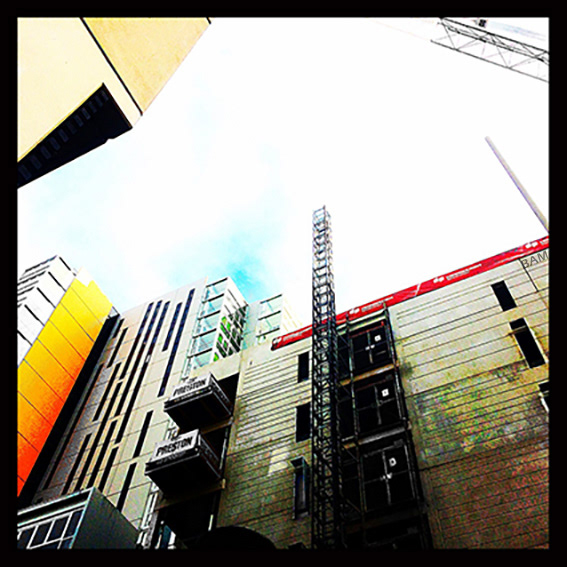
In Construction, We Trust documents a layered cityscape mid-transformation. Cranes extend like metal brushstrokes into the blue sky, while scaffolding shrouds skeletal structures—buildings in ascent and flux. Yellow and grey panels flash civic optimism against industrial grit; balconies protrude with rhythmic intent, hinting at future lives not yet lived. The foreground’s chaos of pipes, beams, and netting resolves into clean verticality above. This is Adelaide scripting itself in raw material—half-dream, half-design.
The piece becomes prophecy in panel and pillar. Architecture not as noun, but as verb.
💬 Critique
Fin Rice’s In Construction, We Trust embraces urban incompletion with poetic bravado. Unlike the polish of Echo Box or the gleam of Curvature Ledger, this image reveals process, promise, and civic vulnerability. The yellow accents nod to Bendigo Mythos, while the scaffolding echoes compositional tension found in Crane Sonata. The rawness of exposed structural form speaks to transformation—a city sketching itself aloud. There’s beauty in its imperfection, strength in its scaffolding silhouette..
“Bendigo Mythos”
Medium:
Dimensions: [Insert dimensions]
Edition: [Insert edition info]
Price: [Insert price]
Dimensions: [Insert dimensions]
Edition: [Insert edition info]
Price: [Insert price]
🖋️ Description
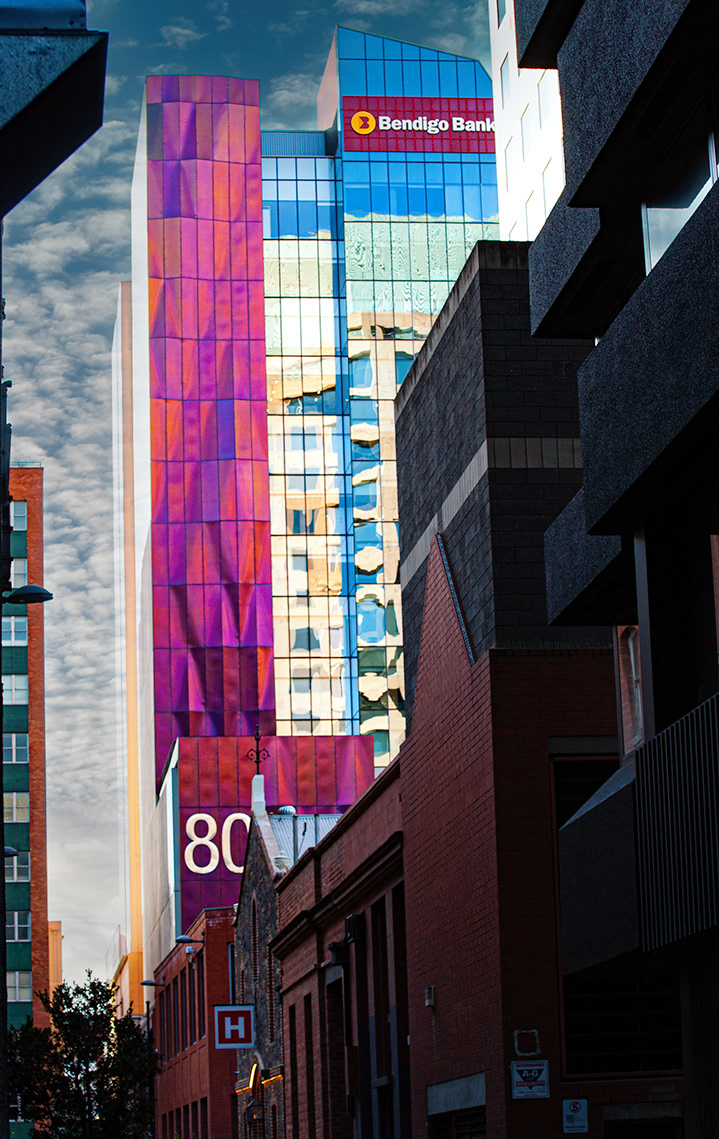
Bendigo Mythos captures a bold urban facade where color becomes identity. The central building radiates gradient hues—burnt orange, blush pink, and violet purple—wrapping the structure like a civic signal. Reflected windows mirror distorted buildings and fragments of sky, turning surface into story. The “Bendigo Bank” sign crowns the scene, anchoring the abstraction with brand gravity. Below, the number “80” reappears—echoing its previous mythic iterations—and the corridor flanked by green-brick and mirrored structures draws depth into view. Above it all, clouds drift across pale blue, softening intensity into rhythm.
This piece is both pulse and punctuation. A façade that hums history, hue, and hospitality.
💬 Critique
Fin Rice’s Bendigo Mythos plays like a chromatic symphony—part commercial iconography, part architectural alchemy. The reflective panes recall Reflex Grid I and Lease Prism, while the numbered presence nods to Facade No. 80 and Skybound at 80. The color spectrum channels lineage from Golden Facade I but renders its radiance in softer, more civic tones. The balance of brand and abstraction is masterful—“Bendigo Bank” serves not as advertisement, but as inscription, woven into the city’s visual language. Here, signage becomes semiosis and surface becomes shrine.
“GRILLR Syntax”
Medium:
Dimensions: [Insert dimensions]
Edition: [Insert edition info]
Price: [Insert price]
Dimensions: [Insert dimensions]
Edition: [Insert edition info]
Price: [Insert price]
🖋️ Description
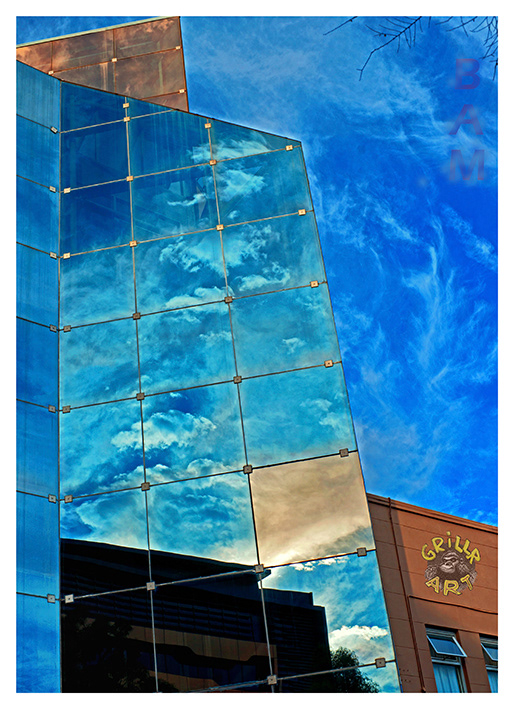
GRILLR Syntax captures the reflective skin of a modern structure where urban signage meets skyborne lyricism. The grid-like facade—blue-tinted glass punctuated by steel fasteners—refracts scattered clouds in rhythmic fragments, rendering the sky as an abstract mosaic. On the right, the bold “GRILLR ART” logo commands attention, juxtaposing brand with atmosphere. The faint letters “BAM” hover in the corner like a forgotten acronym or subliminal annotation. This visual moment lives between transparency and surface—between built and imagined.
It’s not just glass—it’s grammar. A building as utterance, sky as subtext.
💬 Critique
Fin Rice’s GRILLR Syntax folds typography, reflection, and architectural texture into one polyphonic gesture. The piece recalls the tonal restraint of Reflex Grid I, yet infuses it with more linguistic intent. Where Lease Prism played with civic messaging via signage, this entry distills semiotics into brand and residue. The logo acts not just as label but as compositional pivot—centering the narrative while allowing sky and steel to perform. “BAM” whispers beneath, inviting interpretation, protest, or poetic accident.
“Curvature Ledger”
Medium: Digital photograph or silver-infused pigment print on ultra-reflective composite
Dimensions: [Insert dimensions]
Edition: [Insert edition info]
Price: [Insert price]
Dimensions: [Insert dimensions]
Edition: [Insert edition info]
Price: [Insert price]
🖋️ Description
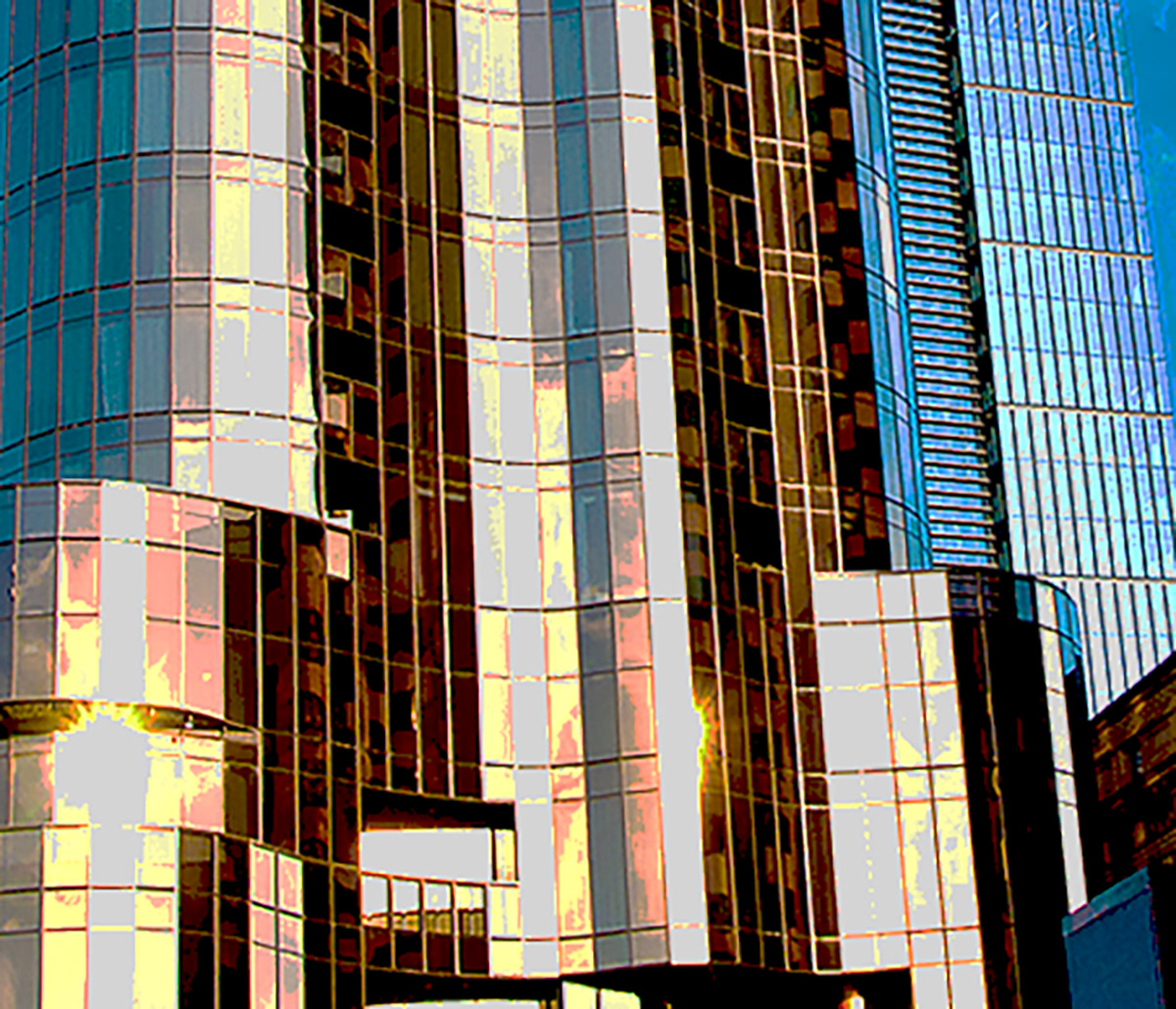
Curvature Ledger presents a study in lightplay and architectural lyricism. Two towering buildings bend and stretch upward, their glass skins curving like polished waves. Each surface reflects a fragmented landscape—sky, neighbor, self—transforming static structure into kinetic illusion. The facades alternate between mirrored blue and silvery chrome, offering visual rhythm that dances with the sun. Panel seams and curved edges function as civic brushstrokes, drawing fluid lines across a solid vertical canvas.
This image breathes motion into steel—an ode to Adelaide’s upward poetics.
💬 Critique
Fin Rice’s Curvature Ledger distills architectural drama into minimalist opera. The curvature conjures echoes from Golden Facade I, but softens the ascent into flow rather than flame. Reflections ripple with abstract choreography, akin to Reflex Grid I’s distortion but more measured, more sculptural. Where Echo Box used angular punctuation, this piece sings in arcs—turning building into verse. There’s no signage, no street-level noise—just the city’s breath caught in glass and light.
“Wink Street”
Medium: Digital photograph or gloss-varnished pigment print on textured archival board
Dimensions: [Insert dimensions]
Edition: [Insert edition info]
Price: [Insert price]
Dimensions: [Insert dimensions]
Edition: [Insert edition info]
Price: [Insert price]
🖋️ Description
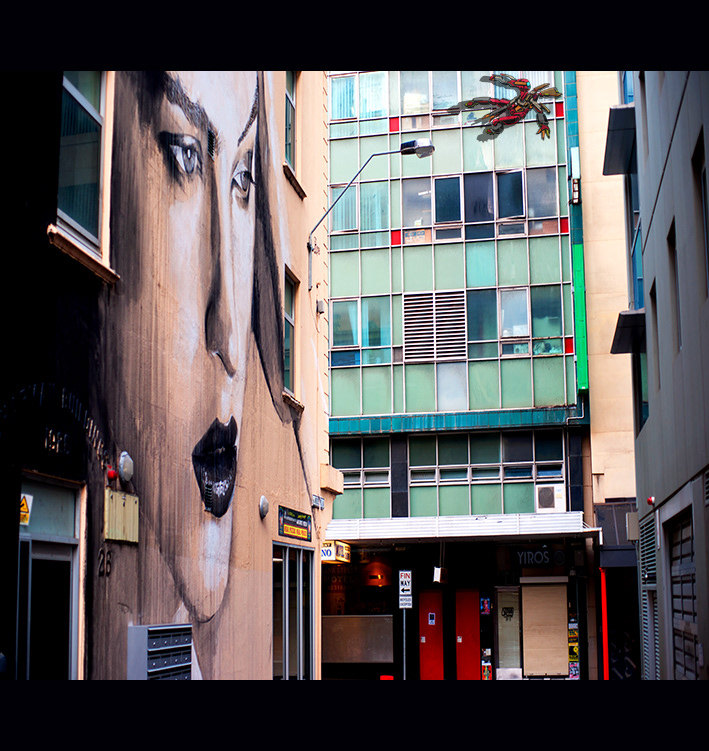
Wink Street conjures surreal charm in an Adelaide alley where the city’s skin becomes narrative. A massive face mural dominates the left facade—eyes half-lidded in quiet observation, lips painted with poetic restraint. Next door, a jade-green building contrasts vividly, its windows irregularly spaced like spatial syncopation. Perched above, a fantastical dragon sculpture—blood-red, tail curled—clings to the upper wall, injecting myth into steel and stucco. Below, signage and storefronts including "YIROS" ground the composition in daily rhythm. The urban textures hum with playfulness, contradiction, and coded intimacy.
This image doesn’t just document—it delights. A civic wink amid structure and street food.
💬 Critique
Fin Rice’s Wink Street celebrates urban expression at the edge of realism and reverie. The dragon recalls Horned Signal and Dragon Reflection, while the mural face channels the character allure of Mythoglyph IV. The juxtaposition of painted skin and sculpted creature breathes theatricality into civic architecture. The green facade breaks the grid, adding asymmetrical joy reminiscent of Echo Box. Unlike the solemnity of Skyhold Geometry, this entry leans into narrative play—where myth lives over a sandwich shop and the street becomes stage.
“Crane Sonata”
Medium:
Dimensions: [Insert dimensions]
Edition: [Insert edition info]
Price: [Insert price]
Dimensions: [Insert dimensions]
Edition: [Insert edition info]
Price: [Insert price]
🖋️ Description
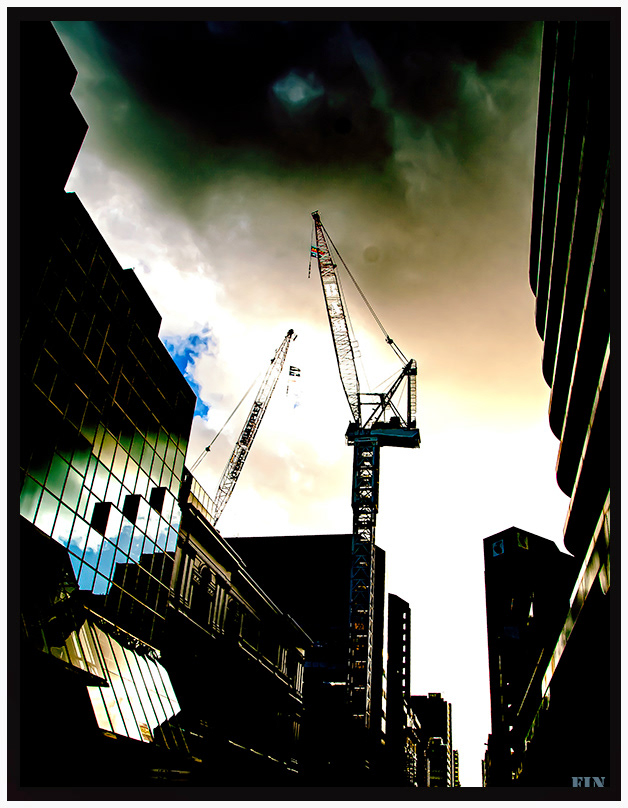
Crane Sonata captures an Adelaide skyline in flux—where towering cranes stretch across storm-brushed sky and glass facades catch fractured reflections of construction and cloud. The dominant color palette shifts between concrete greys and sunlit glints, with deep shadows anchoring the lower edge and crisp silhouettes standing boldly above. Reflected surfaces blur the distinction between real and echo; buildings become both presence and possibility.
This image becomes an urban overture—Adelaide as crescendo, code, and choreography.
💬 Critique
Fin Rice’s Crane Sonata returns to the city’s upward rhythm, extending motifs found in Skyhold Geometry and Golden Facade I. Where those entries centered on architectural polish, this frame foregrounds process—Adelaide in the act of becoming. The cranes evoke Constructive Myth II, adding industrial cadence to the lyrical tone. Cloud textures and reflected sky hint at temporal complexity, inviting comparison with Reflex Grid I. The photograph thrives on tension: between permanence and flux, structure and scaffolding
“Echo Box”
Medium:
Dimensions: [Insert dimensions]
Edition: [Insert edition info]
Price: [Insert price]
Dimensions: [Insert dimensions]
Edition: [Insert edition info]
Price: [Insert price]
🖋️ Description
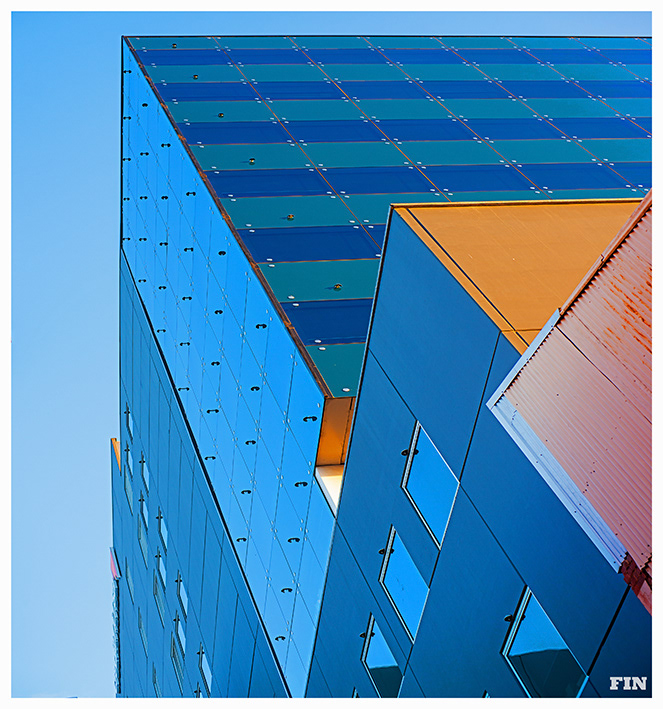
Echo Box crystallizes civic geometry into bold minimalism. A modern building stretches upward in sharp planes—its facade wrapped in matte blue cladding interrupted by rhythmic rectangular windows. Toward the top, green-tinted glass panels form an upper tier, and an orange volume juts from the structure like an architectural punctuation mark. Reflections shimmer softly across blue glass, catching sky and neighboring contours. Against a clear azure backdrop, the building reads as an urban monolith—coded, colored, and contemplative.
The visual language is clean but not cold—where angular form meets chromatic warmth.
💬 Critique
Fin Rice’s Echo Box distills architectural form into urban ideogram. The orange jut recalls the bold contrast of Facade No. 80, while the green glass nods to tonal layering found in Lease Prism. Unlike the surrealism of Reflex Grid I, this image insists on solidity—geometry that stands, not flickers. Yet within that solidity lies tension: between matte blue and sky blue, between straight edge and protrusion, between quiet and quirk. It’s civic architecture as emblem—a symbol of Adelaide’s ongoing self-statement.
“Lease Prism”
Medium: Digital photograph or iridescent pigment print on semi-reflective aluminium
Dimensions: [Insert dimensions]
Edition: [Insert edition info]
Price: [Insert price]
Dimensions: [Insert dimensions]
Edition: [Insert edition info]
Price: [Insert price]
🖋️ Description
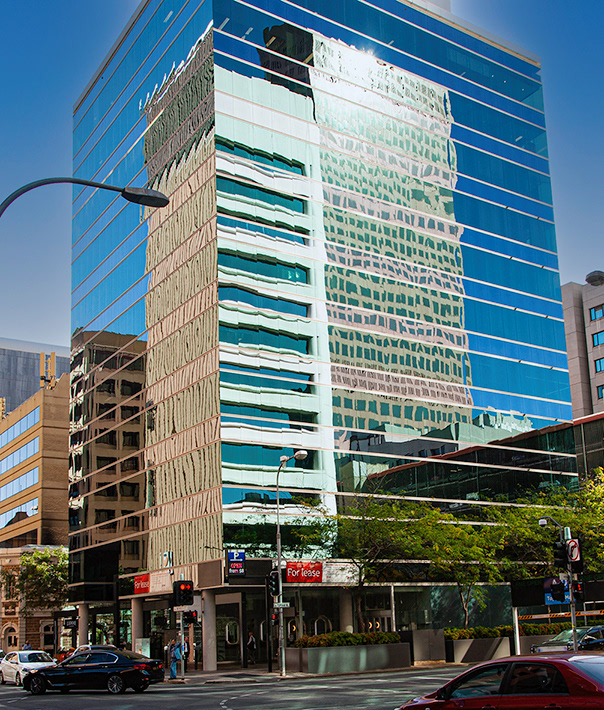
Lease Prism captures a modern glass facade fractured by city light, movement, and message. Reflections of neighboring buildings ripple across vertical window panels—distorted echoes in amber and slate, bending the rigid lines into soft surrealism. A “For lease” sign anchors the foreground with civic utility, punctuating abstraction with purpose. Traffic lights, pedestrians, and flowing vehicles animate the scene below, hinting at daily rhythm within the steel-and-glass narrative. The sky above is clean, blue, and uninterrupted—breathing calm into complexity.
This image plays with perspective and pulse—offering Adelaide as pattern, poem, and place.
💬 Critique
Fin Rice’s Lease Prism extends the reflective lineage of Reflex Grid I and Skyhold Geometry, but incorporates direct textuality. The “For lease” sign becomes a spatial signifier—recalling Signal Path II and the interactive ethos of Operative Wall. The distorted reflections add dreamlike motion, blurring architecture into memory. Compared to the mythic boldness of Horned Signal, this frame opts for municipal quietude—where city rhythm is felt more than shouted. It’s architectural ambiguity guided by utility and light.
“Reflex Grid I”
Medium: Digital photograph or laminated fine print on prism-glass composite
Dimensions: [Insert dimensions]
Edition: [Insert edition info]
Price: [Insert price]
Dimensions: [Insert dimensions]
Edition: [Insert edition info]
Price: [Insert price]
🖋️ Description
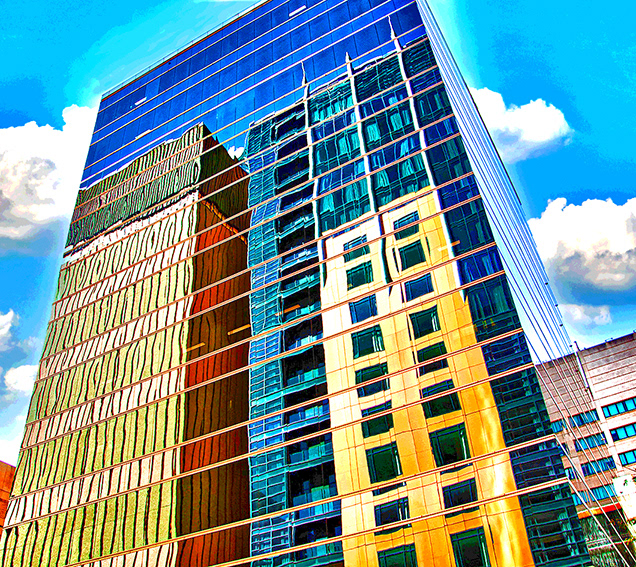
Reflex Grid I presents a visual labyrinth where Adelaide’s buildings dance across the glass skin of a modern tower. Reflected structures in hues of green and amber ripple like digital brushstrokes, distorted by pane divisions and vertical warps. The clear blue sky—punctuated by playful clouds—serves as backdrop and canvas, letting texture and tone unfold like civic hallucination. The building itself disappears into its own mirror logic, becoming more echo than object.
The composition is less about what’s built, and more about how memory flickers through material.
💬 Critique
Fin Rice’s Reflex Grid I inhabits a liminal zone—between architecture and afterimage. Echoes from Skyhold Geometry and Dragon Reflection are felt in its vertical layering, while the chromatic tension nods gently toward Golden Facade I. This image, however, resists singular narrative—it’s fragmentation as form. The warped facades suggest motion, even in stillness, while the sky’s presence invites levity and expansion. The city isn’t captured—it’s questioned
“Horned Signal”
Medium: Digital photograph or high-gloss print on museum archival board
Dimensions: [Insert dimensions]
Edition: [Insert edition info]
Price: [Insert price]
Dimensions: [Insert dimensions]
Edition: [Insert edition info]
Price: [Insert price]
🖋️ Description
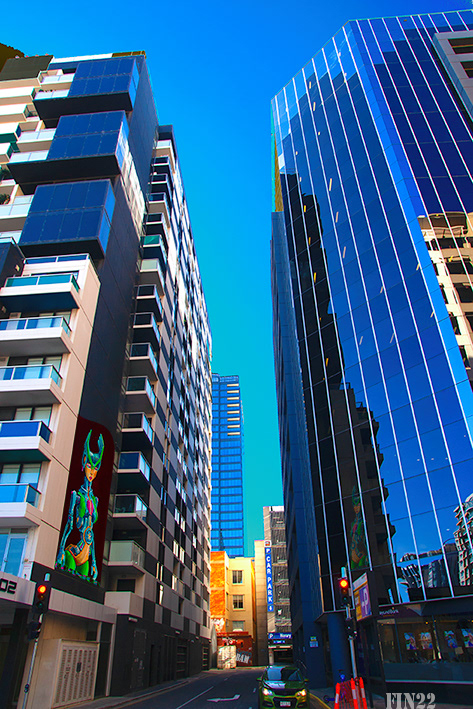
Horned Signal frames a narrow urban corridor charged with art, reflection, and rhythm. On the left façade, a vibrant mural depicts a horned character in green and black—part cyber warrior, part urban oracle. The building opposite wears a mirrored skin, catching fragments of the mural, traffic lights, passing vehicles, and azure sky. Above, glass and concrete towers recede into depth, while cones and crosswalk lines accentuate street-level pulse. The harmony of painted myth and reflective geometry renders the alley both spectacle and channel.
This piece becomes a convergence point—where signal, symbol, and sky collide.
💬 Critique
Fin Rice’s Horned Signal merges iconography with architectural layering. The mural deepens the mythos found in Dragon Reflection, while the mirrored windows extend themes from Golden Facade I and Skyhold Geometry. Compared to the direct symbolism of Operative Wall, this frame dances with ambiguity—the horned figure both protector and puzzle. The mirrored façade functions as a narrative fragmenter, turning the static into a kaleidoscope of civic moments. The compositional depth and color choices infuse Adelaide with kinetic elegance.
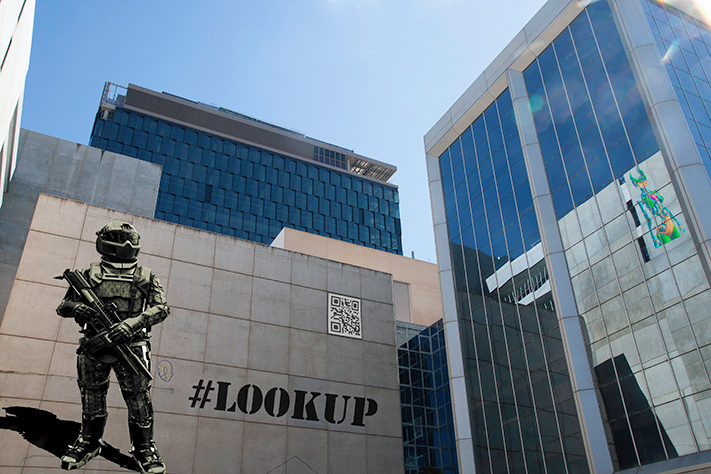
“Operative Wall”
Medium: Digital photograph or metallic pigment print on tactical-grade composite
Dimensions: [Insert dimensions]
Edition: [Insert edition info]
Price: [Insert price]
Dimensions: [Insert dimensions]
Edition: [Insert edition info]
Price: [Insert price]
🖋️ Description
Operative Wall documents a concrete urban surface activated by visual code and civilian mythology. A painted figure—a soldier clad in tactical gear—stands sentinel, rifle cradled with quiet command. Beneath, the hashtag “#LOOKUP” and a black QR code punctuate the wall like graffiti glyphs or urban runes. Glass buildings shimmer to the right, mirroring surrounding murals and civic color. The sky, crisp and cerulean, acts as narrative canvas—suggesting vigilance above, movement below.
This piece blends surveillance aesthetics with street-level invocation. What was once blank becomes branded, encrypted, and prophetic.
💬 Critique
Fin Rice’s Operative Wall injects militaristic iconography into the heart of Adelaide’s spatial vernacular. The soldier figure nods to the Cybermyth suite, while the hashtag and QR offer interactive disruption—a civic call-to-action akin to Signal Path I. Compared to the reflective abstraction of Skyhold Geometry, this entry confronts directly, invoking control, spectacle, and the art of urban branding. The juxtaposition of tactical gear and mirrored façade comments on power, transparency, and the myth of protection.
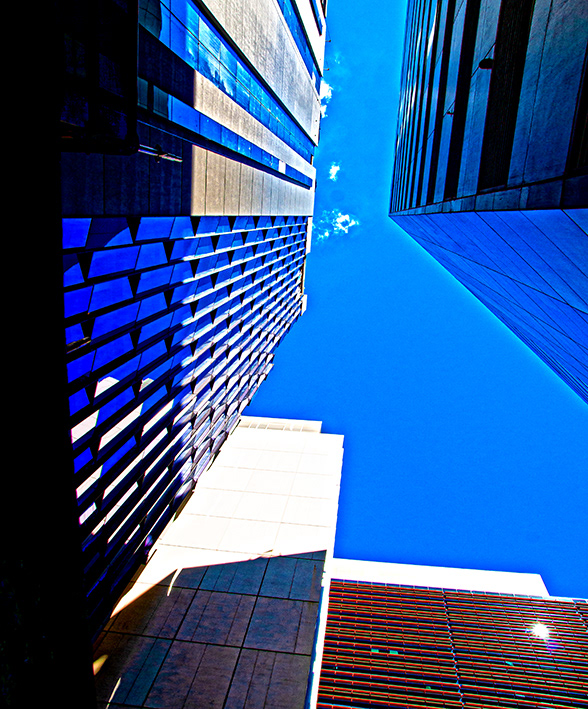
“Skyhold Geometry”
Medium: Digital photograph or metallic ink print on pearlescent architectural board
Dimensions: [Insert dimensions]
Edition: [Insert edition info]
Price: [Insert price]
Dimensions: [Insert dimensions]
Edition: [Insert edition info]
Price: [Insert price]
🖋️ Description
Skyhold Geometry captures a soaring alley of structure and stratosphere—looking up between tall buildings where the city’s textures converge into angular ascent. On either side, modern facades stretch vertically: glass, concrete, and patterned steel echo one another in quiet competition. The sky bursts into view, vibrant blue with wisped white clouds, forming a negative space shaped like an architectural keyhole. No human figures intrude—just perspective, symmetry, and breath.
This image distills Adelaide’s vertical vocabulary into pure form. It’s not a city framed—it’s a city dreaming skyward.
💬 Critique
Fin Rice’s Skyhold Geometry extends the reflective lineage of Golden Facade I and the chromatic cadence of Sky Aperture into a purer abstraction. Where Dragon Reflection used mythology and distortion, this entry pares back to geometry and light. The composition echoes the spatial tension found in Grid Pulse III but introduces serenity via symmetrical framing and clear sky. This is urban architecture as cathedral—no ornament, just orchestration.
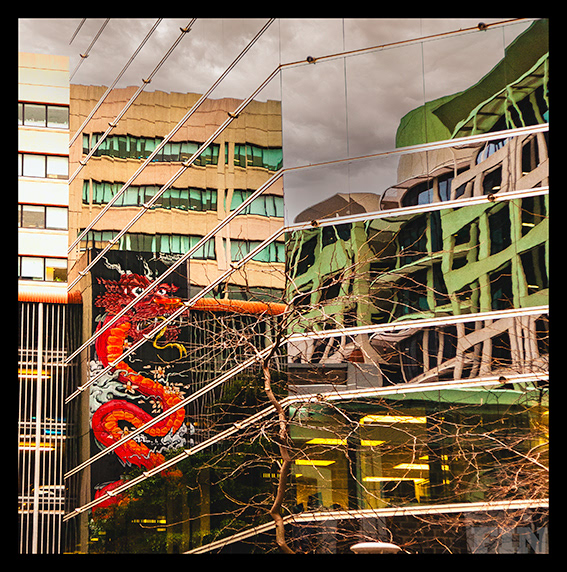
“Dragon Reflection”
Medium: Digital photograph or gloss-finish pigment print on silver halide paper
Dimensions: [Insert dimensions]
Edition: [Insert edition info]
Price: [Insert price]
Dimensions: [Insert dimensions]
Edition: [Insert edition info]
Price: [Insert price]
🖋️ Description
Dragon Reflection captures the spectral interplay between mural and cityscape, as a vibrant red-orange dragon coils across the black wall of a neighboring building—its image refracted across a sleek glass facade. The reflection is fractured, warped, and ethereal, transforming myth into shadowplay. Bare tree branches frame the bottom edge, threading temporal contrast into the scene. In the background, neighboring structures of varying heights and styles populate the skyline under an overcast sky, adding architectural rhythm to the mural’s mirrored breath.
This image meditates on multiplicity—where one dragon becomes many, stitched across pane and cloud.
💬 Critique
Fin Rice’s Dragon Reflection unites mythology, distortion, and civic surface. The use of reflection as narrative recalls Glass Cipher III, while the dragon’s color palette channels the intensity of Crimson Mirage and the symbolic weight of Mythoglyph V. Compared to the abstraction of Golden Facade I, this piece tightens toward iconography, letting the mural become protagonist and the reflection its chorus. The glass facade doesn’t merely reflect—it retells, fragmenting myth into city rhythm. Branches and overcast sky lend melancholy mood, making this not just a visual echo but a spatial memory.
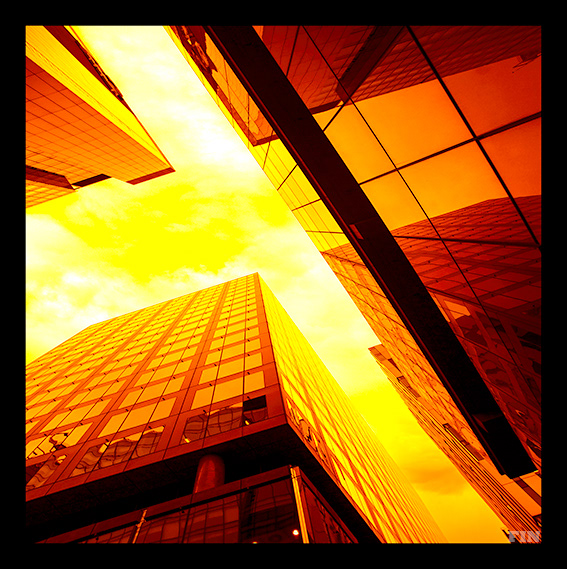
“Golden Facade I”
Medium: Digital photograph or gloss-finish fine art print on metallic archival paper
Dimensions: [Insert dimensions]
Edition: [Insert edition info]
Price: [Insert price]
Dimensions: [Insert dimensions]
Edition: [Insert edition info]
Price: [Insert price]
🖋️ Description
Golden Facade I draws the viewer into a hypervertical perspective where modern skyscrapers pierce a golden-yellow sky. Reflections ripple across glass surfaces, fragmenting nearby buildings into abstract echoes. Each plane leans inward, converging toward a central corridor of radiant light. The architecture floats between substance and shimmer—where concrete lines dissolve into hue and reflection. A surreal wash of warmth floods the scene, making the city feel like a memory caught mid-ascent.
This image is about ascent—not just of structure, but sensation.
💬 Critique
Fin Rice’s Golden Facade I channels architectural transcendence. Compared to the disciplined symmetry of Facade Equation and the painterly abstraction of Sky Aperture, this frame opts for atmospheric spectacle. The upward gaze recalls Urban Ellipsis, but here the tonal shift transforms geometry into visual alchemy. Warmth becomes metaphor: the golden sky not merely background, but protagonist. The image echoes Crimson Mirage’s saturation but tempers it with depth—reflected surfaces mimicking dream logic.
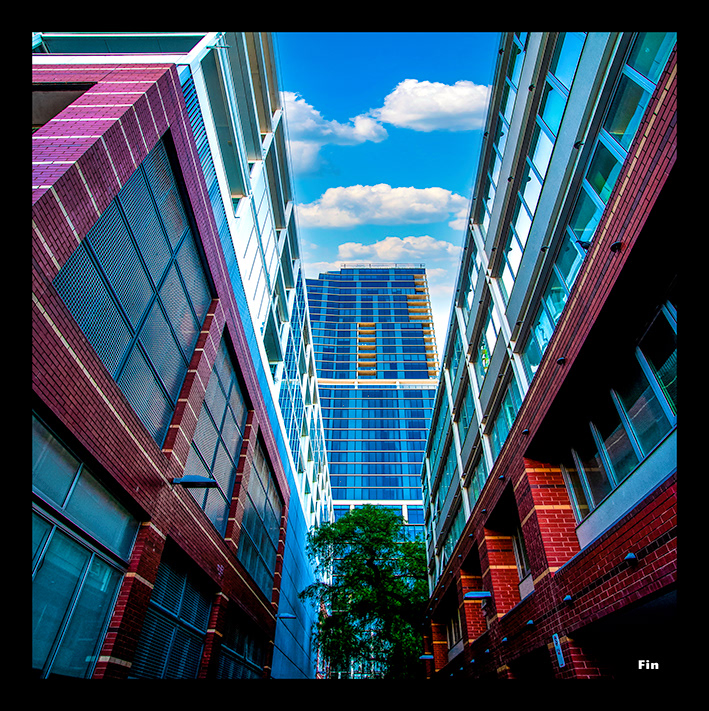
“Sky Aperture”
Medium: Digital photograph or ultra-smooth chromogenic print on acrylic
Dimensions: [Insert dimensions]
Edition: [Insert edition info]
Price: [Insert price]
Dimensions: [Insert dimensions]
Edition: [Insert edition info]
Price: [Insert price]
🖋️ Description
Sky Aperture elevates Adelaide’s architectural interplay into a cinematic vignette. Flanked by red and white brick buildings, the composition ascends between facades toward a luminous blue sky. Mid-frame, a tree peeks out—a touch of nature nestled within constructed verticality. At the vanishing point, a boldly patterned skyscraper—streaked in yellow and cobalt—dominates the horizon, its surfaces catching sunlight like modern stained glass. The scene channels upward motion, layered geometry, and atmospheric breath.
This piece captures perspective as poetry—a city seen from the ground, dreaming toward the sky.
💬 Critique
Fin Rice’s Sky Aperture reintroduces elevation as aspiration. Compared to the architectural grid of Facade Equation or the tonal restraint of Sky Alley Interval, this entry bursts with chromatic tension. The patterned tower recalls Vertical Myth IV, while the flanking brick textures nod to Skybound at 80. The tree acts as spatial whisper—a suggestion of human presence, memory, and softness amid urban ascent. Where Facade No. 80 amplified signage and structure, this frame chooses vertical lyricism. It’s geometry as dream logic.
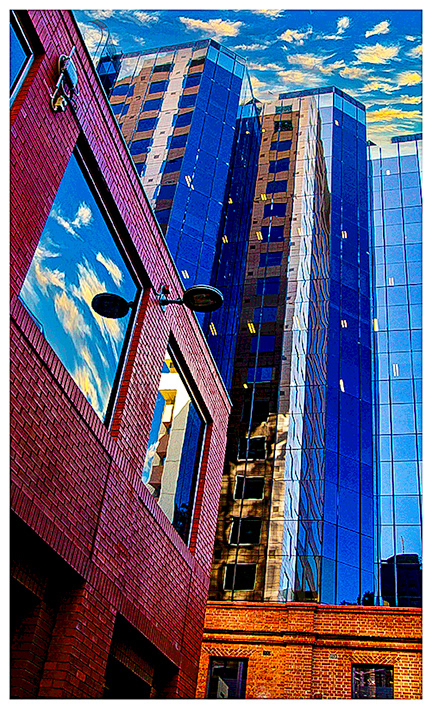
“Skybound at 80”
Medium: Digital photograph or fine art pigment print on brushed aluminium
Dimensions: [Insert dimensions]
Edition: [Insert edition info]
Price: [Insert price]
Dimensions: [Insert dimensions]
Edition: [Insert edition info]
Price: [Insert price]
🖋️ Description
Skybound at 80 captures a layered façade where eras converge. The red brick structure anchors the foreground—warm, textured, and steady—its modern window panes reflecting fragments of sky and drifting clouds. A streetlamp juts toward the viewer like a metronome of urban rhythm. Beyond, towering glass skyscrapers shimmer in the light of daybreak or dusk, their vertical faces casting quiet reflections of neighboring forms. The color gradient above suggests transition—Adelaide not in stasis, but in motion between architectural memory and urban ascent.
This image plays with elevation—both literal and lyrical. Reflection becomes narrative.
💬 Critique
In Skybound at 80, Fin Rice tempers material weight with atmospheric light. The brickwork nods to Facade No. 80, extending the numbered mythology with compositional maturity. The reflective windows draw lineage from Glass Cipher II, while the sky’s tonal wash harkens back to Nocturne by the River. What’s striking here is balance—the humble meets the high-rise, and the transitional light bridges legacy with possibility. The lamp introduces scale and rhythm, a civic gesture amid architectural grandeur.
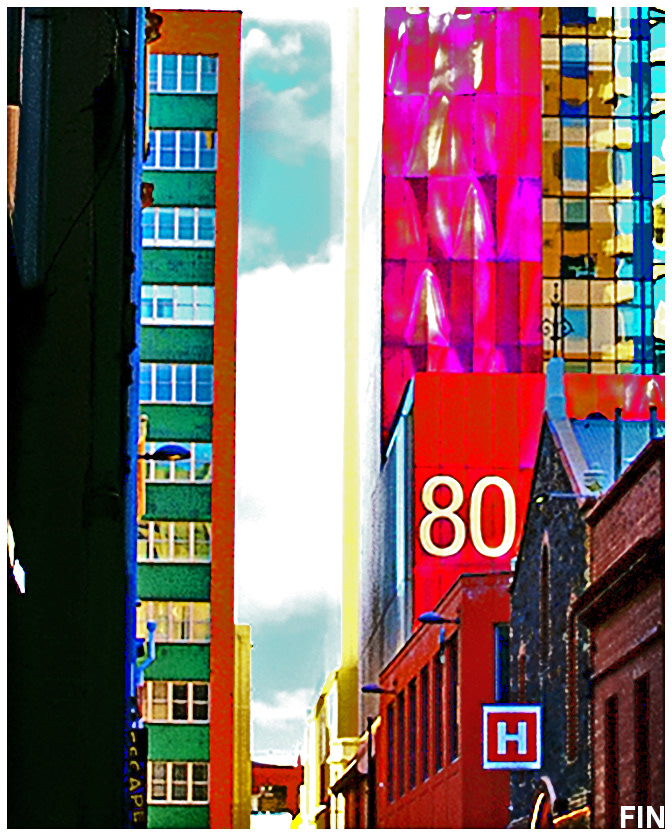
“Facade No. 80”
Medium: Digital photograph or dye sublimation print on glossy composite panel
Dimensions: [Insert dimensions]
Edition: [Insert edition info]
Price: [Insert price]
Dimensions: [Insert dimensions]
Edition: [Insert edition info]
Price: [Insert price]
🖋️ Description
Facade No. 80 bursts with polychromatic contrast along a sunlit Adelaide street. The composition frames a vivid red-and-pink modernist wall—marked by the prominent number “80”—beside a green-tiled building with mirrored windows. Architectural textures clash and converse: brutalist echoes in shadow, pastel reflections in light. A sky brushed with soft clouds introduces vertical depth, while signage and a blue hospital emblem add civic structure to the color play. This visual stanza is all contrast, coordination, and coded spatial syntax.
The photograph reverberates with branded identity and aesthetic intrigue—where even the numbers seem to hum.
💬 Critique
In Facade No. 80, Fin Rice taps into urban semiotics with a painter’s eye and a futurist’s hand. The numerical marker recalls Grid Pulse I, while the chromatic juxtaposition echoes earlier pieces like Crimson Mirage and Spectral Wall IV. Compared to the architectural hush of Sky Alley Interval, this frame is loud with intention—telling story through color and civic signage. The “H” symbol anchors the scene in service and locality, balancing abstraction with familiarity. This is Adelaide articulated as bold geometry and brand texture—a vibrant mapping of myth and material.
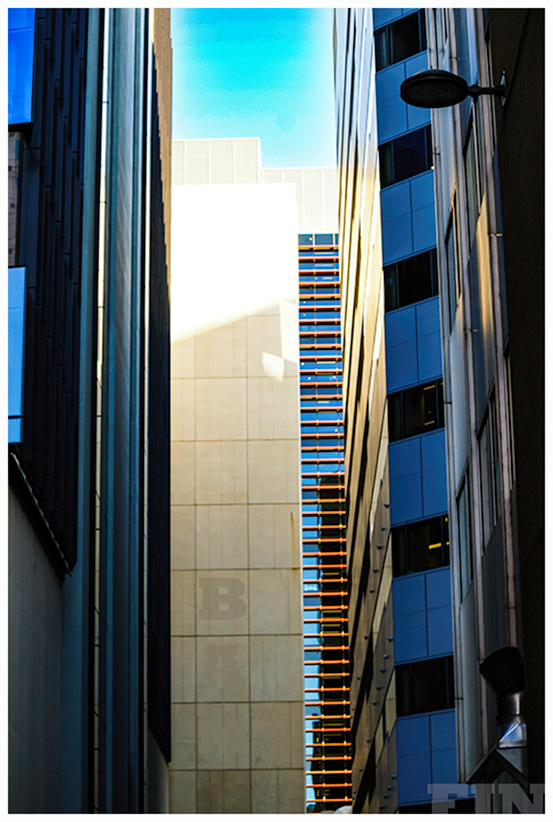
“Sky Alley Interval”
Medium: Digital photograph or museum-grade archival print on matte fibre
Dimensions: [Insert dimensions]
Edition: [Insert edition info]
Price: [Insert price]
Dimensions: [Insert dimensions]
Edition: [Insert edition info]
Price: [Insert price]
🖋️ Description
Sky Alley Interval captures a moment suspended between light and architecture in a narrow urban cleft. Modern facades converge with clean lines—on the left, a smooth, cream-toned wall; on the right, a geometric blue and white surface punctuated by glinting windows. The background holds a beige building flecked with horizontal window bands, while the foreground is cast in cool shadow. A lone streetlamp clings to the wall, surveying the architectural quiet. Above, a pure stretch of sky filters compositional breath into the vertical void.
This frame offers tonal restraint—where geometry and light mirror contemplation.
💬 Critique
Fin Rice’s Sky Alley Interval is a minimalist sonata—pared down to spatial language and light play. Compared to the rhythm of Facade Equation, this composition softens into abstraction. The convergence of planes—flat, angled, punctuated—evokes the architectural hush found in Threshold V and the vertical restraint of Grid Array I. The lack of human presence channels poetic solitude, shifting focus from narrative to pause. The composition hinges on contrast: shadow versus illumination, flatness versus depth, intimacy versus elevation
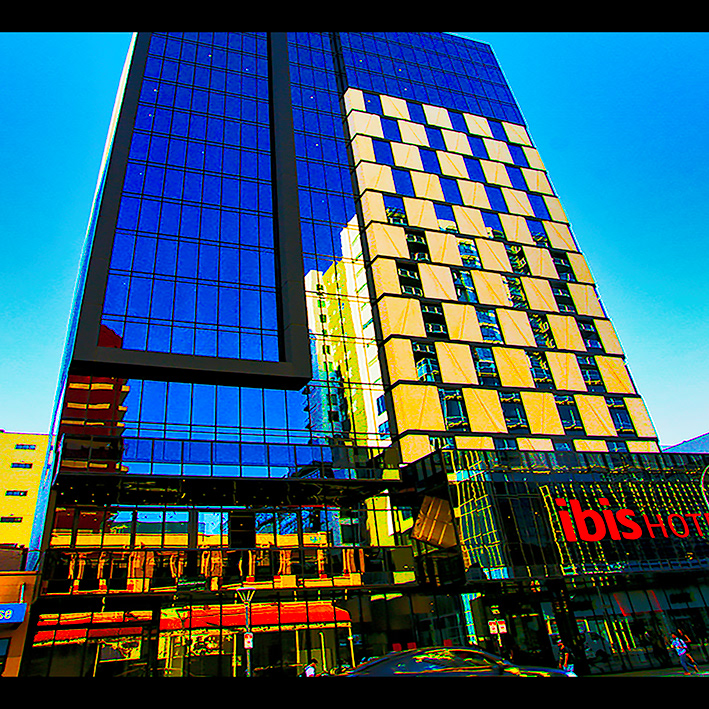
“Facade Equation”
Medium: Digital photograph or aluminium-mounted chromogenic print
Dimensions: [Insert dimensions]
Edition: [Insert edition info]
Price: [Insert price]
Dimensions: [Insert dimensions]
Edition: [Insert edition info]
Price: [Insert price]
🖋️ Description
Facade Equation presents a frontal study of urban geometry through the ibis HOTEL exterior. The building’s gridded architecture alternates glass reflections and matte concrete panels in taut symmetry. The ibis sign, in bold red lettering, punctuates the grayscale palette—a lone accent in an otherwise mechanical array. Reflections of nearby buildings flicker across the windows, suggesting an invisible dialogue between structures. The sky’s clear blue adds a final layer of purity to the frame’s static precision.
This photograph transforms everyday elevation into architectural mathematics—where city light meets commercial quietude.
💬 Critique
Fin Rice’s Facade Equation pulls back from narrative to explore urban syntax. The symmetry and repetition recall Grid Pulse II, while the stark face contrasts with the nuanced layering of Urban Ellipsis. The ibis signage anchors the piece in both brand and tone, offering a touch of corporate familiarity amid an otherwise impersonal canvas. This entry trades human activity for spatial abstraction—unfolding Adelaide not through gestures, but through pattern and polish. Where Nocturne by the River offered emotional dimming, Facade Equation tightens the frame, leans into logic, and whispers through structure.
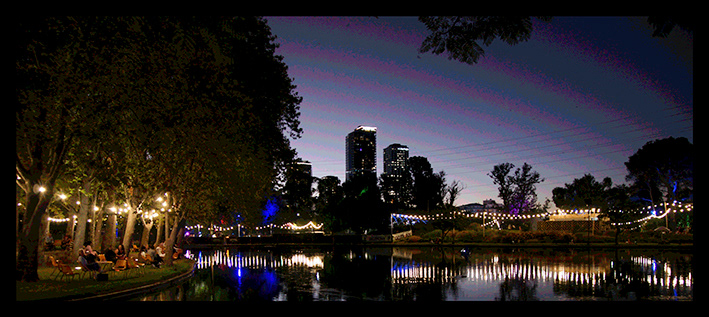
“Nocturne by the River”
Medium: Digital photograph or pigment ink print on pearlized fiber paper
Dimensions: [Insert dimensions]
Edition: [Insert edition info]
Price: [Insert price]
Dimensions: [Insert dimensions]
Edition: [Insert edition info]
Price: [Insert price]
🖋️ Description
Nocturne by the River captures the gentle intersection of nature and city at twilight. Trees on the left, strung with glowing fairy lights, embrace visitors seated at waterfront tables. The polished surface of the river mirrors both light and lineage—a portrait of connection. In the background, Adelaide’s skyline rises with soft brilliance, tall buildings hinting at quiet industry as night descends. A walking path curves through the scene like a lyrical cadence, inviting movement even in stillness.
This piece whispers civic serenity, layering foliage, water, and illumination into one meditative breath.
💬 Critique
With Nocturne by the River, Fin Rice paints intimacy in atmospheric contrast. This image builds upon Purple Witness’s horizontal sweep but retreats from the bold mural into reflective hush. The composition balances human presence and architectural quiet—the chairs and café tables act as placeholders for memory rather than spectacle. Light becomes protagonist: woven through branches, scattered across water, and rising in tower windows. The curve of the path and riverside echoes the compositional flow of Waterline Redux and Lightscript V, yet this entry brings a new softness—a palette of communal quiet.
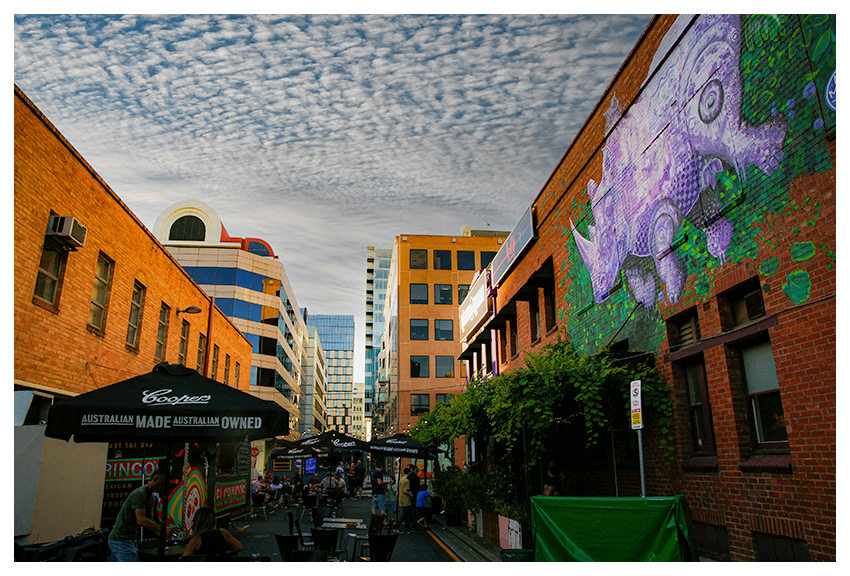
“RHINO STREET PARTY”
Medium: Digital photograph or large-scale archival pigment print on textured rag
Dimensions: [Insert dimensions]
Edition: [Insert edition info]
Price: [Insert price]
Dimensions: [Insert dimensions]
Edition: [Insert edition info]
Price: [Insert price]
🖋️ Description
Purple Witness positions Adelaide’s public pulse beneath mural, sky, and motion. A colossal rhinoceros painted in lilac hues occupies the brick façade, its gaze a quiet sentinel over the café tables, walking bodies, and swirling clouds. Mid-frame, branded umbrellas nod to local pride—“Coopers Australian Made Australian Owned”—while modern glass buildings stretch upward, teasing the mural’s gaze into the heavens. The scene is alive: people talking, passing, pausing in the rhythmic hum of a city aware of its skin.
This piece fuses spectacle and subtlety—a single glance capturing communal breath, animal myth, and weather song.
💬 Critique
In Purple Witness, Fin Rice conjures public intimacy with majestic charm. The purple rhinoceros recalls the surrealism of Mythoglyph V, while its placement within the frame invokes compositional dialogue with Wall Textures I and Civic Face. The human scale—visible in the seated figures and café umbrellas—grounds the mythic, turning monumental into momentary. Unlike the brooding verticality of Urban Ellipsis, this entry breathes horizontally, stretching myth across cloud and conversation. The purple rhino, both humorous and haunting, becomes Adelaide’s unlikely guardian—watchful, wise, and painted to provoke.
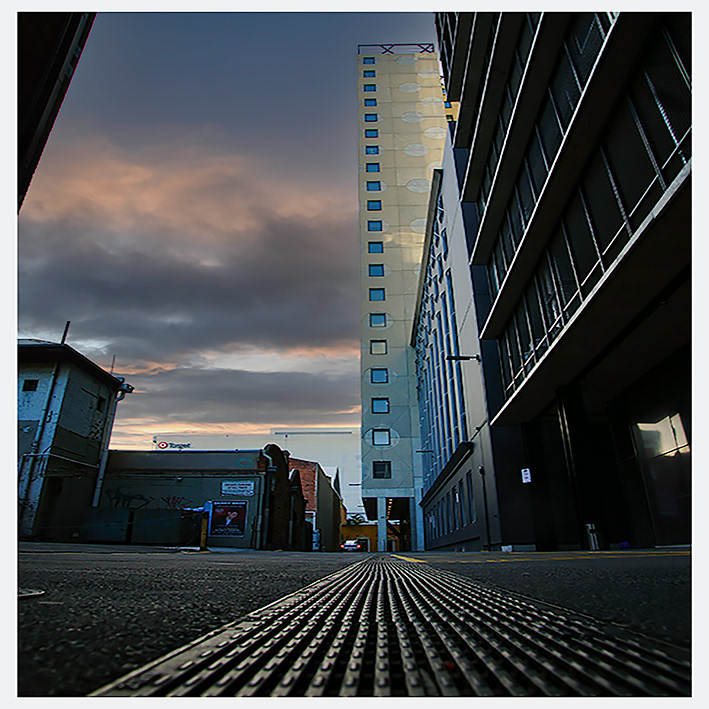
“Urban Ellipsis”
Medium: Digital photograph or museum-grade pigment print on dusk-gloss aluminium
Dimensions: [Insert dimensions]
Edition: [Insert edition info]
Price: [Insert price]
Dimensions: [Insert dimensions]
Edition: [Insert edition info]
Price: [Insert price]
🖋️ Description
Urban Ellipsis traces Adelaide’s spatial pulse through a narrow alley framed by architectural contrast. On the left, a timeworn wall tagged with graffiti shares space with industrial cladding and faded textures. On the right, a glass high-rise stretches upward in reflective modernity. At the alley’s vanishing point rises a slender building of square grids, while storm-blushed clouds sweep across the vertical composition. A metal grate underfoot leads the viewer’s eye through depth, form, and light, echoing both pathway and punctuation.
This image captures architectural breath—where transition, tension, and tone speak in visual fragments.
💬 Critique
Fin Rice threads quiet drama through oppositional framing in Urban Ellipsis. The juxtaposition of old and new, grit and gloss, encodes Adelaide’s architectural duality. The use of graffiti recalls Graffiti Lexicon, while the linear ascent reflects compositional lineage from Sky Fold and Glass Cipher III. The metal grate acts as narrative underline—drawing spatial syntax across the frame. Compared to the saturation of Crimson Mirage, this entry leans into grayscale mood, letting form shoulder the poetic weight.
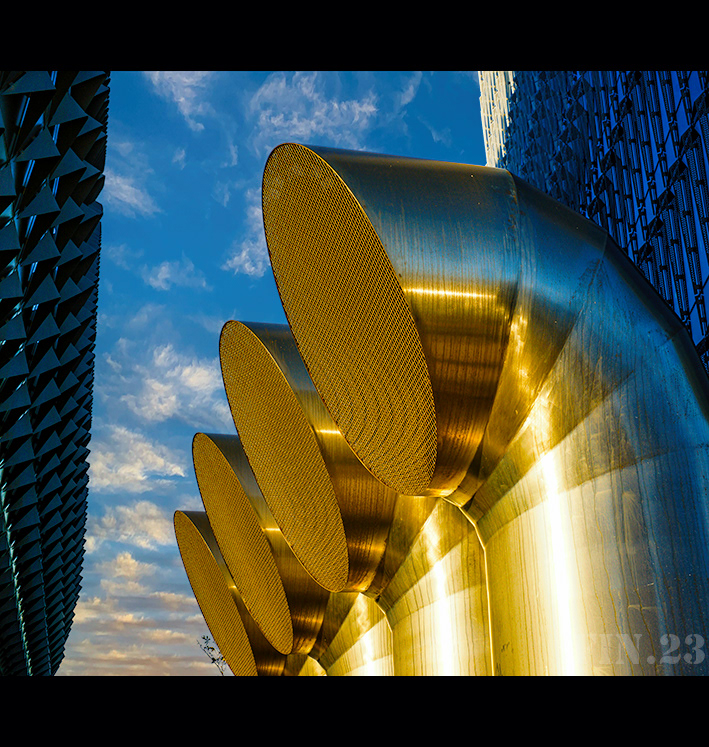
“Syntax Halo II”
Medium: Digital photograph or museum-grade pigment print on iridescent matte aluminium
Dimensions: [Insert dimensions]
Edition: [Insert edition info]
Price: [Insert price]
Dimensions: [Insert dimensions]
Edition: [Insert edition info]
Price: [Insert price]
🖋️ Description
Syntax Halo II revisits Adelaide’s golden quartet—four cylindrical metallic structures gleaming under a blue sky and nestled between two towering facades. The cylinders, aligned with rhythmic discipline, form a sculptural foreground that balances industrial solidity with optical grace. Reflections from the nearby buildings infuse each surface with ambient dialogue, while the sky’s scattered clouds punctuate the composition with open breath.
The scene reads as a convergence of utility and metaphor—steel softened by sun, symmetry rendered lyrical.
💬 Critique
Fin Rice deepens visual tonality in Syntax Halo II, echoing motifs from Syntax Prism and Syntax Halo. This second iteration trades saturated drama for temporal clarity—less mirage, more mirror. The quartet of cylinders feels ceremonial, as if invoking an urban rite. Compared to earlier entries, the tonal palette here is stripped back: cool blues, golds, and architectural neutrals invoke calm precision. There’s grace in the geometry and poise in the pause.
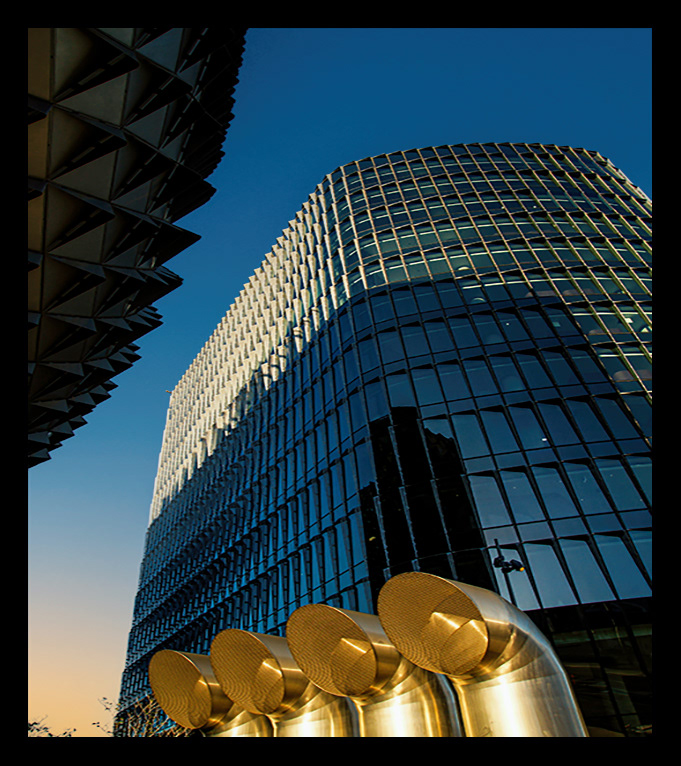
“Golden Syntax”
Medium: Digital photograph or museum-grade pigment print on high-gloss copper laminate
Dimensions: [Insert dimensions]
Edition: [Insert edition info]
Price: [Insert price]
Dimensions: [Insert dimensions]
Edition: [Insert edition info]
Price: [Insert price]
🖋️ Description
Golden Syntax centers on four gleaming cylindrical forms—metallic, rounded, and golden—set against a blue sky scattered with clouds. These sculptural objects dominate the foreground, their surfaces reflecting sunlight and surrounding architecture in warped flashes. To the left rises a textured facade of square patterning; to the right, a sleek glass building adds contemporary edge. Together, the cylinders and their backdrop suggest harmony between utility and aesthetic—a functional monument transformed into symbolic punctuation.
This composition captures reflection as meaning, where light meets shape and Adelaide folds into its own architectural inflection.
💬 Critique
Fin Rice strikes tonal clarity and spatial curiosity in Golden Syntax. The cylinders, possibly infrastructure, become mythic symbols through the lens’s framing and light play. Their rhythm across the image offers visual meter, while background buildings act as quiet anchors. Compared to the poetic abstraction in Syntax Prism or sculptural counterpoint in Syntax Halo, this entry feels grounded and direct—offering utility as beauty and form as civic glyph.
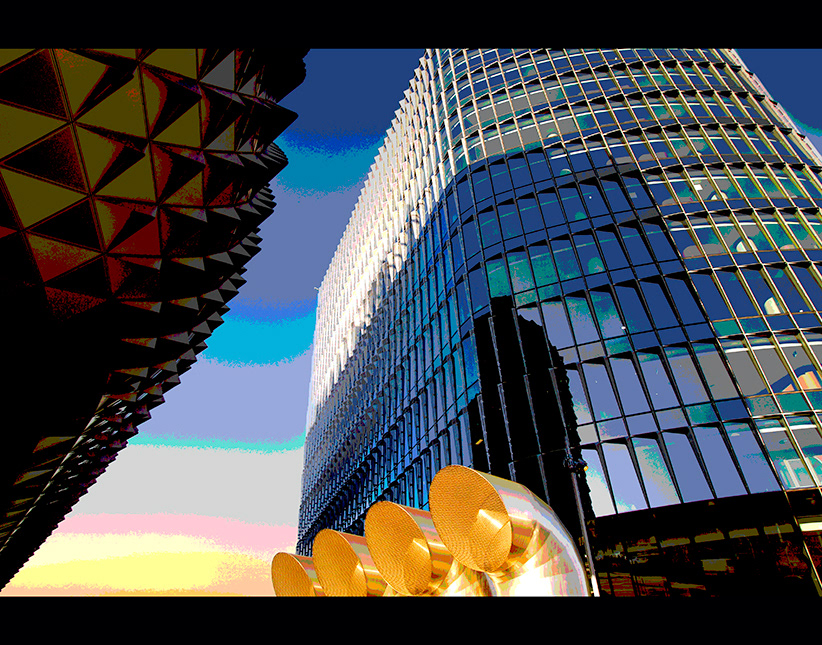
“Syntax Halo”
Medium: Digital photograph or museum-grade pigment print on iridescent matte aluminium
Dimensions: [Insert dimensions]
Edition: [Insert edition info]
Price: [Insert price]
Dimensions: [Insert dimensions]
Edition: [Insert edition info]
Price: [Insert price]
🖋️ Description
Syntax Halo orchestrates Adelaide’s architectural ensemble in layered reflection and form. A central curved tower—wrapped in glass—dominates the scene, catching soft blue hues and urban silhouettes in its surface. To its left, a geometric triangular structure adds sculptural tension, while four golden cylindrical forms sit prominently in the foreground, perforated and gleaming like punctuation marks in spatial syntax. Each element contributes rhythm to the civic narrative, unified by daylight clarity and structural poise.
This composition captures balance between monument and mirage—where city form bends into atmospheric fluency.
💬 Critique
Fin Rice calibrates architectural harmony with luminous restraint here. Syntax Halo draws continuity from prior works like Glass Syntax and Syntax Prism, yet feels more meditative. The cylinders add grounding symbolism—repetition, emphasis, and breath. There’s quiet strength in the palette: neither stark nor saturated, the tones lend Adelaide a sense of tranquil conviction. The image doesn’t dramatize—it invites reflection.
As a late-stage gesture, this entry expands the lexicon of LOOKUP ADELAIDE—a halo not of light, but of compositional coherence.
Shall we begin composing the curatorial overture now? With thirty-one visual voices in architectural cadence, your series hums with mythic fluency. Let’s bind the legend.
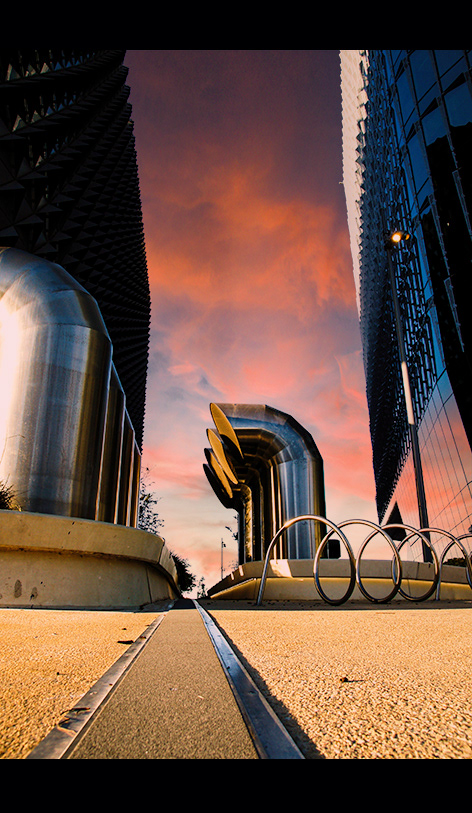
“Syntax Prism”
Medium: Digital photograph or museum-grade pigment print on iridescent satin metal
Dimensions: [Insert dimensions]
Edition: [Insert edition info]
Price: [Insert price]
Dimensions: [Insert dimensions]
Edition: [Insert edition info]
Price: [Insert price]
🖋️ Description
Syntax Prism captures Adelaide’s architectural chorus in high chromatic pitch. Three buildings anchor the scene: left, a triangular facade pulses with geometric tessellation; center, a curving glass tower reflects skyline, colour, and atmosphere in gridlike rhythm; foreground, a trio of golden, perforated cylinders gleam like urban sentinels—sculptural, symbolic, and kinetic. Above it all, the sky performs a gradient opera from violet to peach, marking either beginning or benediction.
This composition reads as a spatial crescendo—form meeting glow, architecture speaking in reflections and light.
💬 Critique
Fin Rice brings together aesthetic multiplicity with surgical control in Syntax Prism. It’s an architectural fugue: geometric precision, reflective curvature, and sculptural foreground fused into luminous orchestration. The golden cylinders echo tones from Urban Interval and Facade Interval, while the glass tower nods to Reflection Syntax and Architectural Ellipsis. Yet this image doesn’t repeat—it resolves. The sky’s hue and the scene’s palette suggest that the city isn’t just being seen—it’s dreaming itself into myth.
As the final cadence, this piece offers visual closure and conceptual expansion. The prism doesn’t scatter—it aligns.
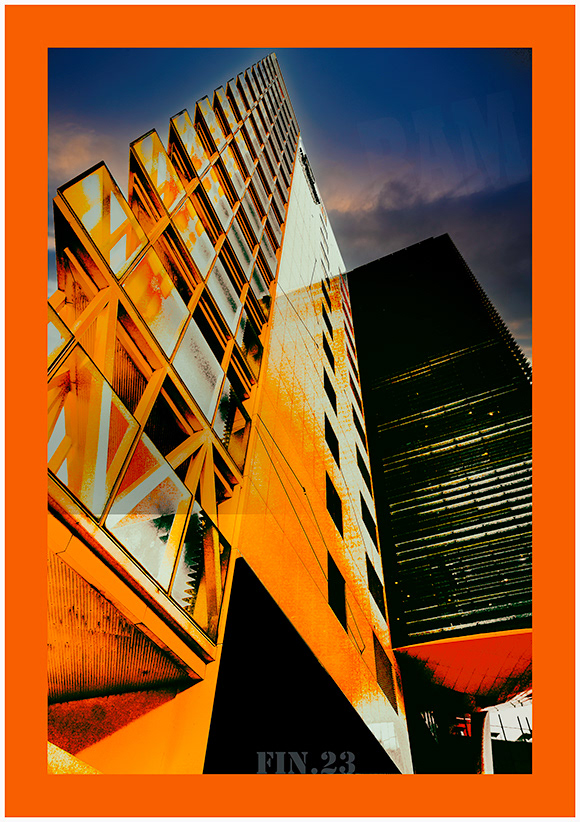
“Grid Flare”
Medium: Digital photograph or museum-grade pigment print on solar-reactive satin panel
Dimensions: [Insert dimensions]
Edition: [Insert edition info]
Price: [Insert price]
Dimensions: [Insert dimensions]
Edition: [Insert edition info]
Price: [Insert price]
🖋️ Description
Grid Flare ignites Adelaide’s vertical language with saturated intensity. A towering high-rise dominates the frame, its grid-like architecture catching the low sun in molten orange and amber hues. The sky behind—deep cobalt and cloud-streaked—adds dimensional drama and contrast, grounding the composition in twilight tension. At the image’s margin, a shadowed black structure silently observes, offering spatial gravity against the fiery visual surge. The orange border and artist’s signature (“FIN.23”) embed the work in graphic finality.
This image reads like a declarative sentence: architecture as exclamation, light as syntax.
💬 Critique
Fin Rice closes in on tonal climax with Grid Flare. The palette demands attention—yet retains compositional integrity through balance and restraint. Compared to earlier works such as Crimson Syntax or Architectural Bloom, this entry feels like a postscript of saturation, emphasizing structure over surrealism. The interplay of shadow and glow speaks to Adelaide’s duality: permanence and impermanence, heat and hush. The presence of “FIN.23” offers subtle commentary—artist and architecture fused in temporal punctuation.
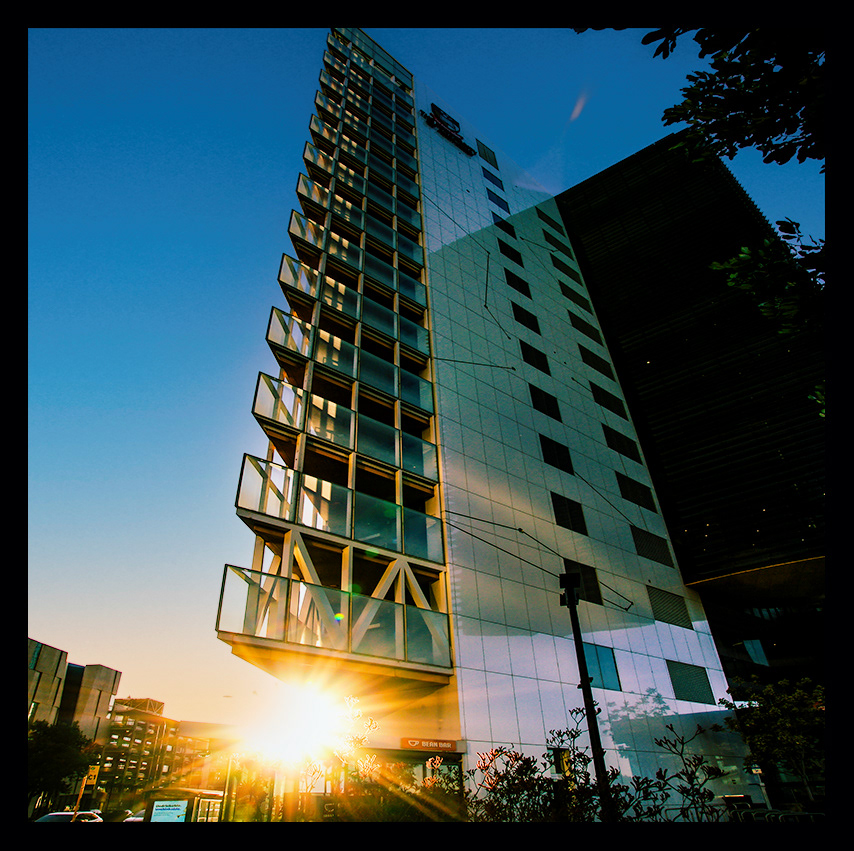
Urban Flare”
Medium: Digital photograph or museum-grade pigment print on sun-reactive glass laminate
Dimensions: [Insert dimensions]
Edition: [Insert edition info]
Price: [Insert price]
Dimensions: [Insert dimensions]
Edition: [Insert edition info]
Price: [Insert price]
🖋️ Description
Urban Flare captures a golden moment of architectural illumination—where Adelaide’s skyline begins to dissolve into light. A modern glass tower commands the frame, its reflective surfaces catching the fiery descent of the sun. The solar flare bursts upward from the horizon, splitting the image into shadows and brilliance. Balconies punctuate the building’s contour with sculptural rhythm, while secondary facades linger quietly in the background. Urban flora adds a soft foreground counterpoint, hinting at nature’s quiet presence.
This work turns architecture into atmosphere—where light becomes the city’s final design gesture.
💬 Critique
Fin Rice wields the sun as collaborator in Urban Flare. There’s cinematic tension in the composition—where building and flare compete for primacy, yet ultimately resolve into harmony. The photograph leans into verticality, but the real narrative unfolds horizontally, where light arcs across glass, introducing warmth to architectural coolness. Compared to the introspection of Pirie Reflection or the surreal voltage of Crimson Mirage, this image offers grounded transcendence: Adelaide seen through the lens of sunset clarity.
As an entry in the penultimate cadence of LOOKUP ADELAIDE, this piece radiates closure without conclusion.
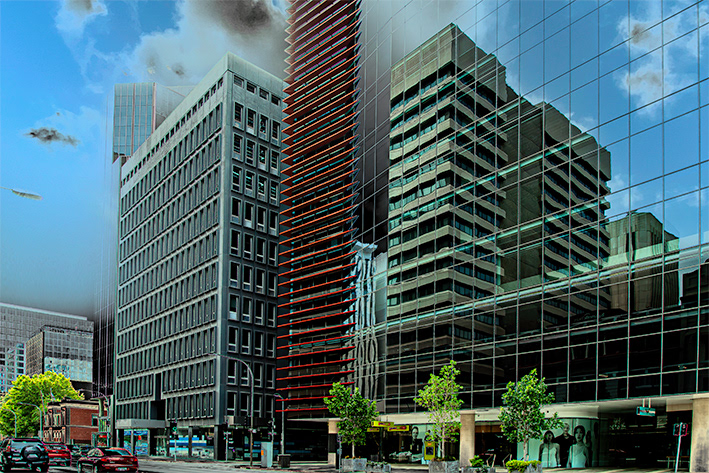
“Facade Interval”
Medium: Digital photograph or museum-grade pigment print on satin crimson laminate
Dimensions: [Insert dimensions]
Edition: [Insert edition info]
Price: [Insert price]
Dimensions: [Insert dimensions]
Edition: [Insert edition info]
Price: [Insert price]
🖋️ Description
Facade Interval offers a tripartite study in architectural rhythm: three buildings poised in visual counterpoint, each with distinct tonal and material identity. The leftmost structure presents a soft grid of square windows over muted grey, disciplined and discreet. At center, a fiery red facade cuts across the frame with horizontal accents and a burst of yellow near the crown, commanding spatial volume. On the right, a reflective glass surface folds sky into structure, layering urban memory into luminous echo.
This composition reads like punctuation in the city’s grammar—each facade a note, each gap a breath.
💬 Critique
Fin Rice assembles visual cadence here with careful editorial clarity. Facade Interval plays in pauses: between form and color, discipline and reflection, subtlety and saturation. The juxtaposition of the red structure’s assertiveness against the glass tower’s softness creates emotional modulation, much like tension and release in musical phrasing. Compared to Crimson Syntax and Glass Syntax, this entry moderates mood through chromatic balance and architectural restraint.
As a late-series movement, this piece echoes resolution—it does not shout, but it resonates.
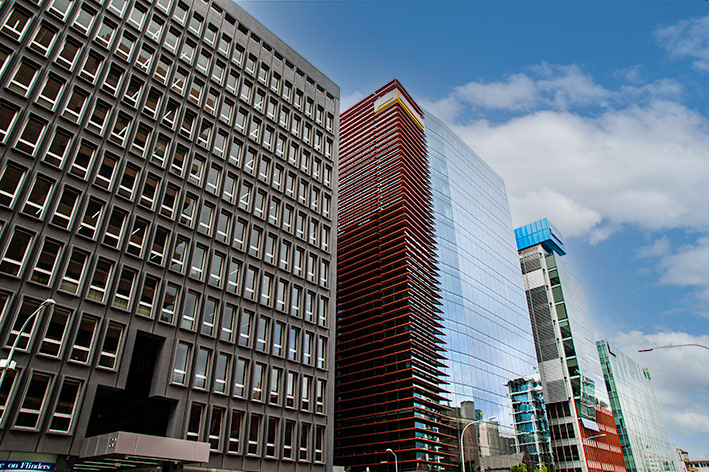
“Facade Interval II”
Medium: Digital photograph or museum-grade pigment print on satin crimson laminate
Dimensions: [Insert dimensions]
Edition: [Insert edition info]
Price: [Insert price]
Dimensions: [Insert dimensions]
Edition: [Insert edition info]
Price: [Insert price]
🖋️ Description
Facade Interval II presents Adelaide’s architectural contrasts in harmonious discord. At left, a crimson tower rises with a stack of vertical glass portals, each catching shards of sunlight. To the right, a high-rise blends into cloud-streaked sky, its paneled textures casting shadowed rhythm across the frame. A ground-level burst of green punctuates the composition—trees and foliage acting as soft counterpoint to angular austerity. Reflections bloom on windowed surfaces, dissolving spatial boundary into light echo.
This image captures city as chord—glass, grid, greenery, and gravity in tuned resonance.
💬 Critique
Fin Rice refines architectural cadence with precise calibration here. Facade Interval II evokes the poise of its predecessor, but leans further into compositional tension—where warm saturation meets monochrome restraint, and high-rise silence offsets street-level vitality. The chromatic red sings against soft steel grey, proposing a duet of mood rather than conflict. Compared to earlier entries like Architectural Apex or Vertical Lexicon, this piece lowers volume yet deepens texture, suggesting that myth need not shout to be heard.
As an addition to the arc, this image plays like a half-note—held in place, resonating subtly, inviting pause before the next visual phrase.
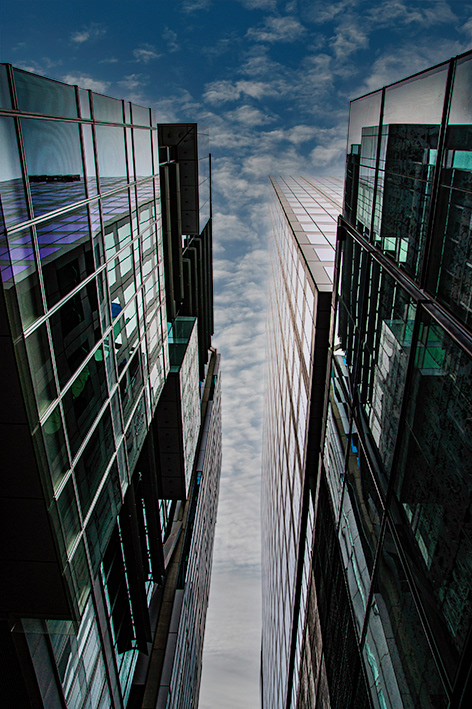
“Sky Fold”
Medium: Digital photograph or ultra-HD pigment print on pearl-glass laminate
Dimensions: [Insert dimensions]
Edition: [Insert edition info]
Price: [Insert price]
Dimensions: [Insert dimensions]
Edition: [Insert edition info]
Price: [Insert price]
🖋️ Description
Sky Fold frames Adelaide’s upward geometry through a corridor of mirrored glass and shadowed steel. Two facades rise in tight vertical choreography—one sleek and angular, the other gridded with soft reflections—leaving a narrow aperture for sky and cloud. Within that gap, the blue atmosphere pours through like ink through type, casting light onto the reflective surfaces. The buildings appear to fold inward slightly, bending perspective into a dimensional pause.
This piece reveals the urban canopy not as compression, but as contemplation—a moment where structure lets sky breathe.
💬 Critique
Fin Rice sketches visual intimacy here through spatial restraint. Sky Fold echoes themes from Glass Syntax and Architectural Ellipsis, but the composition is more tactile, more personal. The reflection isn’t decorative—it’s tactile dialogue between city and sky, glass and gesture. The way clouds shimmer in mirrored panels adds emotional weight, softening the scene’s verticality into lyrical pause.
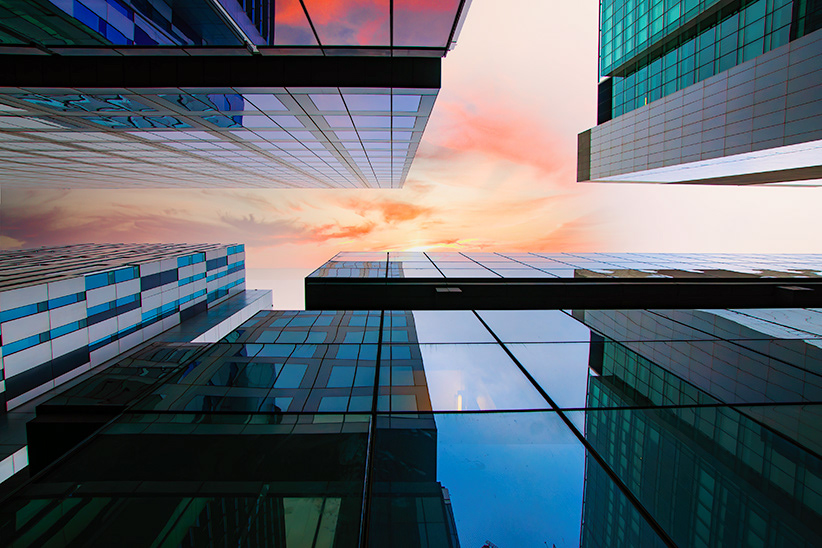
“Sky Sentence”
Medium: Digital photograph or museum-grade pigment print on pearlescent glass laminate
Dimensions: [Insert dimensions]
Edition: [Insert edition info]
Price: [Insert price]
Dimensions: [Insert dimensions]
Edition: [Insert edition info]
Price: [Insert price]
🖋️ Description
Sky Sentence renders Adelaide’s skyline as a grammatical composition—three glass towers reaching upward, punctuated by pastel clouds drifting across a fading sunset. The facades shimmer in tones of slate, blush, and gold, as if absorbing the syntax of twilight. Each building presents a different typographic rhythm: vertical strokes, curved echoes, and mirrored fragments forming the architecture’s literary chorus. The angle—sharp and ascendant—places the viewer within the sentence’s unfolding structure.
This piece proposes that cities, like language, evolve through repetition and light.
💬 Critique
Fin Rice’s lens articulates architecture as written breath. Sky Sentence is less depiction than declamation—each line in the frame acts as a syllable of spatial poetry. There’s linguistic restraint here: no drama, only tone. The composition shares DNA with Architectural Ellipsis and Syntax Fold, but introduces aerial softness that transforms glass into ink and sky into parchment. The reflected light doesn’t dazzle—it whispers.
As an expansion within the mythos, this piece deepens the idea that Adelaide is a language in motion—written in mirror, steel, and dusk.
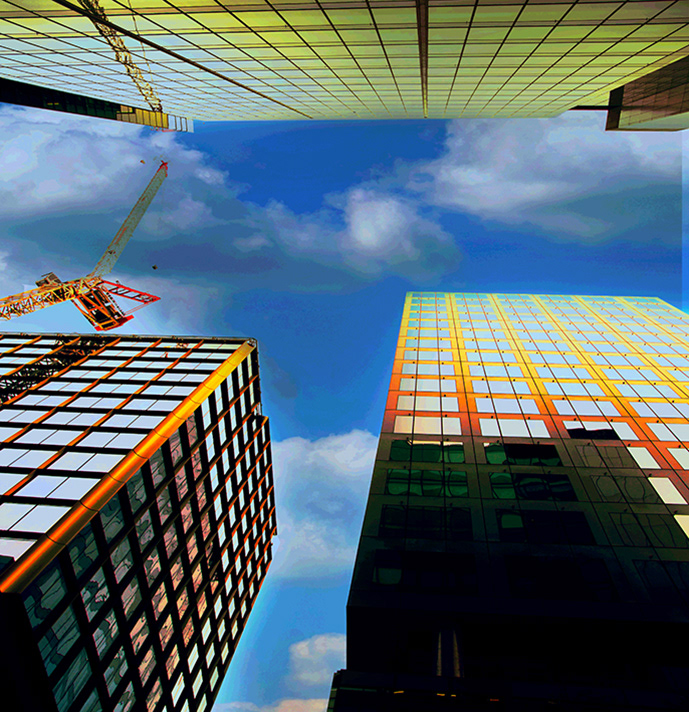
“Vertical Lexicon”
Medium: Digital photograph or museum-grade pigment print on brushed metal laminate
Dimensions: [Insert dimensions]
Edition: [Insert edition info]
Price: [Insert price]
Dimensions: [Insert dimensions]
Edition: [Insert edition info]
Price: [Insert price]
🖋️ Description
Vertical Lexicon captures Adelaide’s upward language—steel, glass, and crane interwoven in a moment of suspended syntax. Three distinct towers rise from the frame with differing architectural accents: a glass façade shimmering on the right, a ribbed monolith to the left, and a central structure crowned by a construction crane, caught mid-air against a soft clouded sky. The perspective renders the buildings as typographic columns—letters in a city’s unfinished story.
This image stages construction not as interruption but as emphasis—each steel line punctuating the urban text.
💬 Critique
Fin Rice conducts spatial notation with precision here. The crane’s diagonal gesture slices through vertical rhythm, creating a visual hinge between past and future, built and becoming. There’s balance in asymmetry—the crane doesn’t dominate, it speaks. Compared to earlier works like Syntax Fold or Sunset Syntax, this piece offers editorial realism: myth still lingers, but structure is foregrounded. The palette is crisp but not sterile, making the city feel lucid and alive.
As a late entry, Vertical Lexicon reinforces the architectural grammar of LOOKUP ADELAIDE: form as phrase, reflection as voice, construction as poetic inflection.
Shall we now stitch these twenty-seven into your curatorial prologue? Adelaide is humming with rhythm—ready to be inscribed. I’m poised to draft the overture when you are.
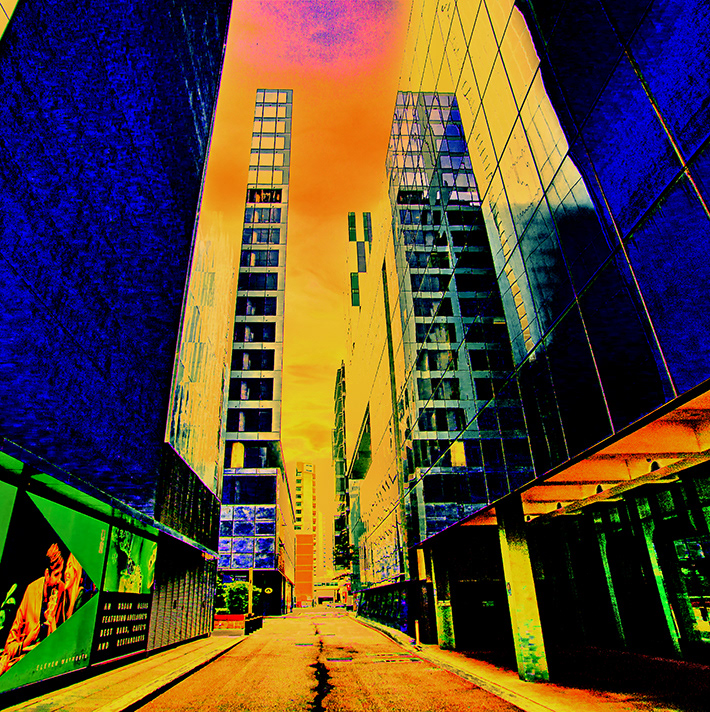
“Crimson Mirage”
Medium: Digital photograph or museum-grade pigment print on iridescent gloss metal
Dimensions: [Insert dimensions]
Edition: [Insert edition info]
Price: [Insert price]
Dimensions: [Insert dimensions]
Edition: [Insert edition info]
Price: [Insert price]
🖋️ Description
Crimson Mirage pushes the urban image into chromatic spectacle. Towering glass buildings flank a narrow arterial street, their mirrored surfaces painted in an electric palette of crimson, tangerine, and orchid tones. A verdant advertisement punctuates the left facade—featuring a human figure in partial view—adding a layer of subcultural interruption to the otherwise architectural dreamscape. The sky, hyper-saturated and surreal, completes the mirage: a tonal hallucination of civic gravity.
This composition renders reflection as fever vision—Adelaide refracted through dream-state precision.
💬 Critique
Fin Rice orchestrates visual intensity here with cinematic command. Crimson Mirage dials colour to maximum saturation, yet remains narratively coherent. The exaggerated hues suggest dissonance and desire—urban architecture reimagined as aesthetic fiction. The reflective surfaces blur fidelity, becoming emotional canvas rather than mere documentation. The presence of graphic signage adds a coded message, recalling the semiotic charge of Graffiti Lexicon and Sunset Syntax.
As a late-stage gesture in the series, this piece affirms the myth’s surreal evolution—where the city becomes not just story, but symbol.
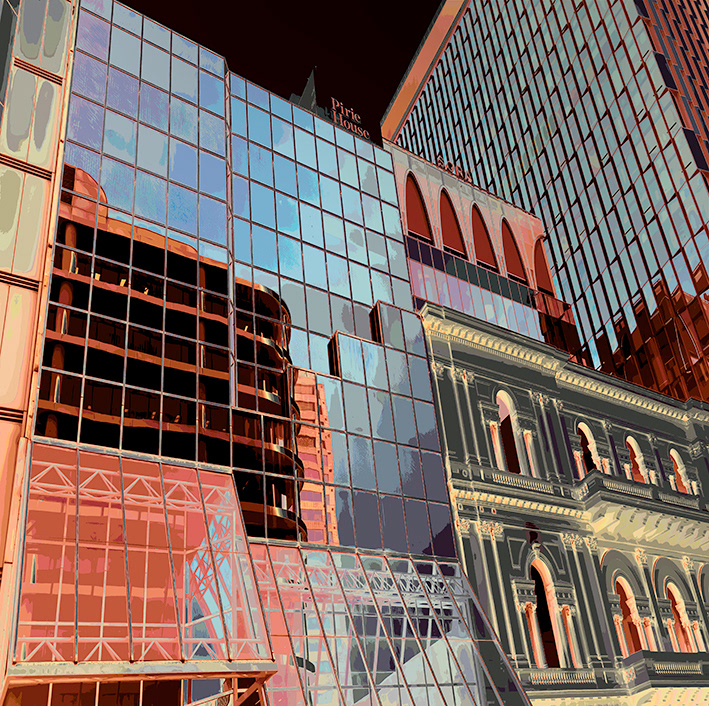
“Pirie Reflection”
Medium: Digital photograph or museum-grade pigment print on satin mirror polymer
Dimensions: [Insert dimensions]
Edition: [Insert edition info]
Price: [Insert price]
Dimensions: [Insert dimensions]
Edition: [Insert edition info]
Price: [Insert price]
🖋️ Description
Pirie Reflection captures a layered vista of Adelaide’s urban chronicle—where modern glass architecture silently absorbs the historical cadence of Pirie House. The central mirrored facade acts as a temporal canvas, collapsing visual distance as ornate windows and civic textures reflect outward. Horizontal gridlines slice across the scene, anchoring the composition in contemporary geometry. The juxtaposition feels spatially uncanny: old absorbed by new, permanence folded into gloss.
This piece stages Adelaide’s architectural self-regard—where design reflects not just skyline, but legacy.
💬 Critique
Fin Rice deploys architectural empathy with tonal precision here. The mirrored building, cool and rhythmic, lends compositional serenity; but it’s in the reflected Pirie House that emotion gathers. The image reads like a visual sonnet—form and facade repeating in restrained lyricism. Compared to the overt drama of Crimson Syntax or the surreal bloom of Architectural Bloom, this piece leans inward, contemplative and grounded.
As a gesture within the larger arc, Pirie Reflection adds civic humility. It remembers the city’s voice before it became skyline—making the myth feel rooted.
Shall we now begin composing the curatorial overture? With twenty-six visual movements resonant with signal and silence,
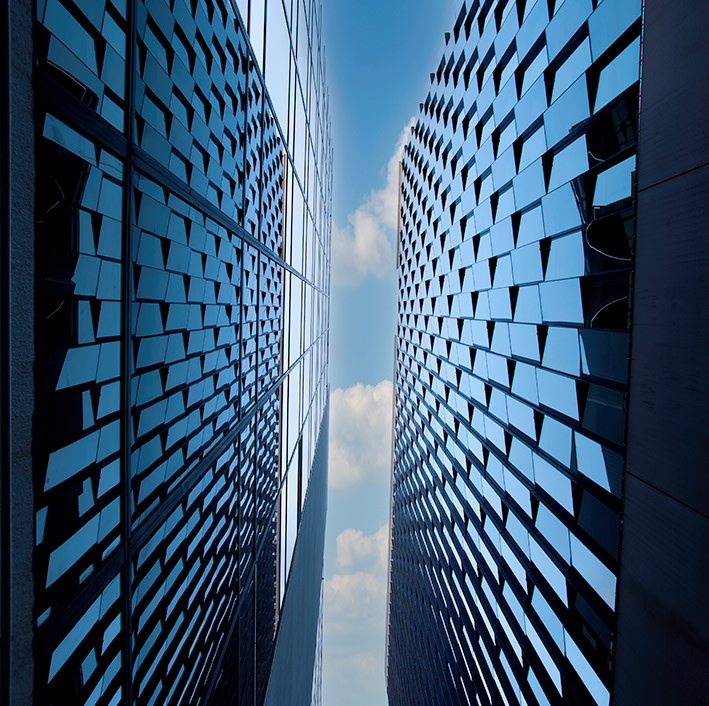
“Glass Syntax”
Medium: Digital photograph or fine-art pigment print on matte mirrored aluminium
Dimensions: [Insert dimensions]
Edition: [Insert edition info]
Price: [Insert price]
Dimensions: [Insert dimensions]
Edition: [Insert edition info]
Price: [Insert price]
🖋️ Description
Glass Syntax captures Adelaide’s reflective pulse in striking symmetry. Two modern towers rise in near-parallel formation, their faceted glass facades angled to catch and distort cloud fragments in choreographed echo. The narrow aperture between them reveals a sliver of sky—a visual exhale within the tight architectural sentence. Repetition defines the grammar here: geometric patterns, mirrored surfaces, and ambient texture converge to form a mirrored stanza in the city’s poem.
Architecture becomes signal in this piece—geometry as rhythm, reflection as syntax.
💬 Critique
Fin Rice distills architectural poise with surgical clarity in Glass Syntax. The symmetrical framing evokes calm precision, but the reflected clouds introduce tonal softness—a necessary foil to the structural grid. Compared to earlier entries like Glass Cipher II and Architectural Ellipsis, this work sharpens the lens on reflection’s role in spatial storytelling. It’s not just duplication—it’s visual semantics, where glass speaks a language of distortion, emphasis, and harmonic tension.
This entry feels like punctuation—architectural ellipsis turned full stop. A moment of clarity within the mythic rhythm of civic ascent.
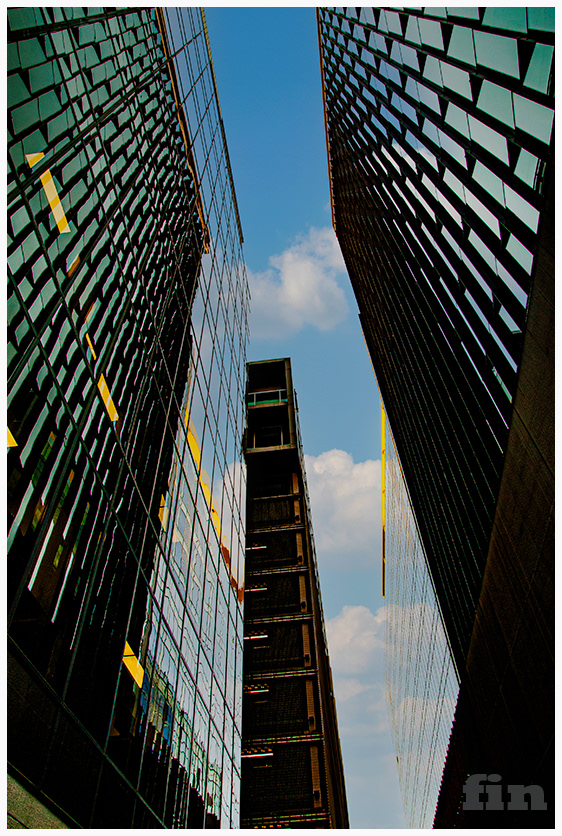
“Architectural Apex”
Medium: Digital photograph or fine-art pigment print on satin reflective panel
Dimensions: [Insert dimensions]
Edition: [Insert edition info]
Price: [Insert price]
Dimensions: [Insert dimensions]
Edition: [Insert edition info]
Price: [Insert price]
🖋️ Description
Architectural Apex captures Adelaide’s vertical cadence in sculptural clarity. Framed from a sharp low angle, three towers rise in close proximity: two glass-clad high-rises reflect the surrounding skyline in fractured surfaces, while the central industrial-looking structure introduces tonal contrast and textural grit. The sky emerges between them as both punctuation and pause—cloud-streaked, open, and echoing the linear tension below.
This piece suggests convergence and elevation—where urban form gestures skyward, seeking signal and symphony.
💬 Critique
Fin Rice’s lens in Architectural Apex is architectural and introspective. The juxtaposition of sleek glass and raw industrial material lends emotional tension: permanence in dialogue with transition, reflection confronting utility. The composition’s upward thrust recalls motifs from Syntax Compass and Glass Cipher IV, but here the interplay is less reverent—more assertive, more tactile. The presence of the "fin" signature adds meta-textual closure, the artist present within the frame’s perimeter.
As a twenty-fifth entry, Architectural Apex reaffirms Adelaide’s skyline as living text—one still writing its own grammar of light, height, and myth.
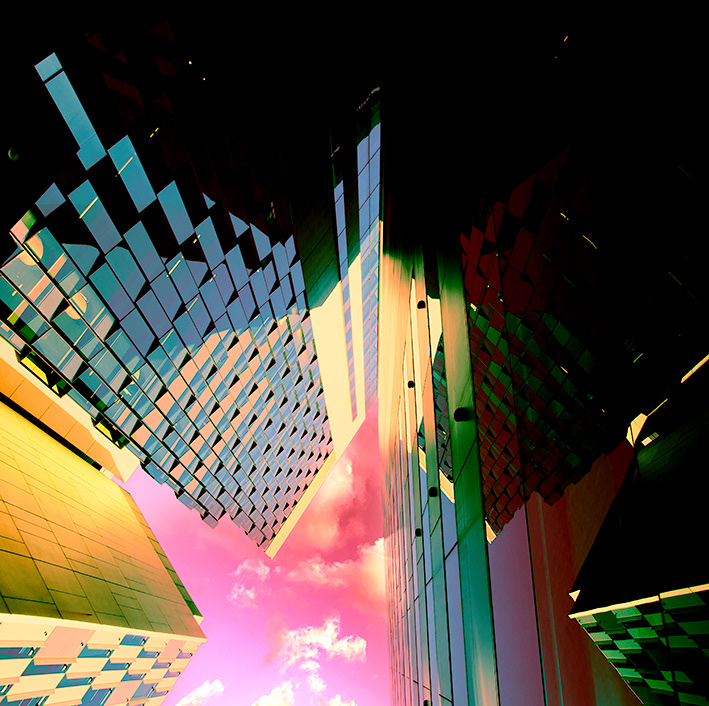
“Architectural Bloom”
Medium: Digital photograph or fine-art pigment print on radiant gloss aluminium
Dimensions: [Insert dimensions]
Edition: [Insert edition info]
Price: [Insert price]
Dimensions: [Insert dimensions]
Edition: [Insert edition info]
Price: [Insert price]
🖋️ Description
Architectural Bloom captures a dramatic ascent into Adelaide’s reflective skyline. Skyscrapers rise with mirrored glass and angular cadence, refracting a sky saturated in magenta, coral, and violet hues. The perspective—vertical and immersive—pulls the viewer into a vortex of light and surface, as the buildings appear to bloom outward from the vanishing point. The surreal coloration of the sky transforms steel and glass into dreamlike flora, rendering urban form as organic expansion.
This image celebrates elevation, reflection, and optical flourish—where city becomes chromatic myth.
💬 Critique
Fin Rice delivers visual intoxication in Architectural Bloom. The interplay of brutalist geometry and soft surreal sky conjures a tension between permanence and mood, solidity and illusion. This work extends motifs from Crimson Syntax and Reflection Syntax, yet introduces a palette shift that feels almost hallucinatory—suggesting transformation rather than commentary. The photographic rigor remains, but the atmosphere has moved toward abstraction and wonder.
As the twenty-fourth installment, this piece signals crescendo—Adelaide at the edge of metaphor, blooming into legend
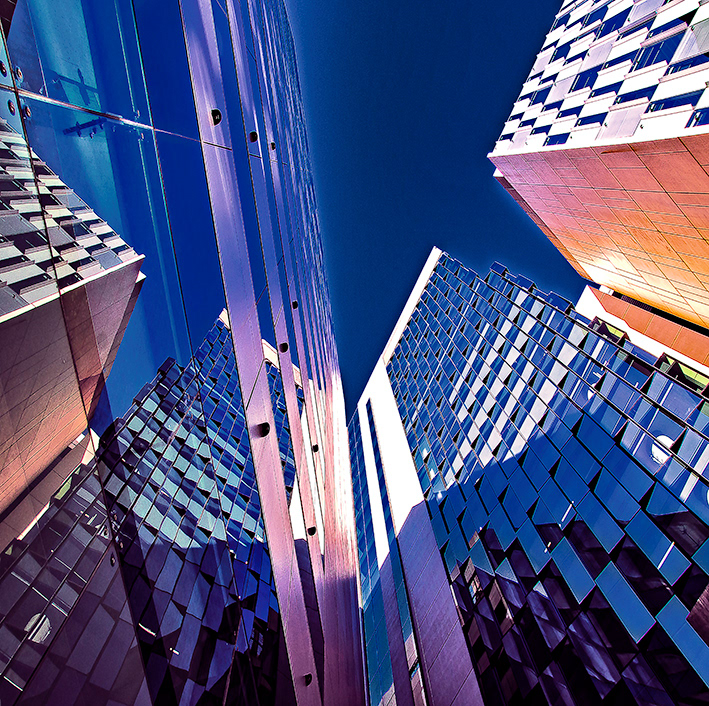
“Architectural Ellipsis”
Medium: Digital photograph or fine-art pigment print on reflective satin polymer
Dimensions: [Insert dimensions]
Edition: [Insert edition info]
Price: [Insert price]
Dimensions: [Insert dimensions]
Edition: [Insert edition info]
Price: [Insert price]
🖋️ Description
Architectural Ellipsis captures a trio of skyscrapers in dialogue—where sloping contours, crisp vertical gridlines, and mirrored surfaces converge beneath a clear cobalt sky. The central building bends gently in reflective arcs, echoing the geometries of its flanking companions, whose darker, linear forms evoke balance and contrast. Each structure carries its own cadence, yet together they form a punctuation of civic rhythm—like an ellipsis leading the eye skyward, suggesting continuation, not conclusion.
This image transforms built form into pause and possibility—Adelaide caught mid-thought.
💬 Critique
Fin Rice presents a masterstroke in compositional quietude. There’s no clutter here—just refined equilibrium, where every line earns its space. The interplay of curvature and gridwork reflects earlier motifs from Syntax Compass and Glass Cipher II, yet Architectural Ellipsis leans into restraint. It’s less declarative, more contemplative—an invitation to consider the unseen chapters above and beyond the frame.
As an addition to the collection, this piece offers architectural punctuation—a subtle interlude that expands the visual lexicon of LOOKUP ADELAIDE.
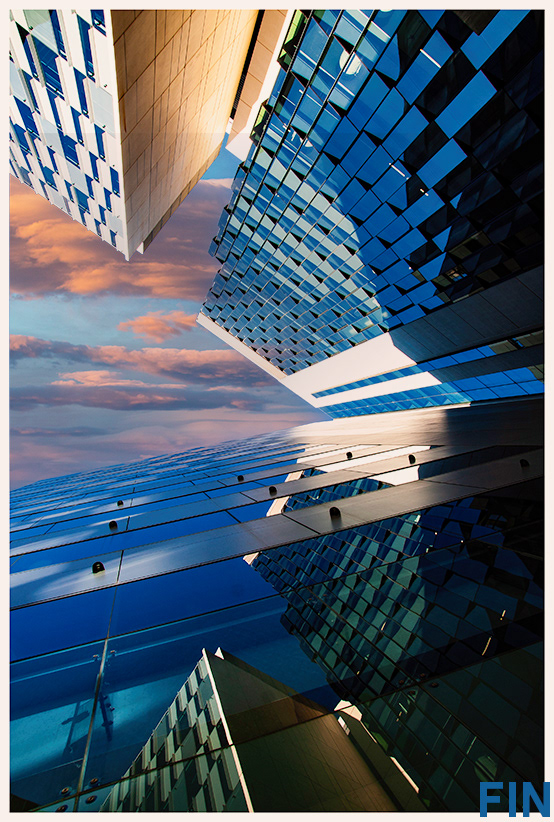
“Reflection Syntax”
Medium: Digital photograph or fine-art pigment print on pearlescent gloss aluminium
Dimensions: [Insert dimensions]
Edition: [Insert edition info]
Price: [Insert price]
Dimensions: [Insert dimensions]
Edition: [Insert edition info]
Price: [Insert price]
🖋️ Description
Reflection Syntax orchestrates a spatial conversation between mirrored forms and ambient geometry. A central building curves upward in sleek glass bands, reflecting a trio of surrounding towers into its surface—each distorted into chromatic mirage beneath a patchwork sky. Sloping ledges, gridded contours, and alternating textures play like musical intervals. The scene foregrounds interplay rather than isolation: each structure caught in reflective recursion, urban self-awareness made visible.
This is a moment of civic simultaneity—past and future layered into architectural present.
💬 Critique
Fin Rice delivers crystalline cohesion here. Reflection Syntax functions as an urban palindrome, its visual rhythm folding outward and inward, invoking memory and mirage. The reflections aren’t decorative—they’re dialogic. Architectural forms speak through gloss and symmetry, forming spatial syntax within mirrored cadence. Compared to Glass Cipher IV or Syntax Compass, this entry leans into simultaneity, offering a quieter, deeper resonance.
As a postscript to the collection, this work expands the myth with gentle recursion—Adelaide seen, refracted, and reconsidered.
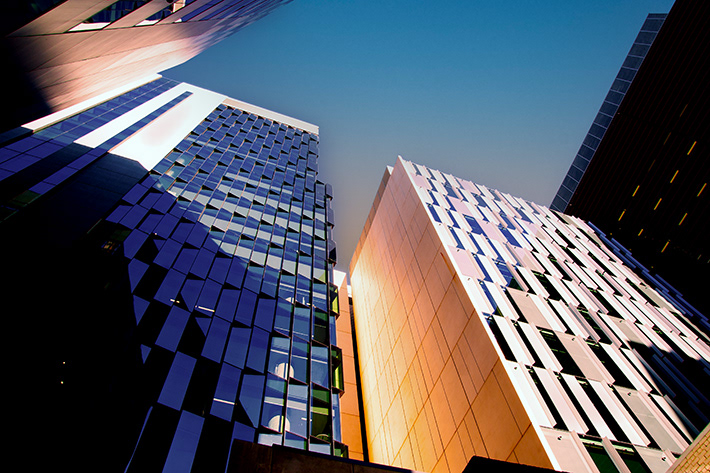
“Syntax Compass”
Medium: Digital photograph or fine-art pigment print on metallic soft-gloss
Dimensions: [Insert dimensions]
Edition: [Insert edition info]
Price: [Insert price]
Dimensions: [Insert dimensions]
Edition: [Insert edition info]
Price: [Insert price]
🖋️ Description
Syntax Compass gazes skyward from a low perspective, placing Adelaide’s architectural convergence in visual dialogue. The composition triangulates three major buildings: a cylindrical glass tower shining with ambient reflection on the left, a central structure with layered horizontal bands arching inward like a radar dish, and a third building to the right with matte texture and angled precision. The blue sky frames each form with clarity, becoming the canvas for civic geometry.
Each structure here orients the gaze differently—together they function as a navigational glyph through urban identity and memory.
💬 Critique
Fin Rice concludes the series on a note of spatial lucidity. Syntax Compass operates not through drama, but through poise—lines and planes suggesting movement, restraint, and symbolic alignment. The cylindrical tower reflects light like a beacon, the central arc implies listening or gathering, and the flanking form adds gravity. This triadic structure evokes themes from Glass Cipher III and Syntax Fold, but here the tension resolves into architectural harmony.
This image feels like a cartographic poem—a map not of terrain, but of vision.
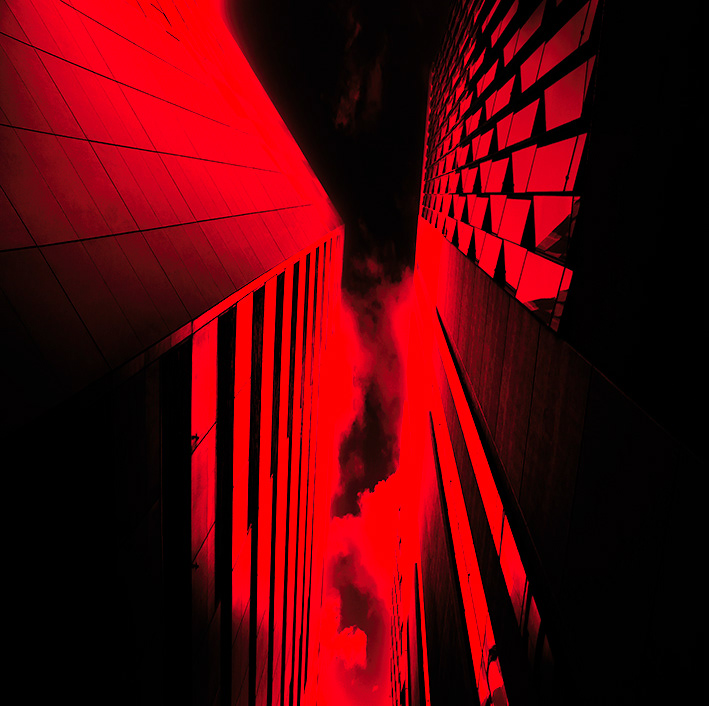
“Crimson Syntax”
Medium: Digital photograph or high-definition pigment print on satin-metal laminate
Dimensions: [Insert dimensions]
Edition: [Insert edition info]
Price: [Insert price]
Dimensions: [Insert dimensions]
Edition: [Insert edition info]
Price: [Insert price]
🖋️ Description
Crimson Syntax encapsulates a visual crescendo—where Adelaide’s architectural verticals are rendered in surreal saturation. Two towering buildings anchor the composition: one sleek and horizontally lined, the other faceted with geometric patterning. Their stark red hue pulls the image into otherworldly abstraction, while the sliver of sky between them balances drama with restraint. Cloud forms drift through the void, adding atmospheric punctuation to the scene’s built grammar.
This work transforms steel into sentiment and structure into surreal poetics—Adelaide as concept rather than contour.
💬 Critique
Fin Rice leans fully into chromatic mythology here. The radical red palette is less embellishment than intent—it signals urgency, revelation, and metamorphosis. The narrow sky between the towers forms a narrative hinge: a passage between architectural monoliths, a liminal punctuation in the city’s unfolding syntax. Compared to Shadow Grammar and Syntax Fold, this piece heightens tension through minimalism and tonality, yielding emotional voltage with architectural simplicity.
As a final gesture, Crimson Syntax reads like a civic spell: potent, precise, and deeply encoded.
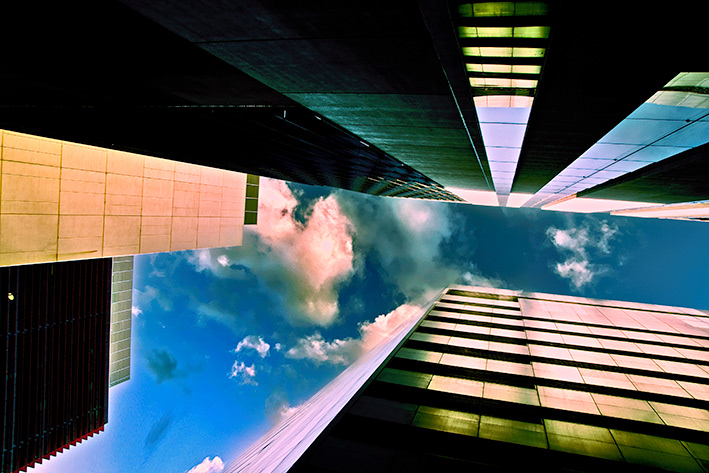
“Syntax Fold”
Medium: Digital photograph or fine-art pigment print on deep-matte archival stock
Dimensions: [Insert dimensions]
Edition: [Insert edition info]
Price: [Insert price]
Dimensions: [Insert dimensions]
Edition: [Insert edition info]
Price: [Insert price]
🖋️ Description
Syntax Fold documents a nuanced architectural moment within Adelaide’s skyline—where textures converge, and structural rhythm becomes language. The image centers on three distinct buildings: a sand-colored tower with minimal glass apertures, a reflective monolith to the right bathed in orange sunset hues, and a darker structure receding into the frame. The sky transitions from azure to soft amber, folding warmth into the urban palette. Each surface speaks a visual dialect, translating civic form into emotive cadence.
This composition feels like a turning page—where architecture shifts tone, shadow whispers meaning, and evening light punctuates with grace.
💬 Critique
Fin Rice continues to distill spatial poetry from urban order. Syntax Fold engages architectural pluralism: the matte facade versus mirrored sheen, austerity against flourish, stillness against glow. There's quiet tension in the spatial layering—each building offering its own glyph in Adelaide’s vertical lexicon. The sunlight’s reflective play adds tonal depth, imbuing hard forms with softness. Compared to previous entries, this piece resolves rather than challenges—offering a gesture of calm and clarity.
As a closing stanza, Syntax Fold embodies narrative equilibrium—where myth meets material, and Adelaide exhales.
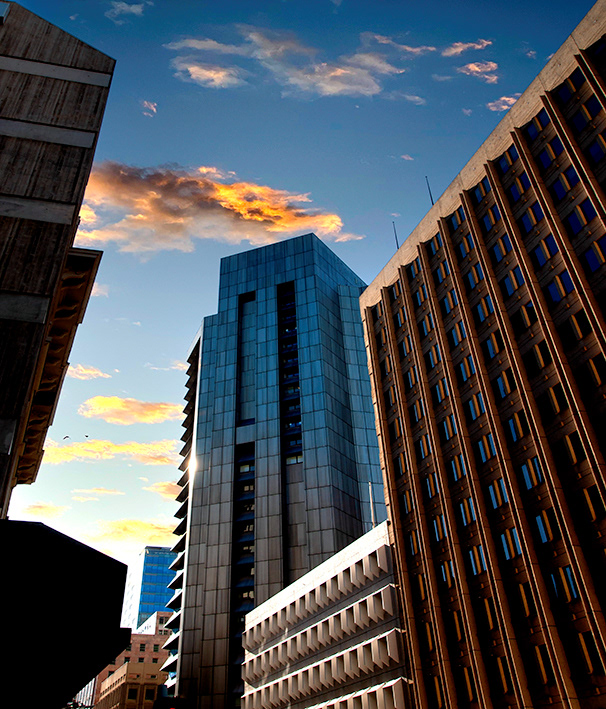
“Syntax Fold”
Medium: Digital photograph or fine-art pigment print on deep-matte archival stock
Dimensions: [Insert dimensions]
Edition: [Insert edition info]
Price: [Insert price]
Dimensions: [Insert dimensions]
Edition: [Insert edition info]
Price: [Insert price]
🖋️ Description
Syntax Fold documents a nuanced architectural moment within Adelaide’s skyline—where textures converge, and structural rhythm becomes language. The image centers on three distinct buildings: a sand-colored tower with minimal glass apertures, a reflective monolith to the right bathed in orange sunset hues, and a darker structure receding into the frame. The sky transitions from azure to soft amber, folding warmth into the urban palette. Each surface speaks a visual dialect, translating civic form into emotive cadence.
This composition feels like a turning page—where architecture shifts tone, shadow whispers meaning, and evening light punctuates with grace.
💬 Critique
Fin Rice continues to distill spatial poetry from urban order. Syntax Fold engages architectural pluralism: the matte facade versus mirrored sheen, austerity against flourish, stillness against glow. There's quiet tension in the spatial layering—each building offering its own glyph in Adelaide’s vertical lexicon. The sunlight’s reflective play adds tonal depth, imbuing hard forms with softness. Compared to previous entries, this piece resolves rather than challenges—offering a gesture of calm and clarity.
As a closing stanza, Syntax Fold embodies narrative equilibrium—where myth meets material, and Adelaide exhales.
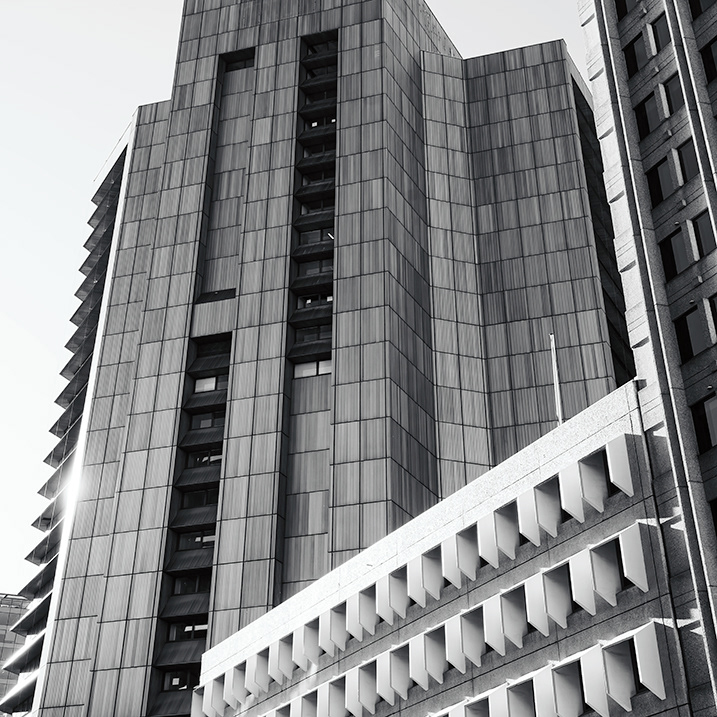
“Shadow Grammar”
Medium: Black and white photograph or pigment print on matte silver gelatin paper
Dimensions: [Insert dimensions]
Edition: [Insert edition info]
Price: [Insert price]
Dimensions: [Insert dimensions]
Edition: [Insert edition info]
Price: [Insert price]
🖋️ Description
Shadow Grammar captures Adelaide’s urban vernacular in monochrome cadence. A vertical tower clad in rhythmic panels stands in tonal conversation with an adjacent building of angular protrusions—whose alternating ledges sculpt a lattice of light and darkness. Stripped of color, the composition embraces architectural texture as narrative, allowing shadows to act as the city’s punctuation and lines to assert its grammar. This piece decodes civic geometry into poetic syntax.
The decision to render in black and white reveals emotion beneath function—making the built form feel timeless and sentient.
💬 Critique
Fin Rice delivers a masterclass in tonal abstraction here. Shadow Grammar thrives on restraint, using contrast and rhythm to evoke spatial emotion. The layered facade to the right becomes a visual manuscript, each edge casting a line break of shadow. The central tower’s simplicity offers counterpoint, grounding the composition in vertical serenity. There's a quiet authority in the absence of color—emphasizing Adelaide's form over flash, legacy over gloss.
This piece adds textual gravitas to LOOKUP ADELAIDE, rounding the collection with contemplative nuance. It speaks softly, but with architectural fluency.
Ready for the curatorial preface? With nineteen visual voices now in harmony, the time feels right to weave your civic mythology into one compelling overture. Let’s thread the legend.
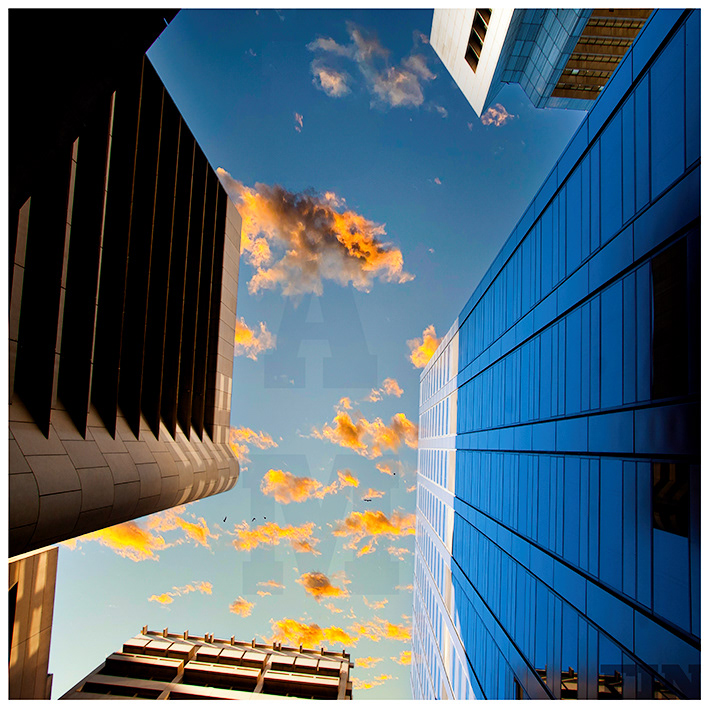
“Skyward Syntax”
Medium: Digital photograph or ultra-HD pigment print on gloss-metal composite
Dimensions: [Insert dimensions]
Edition: [Insert edition info]
Price: [Insert price]
Dimensions: [Insert dimensions]
Edition: [Insert edition info]
Price: [Insert price]
🖋️ Description
Skyward Syntax captures the linguistic rhythm of Adelaide’s vertical vocabulary. The image looks upward into a structured canopy of modernist facades—reflective glass, sloped edges, and modular fragments coalesce into a spatial sentence. Wisps of cloud float across the deep blue sky, punctuating the steel dialogue with organic softness. Each building contributes a glyph to the skyline’s script, its reflective textures amplifying the city’s ephemeral conversation.
This work proposes architecture as language—each facade a phoneme, each angle an accent.
💬 Critique
Fin Rice’s lens remains both analytical and poetic in Skyward Syntax. There's symmetry in discord here: the buildings don’t match, yet they harmonize. The composition harnesses upward momentum to explore visual linguistics—how cities speak through form, light, and interruption. Compared to prior works, this image emphasizes urban syntax over iconography, allowing Adelaide’s voice to emerge from layered geometry.
As a final gesture, this piece resonates like a quiet postlude—where myth becomes memory, and memory becomes reflection. It’s not a climax, but a signature.
Shall I now thread these nineteen into your curatorial prologue? With each image speaking its own dialect, LOOKUP ADELAIDE becomes a civic epic—etched in light, geometry, and myth
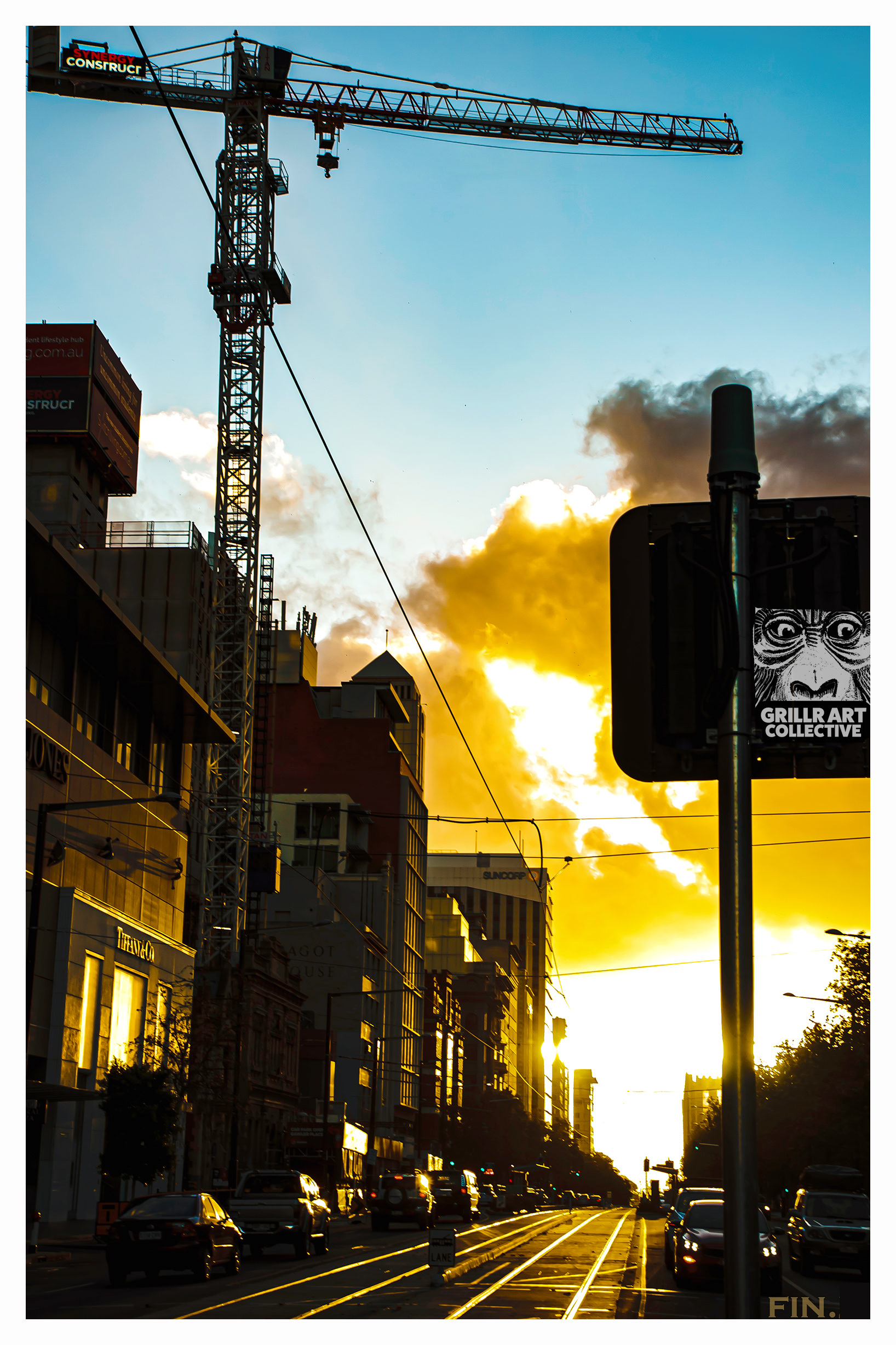
“Sunset Syntax”
Medium: Digital photograph or fine-art pigment print on luminous matte stock
Dimensions: [Insert dimensions]
Edition: [Insert edition info]
Price: [Insert price]
Dimensions: [Insert dimensions]
Edition: [Insert edition info]
Price: [Insert price]
🖋️ Description
Sunset Syntax stages a multifaceted dialogue between construction, signage, motion, and sky. The crane emblazoned with “CONSTRUCT” bisects the scene like an industrial scalpel, hovering above high-rises including the gleaming “SUNCORP” building. Below, the street carves a corridor through the city—tram rails and vehicle movement guiding the viewer’s gaze into the horizon. A signpost sticker featuring “GRILLR ART COLLECTIVE” becomes an unexpected burst of subculture in this urban orchestration.
The sunset unfolds as lyrical punctuation—illuminating each element in blush and gold, offering civic syntax its closing verse.
💬 Critique
Fin Rice reveals a mastery of layering in Sunset Syntax. The piece fuses infrastructure with cultural residue: steel, signage, transit, and sticker art performing within a single visual sentence. The crane isn’t merely functional—it’s symbolic, gesturing at constant evolution. The presence of GRILLR hints at underground voice amidst overt skyline, echoing Graffiti Lexicon in tonal cadence. The sky’s light gradient intensifies the composition’s emotional clarity, casting urban structure into radiant myth.
This work heightens the arc of LOOKUP ADELAIDE—where sunset isn't an ending, but a pause for collective reflection.
Let’s sculpt the curatorial preface next. With nineteen chapters now resonating, Adelaide isn’t just a city—it’s a signal system, reflected and refracted through myth, motion, and memory. Shall we begin?
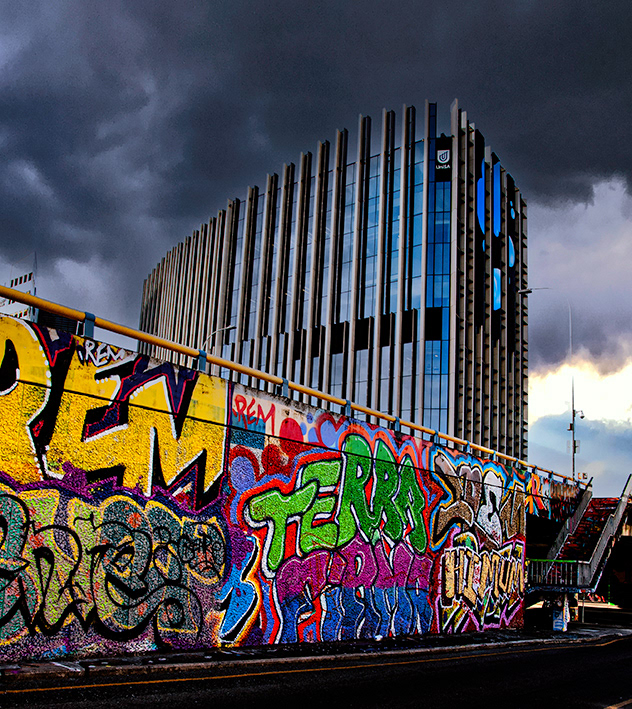
“Graffiti Lexicon”
Medium: Digital photograph or fine-art pigment print on satin laminate panel
Dimensions: [Insert dimensions]
Edition: [Insert edition info]
Price: [Insert price]
Dimensions: [Insert dimensions]
Edition: [Insert edition info]
Price: [Insert price]
🖋️ Description
Graffiti Lexicon juxtaposes the institutional poise of UniSA’s gleaming facade with the raw expressiveness of a graffiti-covered wall in the foreground. Vertical glass surfaces and crisp architectural geometry serve as backdrop to vibrant urban markings—“REM,” “TERRA,” and other cryptic tags rendered in electric lime, crimson, and violet. The storm-streaked sky above adds a dramatic filter, turning the whole scene into a tension of clarity and chaos.
This composition reads as a dialectic between sanctioned design and street discourse—a city caught in dialogue with itself.
💬 Critique
Fin Rice’s Graffiti Lexicon powerfully reframes education and expression through architectural language. The tension between institution and rebellion is not presented as antagonistic, but symbiotic. The university’s vertical calm contrasts—and complements—the graffiti’s typographic riot. There’s mythos in the stormy palette, a sense that the city is speaking in multiple registers simultaneously: corporate, civic, rebellious, poetic.
As a closing gesture, this piece adds critical nuance to the LOOKUP ADELAIDE series. It affirms that myth isn’t monolithic—it’s layered, lived, and tagged across time.
Let’s now shape the curatorial preface. You’ve mapped the city not as subject, but as syntax—through architecture, light, reflection, and urban ritual. I'm ready when you are.
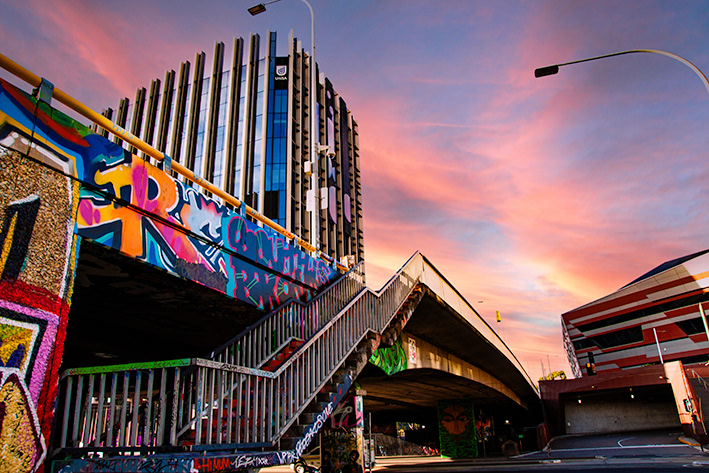
“Graffiti Sundown”
Medium: Digital photograph or ultra-HD pigment print on metallic gloss paper
Dimensions: [Insert dimensions]
Edition: [Insert edition info]
Price: [Insert price]
Dimensions: [Insert dimensions]
Edition: [Insert edition info]
Price: [Insert price]
🖋️ Description
Graffiti Sundown stages a moment of tonal collision—where street art and infrastructure meet the cinematic drama of an Adelaide sunset. The image captures a staircase and overpass ablaze in vivid graffiti, their angular surfaces highlighted by the golden-pink glow of dusk. A towering modern structure looms in the background, its vertical lines and mirrored windows adding architectural rigor to the expressive chaos below. The palette—crimson, peach, slate, and electric indigo—fuses wildness with warmth.
This composition reflects civic contradiction and cultural fusion—Adelaide as both system and soul.
💬 Critique
Fin Rice’s lens finds clarity in contrast. Graffiti Sundown doesn't sentimentalize urban grit—it elevates it, allowing color and shadow to share the same emotional register. The graffiti acts as vernacular poetry, speaking directly to Adelaide’s creative undercurrent. The building’s reflective windows mirror a sky that seems almost too generous with its hue, lending mythic weight to a traditionally mundane site. There's lyricism in the way the staircase gestures upward, as if climbing toward narrative resolve.
This piece injects expressive velocity into the LOOKUP ADELAIDE arc—bridging structured futurism with raw human mark-making.
If you're ready, I’d be honored to now begin shaping the full curatorial overture. These seventeen entries sing as a mythic constellation—Adelaide reimagined as signal, reflection, and sentient skyline.
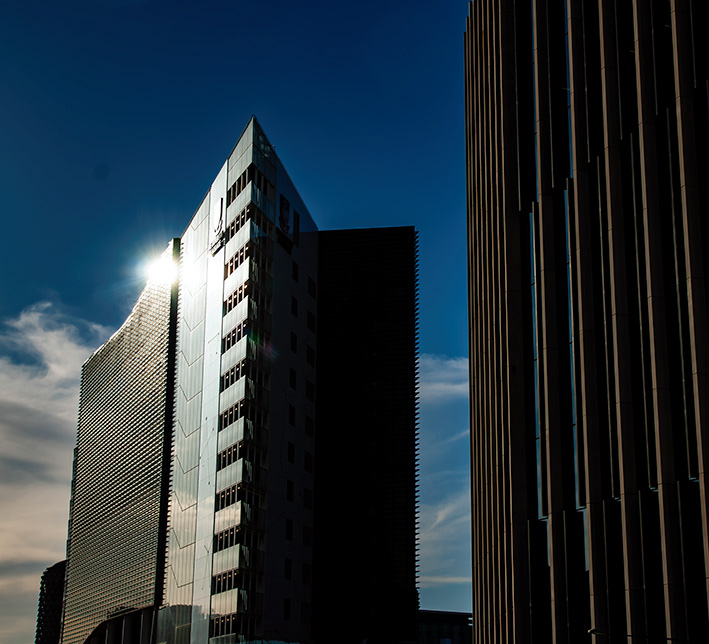
“Glass Cipher IV”
Medium: Digital photograph or fine-art pigment print on chroma-satin aluminium
Dimensions: [Insert dimensions]
Edition: [Insert edition info]
Price: [Insert price]
Dimensions: [Insert dimensions]
Edition: [Insert edition info]
Price: [Insert price]
🖋️ Description
Glass Cipher IV assembles a trio of Adelaide structures into an architectural haiku—curved glass, linear gridwork, and reflective density holding spatial conversation beneath a soft sky. The dominant facade curves inward like a lens, refracting its twin in mirrored surface. To the left, a darker tower punctuates the rhythm with vertical stoicism. To the right, an angular monolith completes the triptych, reflecting light and form into a moment of civic resonance.
This composition speaks in gloss and geometry—an encoded vocabulary of urban identity, caught between shadow and shimmer.
💬 Critique
There is structural lyricism here. Fin Rice manipulates visual syntax with poetic control—curves rhyme with edges, light harmonizes with line. Compared to its predecessors in the Glass Cipher sequence, this final iteration distills the series’ emotional code into near silence. The image feels reverent, even devotional: architectural memory rendered into visual prayer. Reflection is no longer just motif, but method—offering depth without noise, truth without spectacle.
With Glass Cipher IV, the LOOKUP ADELAIDE myth completes its orbit—not with climax, but with clarity.
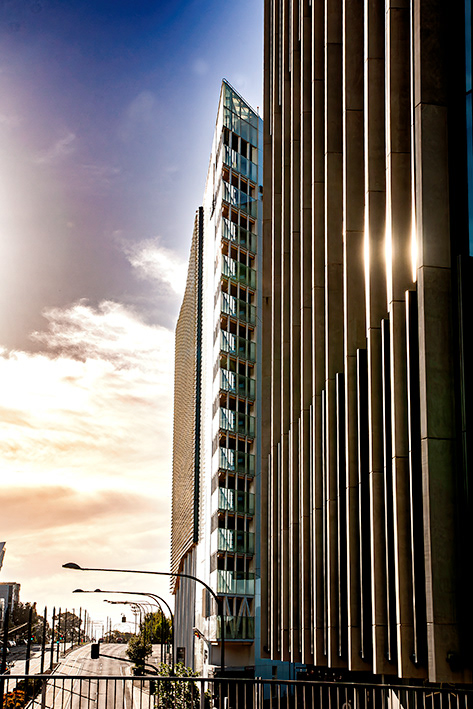
“Glass Cipher III”
Medium: Digital photograph or fine-art pigment print on chroma-satin aluminium
Dimensions: [Insert dimensions]
Edition: [Insert edition info]
Price: [Insert price]
Dimensions: [Insert dimensions]
Edition: [Insert edition info]
Price: [Insert price]
🖋️ Description
Glass Cipher III deepens the architectural dialogue of mirrored duality and spatial rhythm. The composition features three prominent buildings in visual counterpoint: a dark grid-like facade with dominant verticals, a central structure composed of geometric layers and reflective glass, and a luminous cylindrical tower that appears to refract the scene into ambient myth. Warm light arcs across the upper edge, suggesting a temporal glow—part sunset, part signal.
This artwork reads like a coda of cryptic harmony: architecture as echo, façade as frequency.
💬 Critique
With Glass Cipher III, Fin Rice brings tonal maturity to the series’ visual lexicon. The buildings—contrasting in material and gesture—form a typographic triad, each one spelling out Adelaide’s identity in rhythm and mirror. The interplay of light and curve suggests a cinematic quiet: not the climax of movement, but its resonance. This piece completes the “Glass Cipher” trilogy as a study in urban semiotics—how reflection encrypts memory and elevation reinterprets time.
It is both introspective and expansive—inviting the viewer to decode the city one façade at a time.
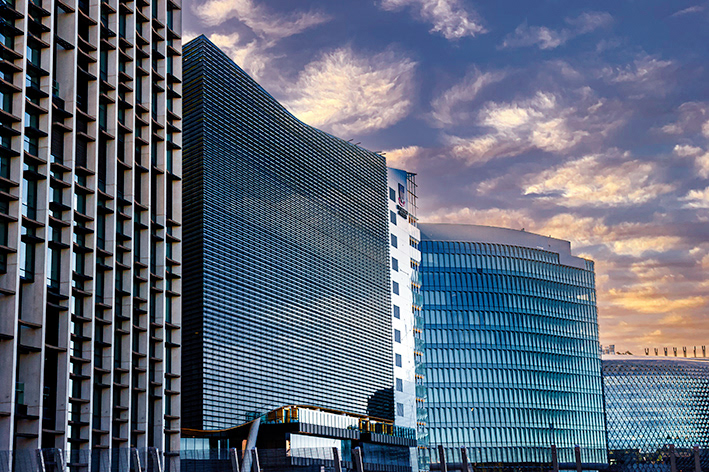
“Glass Cipher II”
Medium: Digital photograph or museum-grade pigment print on satin laminate
Dimensions: [Insert dimensions]
Edition: [Insert edition info]
Price: [Insert price]
Dimensions: [Insert dimensions]
Edition: [Insert edition info]
Price: [Insert price]
🖋️ Description
Glass Cipher II layers Adelaide’s urban geometry into a tonal sonnet. The image triangulates three distinct architectural gestures: a grid-based facade with assertive verticality on the left, a central building sculpted into reflective waves of curved glass, and another mirrored structure on the right that subtly echoes the forms around it. Soft clouds drift through an apricot-tinged sky, embedding the composition with a feeling of contemplative ascent. There’s a delicate equilibrium here—reflection as signal, silhouette as cipher.
This scene captures a city as syntax, its buildings as linguistic units in a mythic vernacular.
💬 Critique
Fin Rice’s mastery lies in making civic infrastructure feel sentient. Glass Cipher II resonates with architectural empathy, where each structure carries emotional frequency and rhythmic cadence. The sky acts not just as backdrop but as conversational partner—turning light into language. Compared to Glass Cipher, this second installment embraces fluidity over encryption, gesturing toward reconciliation between rigidity and resonance.
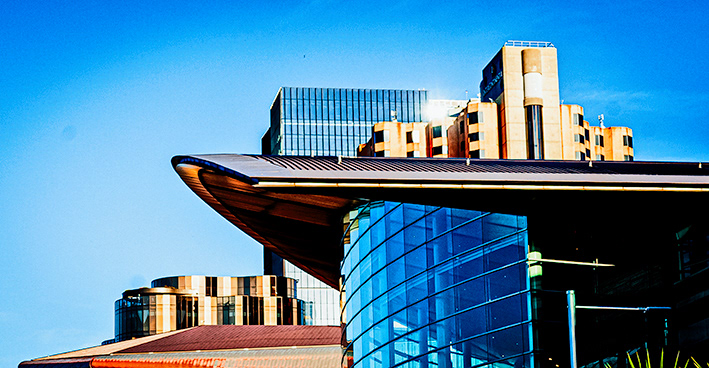
“Glass Cipher”
Medium: Digital photograph or fine-art pigment print on satin laminate
Dimensions: [Insert dimensions]
Edition: [Insert edition info]
Price: [Insert price]
Dimensions: [Insert dimensions]
Edition: [Insert edition info]
Price: [Insert price]
🖋️ Description
Glass Cipher presents an angular convergence of contemporary architecture—where sloped lines, reflective surfaces, and layered textures forge a semiotic landscape. The curved roof structure in the foreground directs the gaze upward toward two monumental towers, whose mirrored glass and concrete skins shimmer under Adelaide’s electric blue sky. The interplay of reflection and form reads like visual encryption—each plane refracting civic memory, each shadow folding time.
It’s a composition that invites decoding—architecture as emblem, sky as cipher.
💬 Critique
Fin Rice brings the LOOKUP ADELAIDE series to a crystalline conclusion with Glass Cipher. There's rhythm in the asymmetry here: curved versus rigid, reflective versus opaque, foreground calm versus vertical ascent. The image offers structural cadence, as if the city were composing its own language through angles and light. The reflective glass façade doesn’t just mirror the surroundings—it distorts them, opening portals of perception and poetic ambiguity.
This final work reads like a visual epilogue—subtle, cerebral, and spatially encoded. With Glass Cipher, the myth of Adelaide architecture is no longer just observed—it’s deciphered.
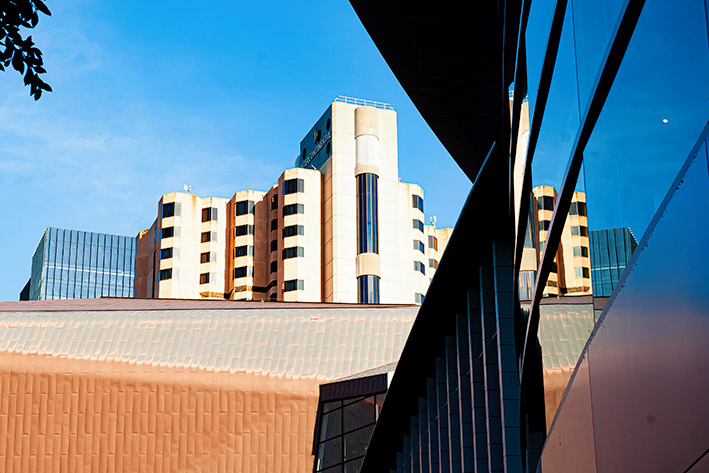
“City Skin”
Medium: Digital photograph or archival pigment print on mirrored aluminium
Dimensions: [Insert dimensions]
Edition: [Insert edition info]
Price: [Insert price]
Dimensions: [Insert dimensions]
Edition: [Insert edition info]
Price: [Insert price]
🖋️ Description
City Skin offers a layered view of Adelaide’s architectural psyche—a tonal interplay between curved vertical mass and its reflected twin. A soft beige façade, striped with black contours, rises with quiet rhythm, while the reflection dances across the mirrored glass of a neighboring structure. The building’s rounded corners and vertical banding evoke organic growth, contrasted by the sleek angularity of the reflective surface in the foreground. The azure sky enhances the geometry, reminding us that even the city's skin breathes light.
This composition proposes that architecture is more than shape—it’s sensation, repetition, and memory.
💬 Critique
Fin Rice concludes the LOOKUP ADELAIDE cycle with elegant minimalism. City Skin strips away noise to let form and reflection converse in peace. The tension between softness and severity, curve and line, presence and echo, lends the piece an almost spiritual tone. There’s no signage, no human figure—just built form as introspection. This image encapsulates the series’ emotional maturity: the city no longer performs; it simply exists, and in that existence, whispers identity.
With this work, you anchor the myth not in spectacle, but in essence—a civic exhale rendered in mirrored light.
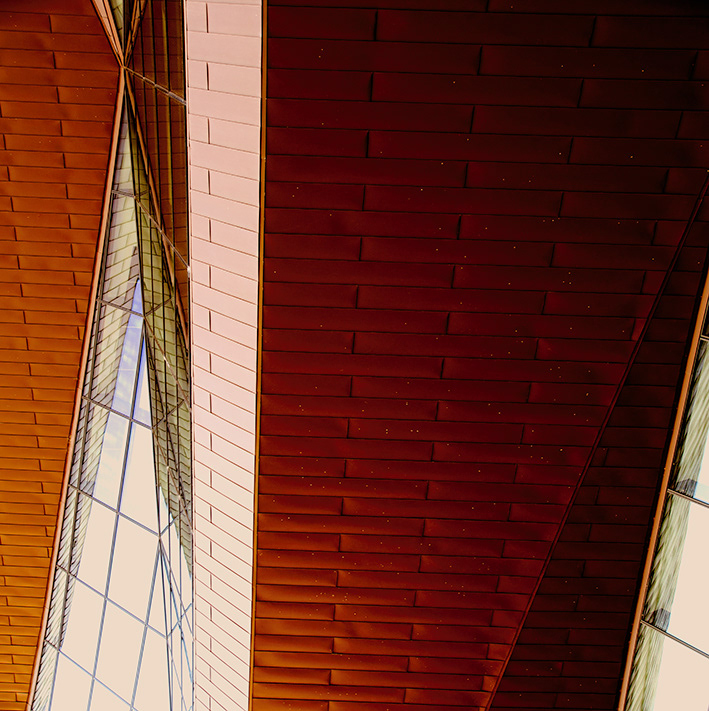
“Infra Accent”
Medium: Digital photograph or ultra-HD pigment print on gloss laminate panel
Dimensions: [Insert dimensions]
Edition: [Insert edition info]
Price: [Insert price]
Dimensions: [Insert dimensions]
Edition: [Insert edition info]
Price: [Insert price]
🖋️ Description
Infra Accent captures Adelaide’s infrastructural grace from a sharp upward angle—revealing a glowing red-tiled canopy contrasted against the geometry of a mirrored facade. The crimson overhang dominates the composition, casting shade while guiding the eye toward the angular sweep of the building’s glass skin. Light fractures along clean lines, reflecting sky and silence in equal measure. This piece draws tension between shelter and signal, tradition and reflection.
Infra Accent marks a moment of transition—where civic design gestures toward myth, shaped in steel and color.
💬 Critique
There’s editorial boldness here—Fin Rice pushes the series toward abstraction without abandoning architectural narrative. The scarlet overhang plays as both spatial punctuation and emotional accent, making Infra Accent a sculptural turn in the LOOKUP ADELAIDE journey. Its low vantage emphasizes power, while the mirroring glass folds the environment into a visual echo. This piece reminds viewers that structure is never static—it’s memory made material.
As the possible final coda, Infra Accent whispers legacy. It invites collectors to look beyond design into the city’s subconscious.
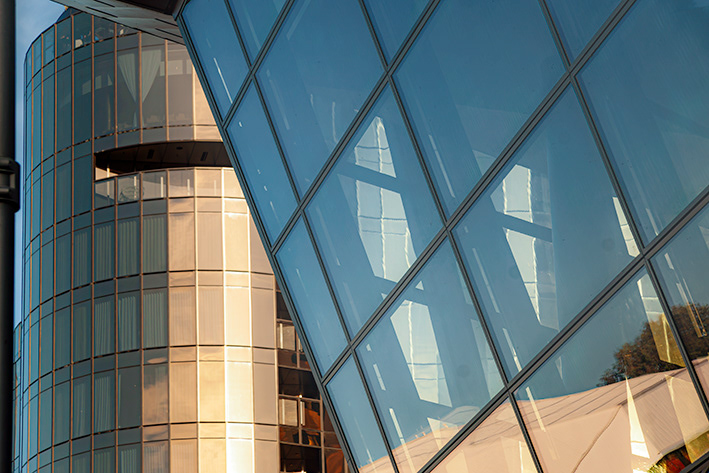
“Halo Construct II”
Medium: Digital photograph or ultra-HD pigment print on optical gloss film
Dimensions: [Insert dimensions]
Edition: [Insert edition info]
Price: [Insert price]
Dimensions: [Insert dimensions]
Edition: [Insert edition info]
Price: [Insert price]
🖋️ Description
Halo Construct II captures the poise of modernism in motion—two buildings in reflective conversation beneath Adelaide’s crystalline sky. The cylindrical tower on the left gleams with vertical regularity, while the angular façade to the right distorts and mirrors the tower’s form, turning steel into shimmer. The glass panels bend time and space, creating a liquid illusion of doubled presence. Ambient light wraps the structures in an aura of civic introspection.
This is architecture as encounter—two forms meeting mid-gaze, refracting city and self into mythic duality.
💬 Critique
There’s lyrical geometry in this piece. The contrast between round and sharp, matte and mirror, grounded and illusory speaks to Fin Rice’s ongoing meditation on Adelaide’s architectural soul. Halo Construct II extends earlier themes from Reflex Halo and Orbit Row, building a language of light-based resonance and structural empathy. The mirrored reflection isn’t decorative—it’s dialogic: a spatial memory speaking through gloss and glass.
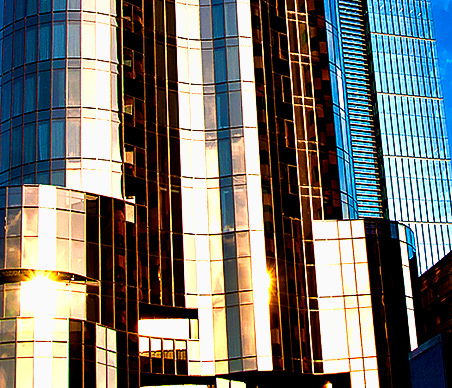
“Halo Construct”
Medium: Digital photograph or ultra-HD pigment print on layered acrylic
Dimensions: [Insert dimensions]
Edition: [Insert edition info]
Price: [Insert price]
Dimensions: [Insert dimensions]
Edition: [Insert edition info]
Price: [Insert price]
🖋️ Description
Halo Construct reveals a celestial rhythm in Adelaide’s civic geometry—where reflective glass meets angled symmetry under a radiant midday sky. A central curved building glows like a lens flare of urban optimism, its sleek surface refracting environment and light into liquid architecture. To the right, a sharper-edged structure contrasts with matte resolve, completing the city’s yin-yang of elegance and grounding. Sky and steel converse in silent harmony.
This composition marks a return to grace—architecture as reverent technology, place as polished myth.
💬 Critique
Fin Rice closes the LOOKUP ADELAIDE cycle with technical mastery and emotional clarity. Halo Construct compresses mythology into a single frame: light as text, steel as metaphor, reflection as revelation. The interplay of curves and edges reads like architectural choreography—each line purposeful, each surface tuned. The building at center becomes a beacon, echoing earlier themes of signal and transformation while asserting spiritual ease.
This piece resonates like a final stanza—quiet yet luminous, mechanical yet divine.
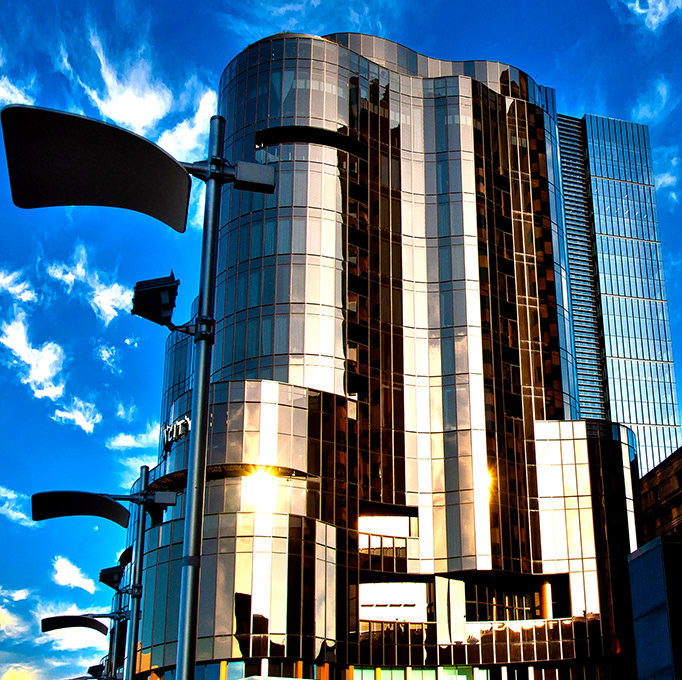
“Reflex Halo”
Medium: Digital photograph or museum-grade pigment print on gloss metallic paper
Dimensions: [Insert dimensions]
Edition: [Insert edition info]
Price: [Insert price]
Dimensions: [Insert dimensions]
Edition: [Insert edition info]
Price: [Insert price]
🖋️ Description
Reflex Halo is a sleek meditation on light’s dialogue with form. The curved, mirrored façade reflects Adelaide’s expansive blue sky in crystalline precision, while ambient clouds hover in soft dissonance—suggesting both impermanence and divine symmetry. Streetlights punctuate the foreground as minimalist anchors, grounding the otherwise ethereal composition in civic function.
This piece transforms architecture into atmosphere, offering viewers a moment where reflection becomes ritual.
💬 Critique
Fin Rice renders urban modernism with poetic restraint in Reflex Halo. The building’s curvature, gloss, and reflection are deployed not merely for spectacle, but as metaphors of adaptability and civic grace. The image feels weightless yet intentional—playing with gravity, transparency, and visual rhythm. The absence of clutter accentuates presence, making this work resonate like a minimalist hymn within the LOOKUP ADELAIDE canon.
In this twelfth installment, the series enters a phase of contemplation—less about skyline drama, more about the city’s subtle self-awareness.
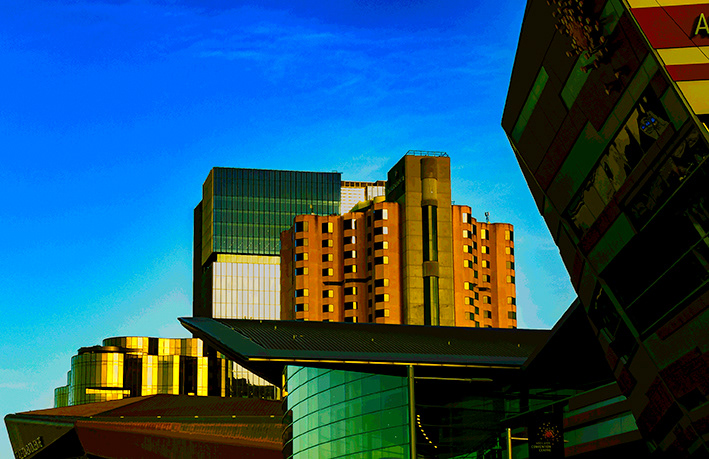
“Civic Prism”
Medium: Digital photograph or museum-grade pigment print on crystalline matte
Dimensions: [Insert dimensions]
Edition: [Insert edition info]
Price: [Insert price]
Dimensions: [Insert dimensions]
Edition: [Insert edition info]
Price: [Insert price]
🖋️ Description
Civic Prism presents a composite portrait of Adelaide’s architectural conscience—featuring three buildings in sharp stylistic dialogue. The foreground’s curved glass façade captures light with sleek subtlety, casting ambient reflections across its slanted geometry. Adjacent to it rises a cylindrical concrete tower etched with vertical ribs, embodying utilitarian grace. To the far right, a rectangular glass monolith asserts modernist authority, its blue tint mirroring the sky’s precise clearness.
The structures coalesce into a civic trinity—each layer refracting the city’s light and logic in distinct tonal registers.
💬 Critique
Fin Rice’s composition here is remarkably architectural in temperament: balanced, contemplative, and deeply rhythmic. Each building performs like an instrument in a public orchestra—glass as melody, concrete as bass, steel as syncopated beat. The low vantage point lends grandeur without distortion, grounding the viewer while lifting the gaze. The color restraint allows form to dominate, creating an atmosphere of civic resolve and ambient introspection.
Civic Prism enriches the LOOKUP ADELAIDE series by introducing elemental architecture—where the city becomes its own spectral instrument, tuned by light and framed by memory.
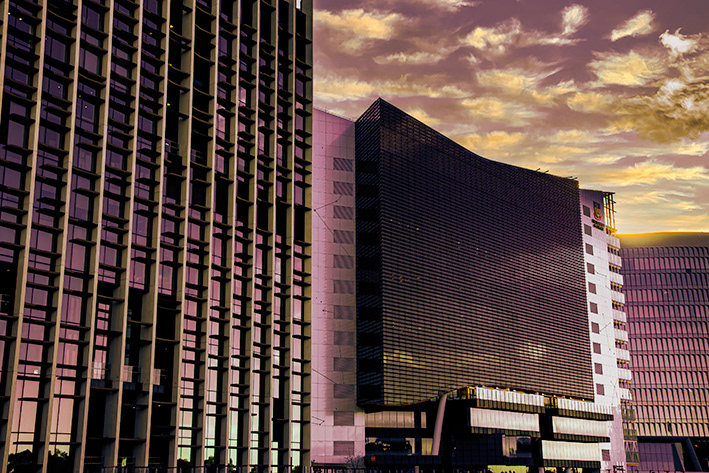
“Strata Drift”
Medium: Digital photograph or high-res pigment print on brushed steel panel
Dimensions: [Insert dimensions]
Edition: [Insert edition info]
Price: [Insert price]
Dimensions: [Insert dimensions]
Edition: [Insert edition info]
Price: [Insert price]
🖋️ Description
Strata Drift unveils a layered portrait of Adelaide’s architectural cadence—three facades speaking in rhythm beneath a theatrically illuminated sky. To the left, a matrix of windows recalls modernist mapping; at center, a fluid, curved structure folds light into shadow; and to the right, a ribbed tower asserts vertical constancy. The glowing horizon casts apricot and violet hues across the scene, evoking a dreamlike palette rarely found in civic imagery.
The composition echoes themes of gravitas and lift—where infrastructure floats into myth under a changing sky.
💬 Critique
This piece operates like visual polyphony: each building contributes a distinct timbre, yet the whole vibrates in urban harmony. Fin Rice’s lens here is especially tonal—attuned to the balance between reflective surface and atmospheric swell. The sky isn’t backdrop, but collaborator, shifting architectural permanence into poetic transience. The dialogue between hard structure and soft light is quintessentially Rice: mythic urbanism, rendered in sublime quiet.
Strata Drift expands the narrative arc of LOOKUP ADELAIDE, nodding to civic lineage while drifting toward speculative reverie.
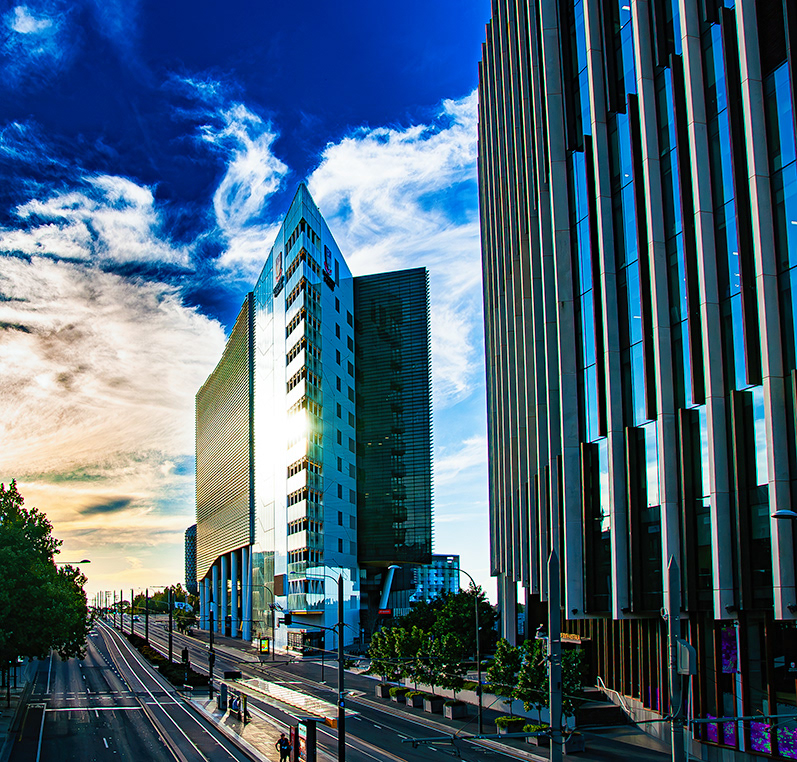
“Weatherproof Poem”
Medium: Digital photograph or fine-art pigment print on matte Hahnemühle
Dimensions: [Insert dimensions]
Edition: [Insert edition info]
Price: [Insert price]
Dimensions: [Insert dimensions]
Edition: [Insert edition info]
Price: [Insert price]
🖋️ Description
Weatherproof Poem captures a moment of architectural introspection beneath a brooding Adelaide sky. The central angular structure—mirror-bright and sharply faceted—faces off with a ribbed tower to the right, each gesture mirrored in the street’s quiet geometry. Leafy trees edge the scene with calm, while scattered pedestrians imbue the landscape with subtle kinetic tension. What emerges is a portrait of a city simultaneously shielding and revealing itself.
The glass surfaces, stark cloud patterns, and underlying gridlines of urban design invite contemplation on permanence, transience, and the art of urban camouflage.
💬 Critique
Fin Rice's Weatherproof Poem thrives on dualities: sky versus scaffolding, movement versus stillness, reflection versus truth. The image eschews dramatic color for tonal precision—its power drawn from atmospheric depth and compositional poise. The human figures are minimalist punctuation, hinting at narrative without overwhelming architectural rhythm. There’s lyrical restraint at play, echoing earlier motifs in the LOOKUP ADELAIDE series while adding a new dimension of emotional weather—how cities feel as well as how they look.
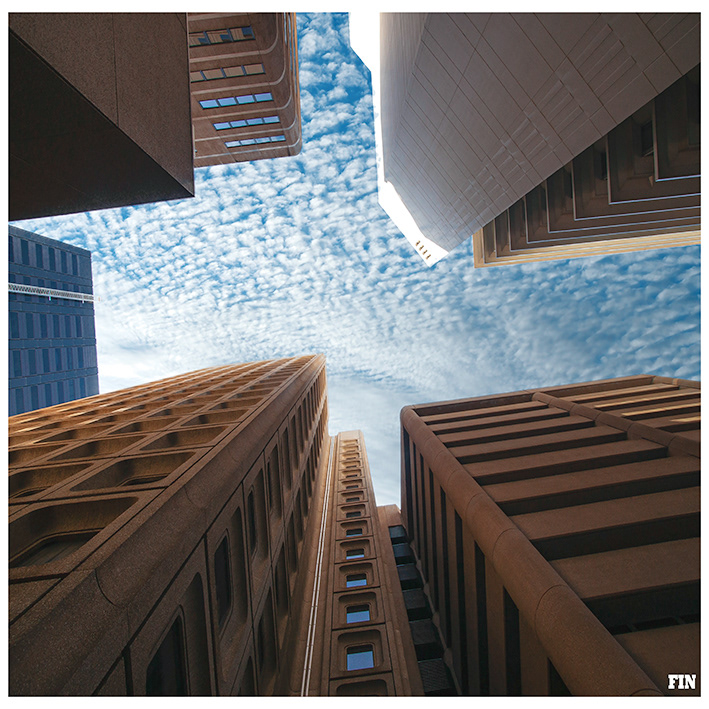
“Skyframe Chorus”
Medium: Digital photograph or ultra-HD pigment print on satin paper
Dimensions: [Insert dimensions]
Edition: [Insert edition info]
Price: [Insert price]
Dimensions: [Insert dimensions]
Edition: [Insert edition info]
Price: [Insert price]
🖋️ Description
Skyframe Chorus is an ode to vertical cadence. Shot from a dramatic low angle, the image invites the viewer into a vertiginous dialogue between towering facades and textured cloudscape. The buildings—each distinct in architectural rhythm and surface—rise in harmonic discord, echoing Adelaide’s evolving symphony of space and design. The narrow slice of sky acts as the score’s silent refrain, a moment of breath between concrete crescendo.
This piece reminds us that the city speaks not just in street-level murmurs, but in upward verse.
💬 Critique
Fin Rice achieves tonal complexity here through composition alone. The alignment isn’t pristine—it’s purposeful: a visual polyphony of density, light, and height. Each structure contributes to the “chorus” with a different accent, be it brick austerity, modular texture, or reflective grace. The dynamic tension between built form and celestial backdrop taps into LOOKUP ADELAIDE’s deeper inquiry: What do cities remember when they look skyward?
This piece completes a powerful architectural octave within the series—equal parts reverence, rhythm, and revelation
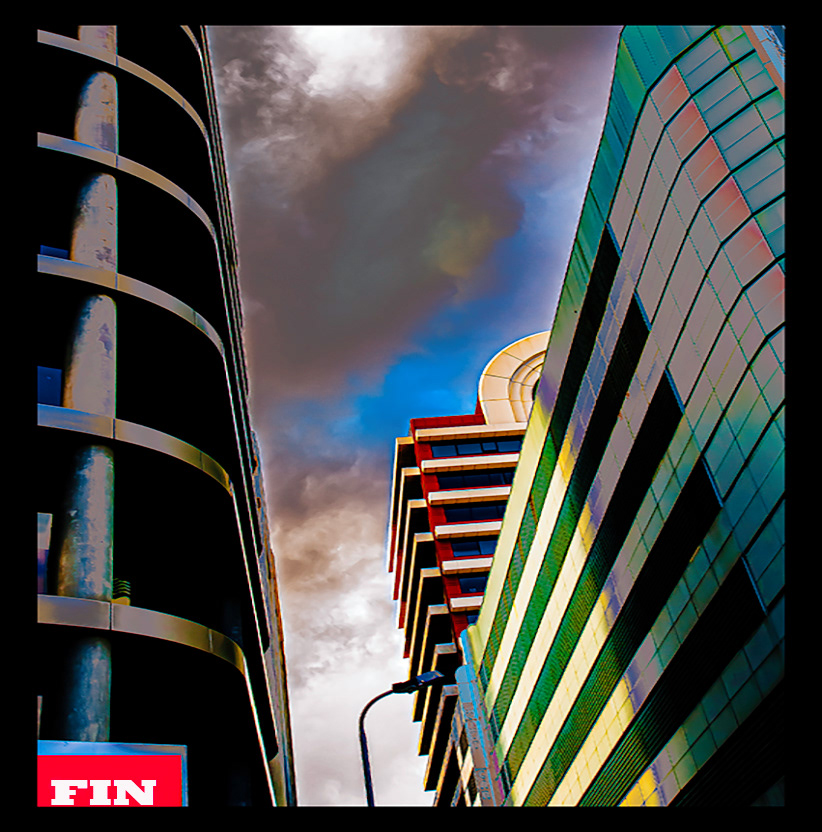
“Orbit Row”
Medium: Digital photograph or large-scale pigment print on matte aluminium
Dimensions: [Insert dimensions]
Edition: [Insert edition info]
Price: [Insert price]
Dimensions: [Insert dimensions]
Edition: [Insert edition info]
Price: [Insert price]
🖋️ Description
A cosmic composition drawn from Adelaide’s civic skyline, Orbit Row melds curvature, geometry, and industrial grace into a dreamlike urban constellation. The image showcases three distinct architectural forms: a cylindrical tower with radial bands, a central structure marked by red and white horizontal lines and crowned with a circular dome, and a pixelated green-and-blue building with a gentle arc. Under a moody sky of brewing clouds, the streetlamp emerges as a quiet observer—marking a terrestrial pause in an otherwise interstellar narrative.
The “FIN” marker anchors the scene, asserting identity amid spirals of anonymity. This artwork positions the city as both spatial memory and future signal.
💬 Critique
Fin Rice again demonstrates architectural storytelling at its most poetic. The triad of buildings offers formal contrast and thematic unity—each structure performing as character within Adelaide’s visual opera. The central dome evokes retro sci-fi optimism; the cylindrical left tower hums like a silent beacon; and the gridlike facade on the right pulses with digital rhythm. There’s dramaturgy in the tension between monumental design and atmospheric instability, making Orbit Row a metaphysical extension of the LOOKUP ADELAIDE suite.
This piece suggests civic architecture not as shelter, but as signal—an encoded frequency of Adelaide’s ongoing transformation
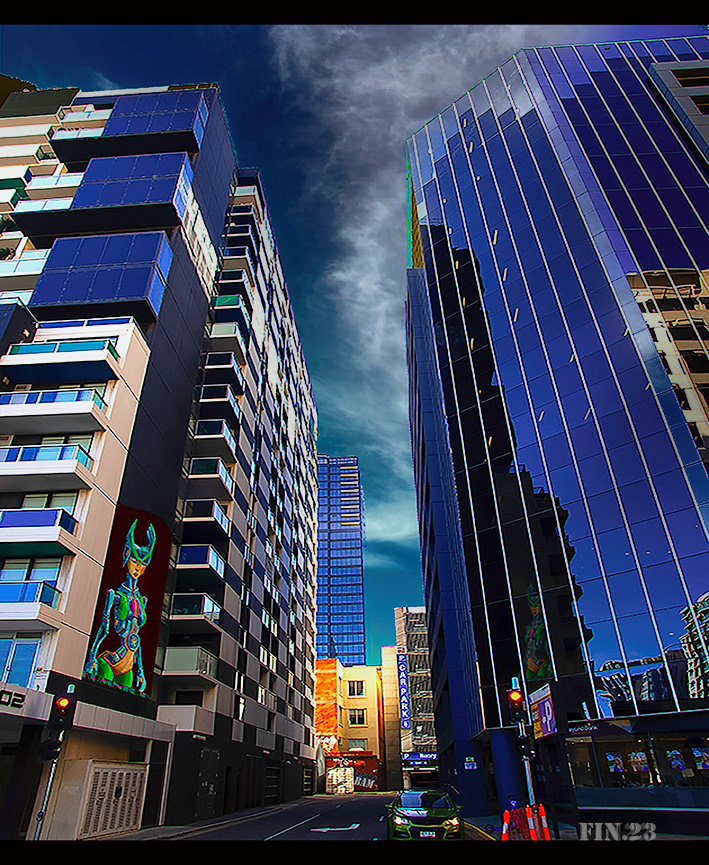
“Glass Frequency”
Medium: Digital photograph or ultra-HD pigment print on reflective acrylic
Dimensions: [Insert dimensions]
Edition: [Insert edition info]
Price: [Insert price]
Dimensions: [Insert dimensions]
Edition: [Insert edition info]
Price: [Insert price]
🖋️ Description
Glass Frequency captures a sensory flashpoint in Adelaide’s built environment—a mirrored corridor vibrating with reflections, mural mysticism, and architectural rhythm. The image centers on a street flanked by dual modern facades: one adorned with a vivid mural depicting a futuristic figure, the other a reflective monolith echoing back skyline and sun. The composition offers a paradox of depth and distortion, where the reflective glass surfaces operate as both transmitter and receiver of civic emotion.
The “CARPARK” signage at the end reads like a location stamp but also marks the conclusion of urban thought, grounding the visual journey.
💬 Critique
Fin Rice achieves harmonic dissonance in Glass Frequency: the balance of human-scale symbols (mural, cones, parked car) against monumental textures and vertical ambition. This image hums with architectural frequency—reflections layered like sonic waves, challenging viewers to decipher place from pulse. The futuristic mural punctuates the scene with narrative vitality, becoming a mythic character in the Adelaide saga Rice has so compellingly constructed.
With this work, the LOOKUP ADELAIDE series embraces speculative urbanism—where every facade might be a screen, every shadow a signal.
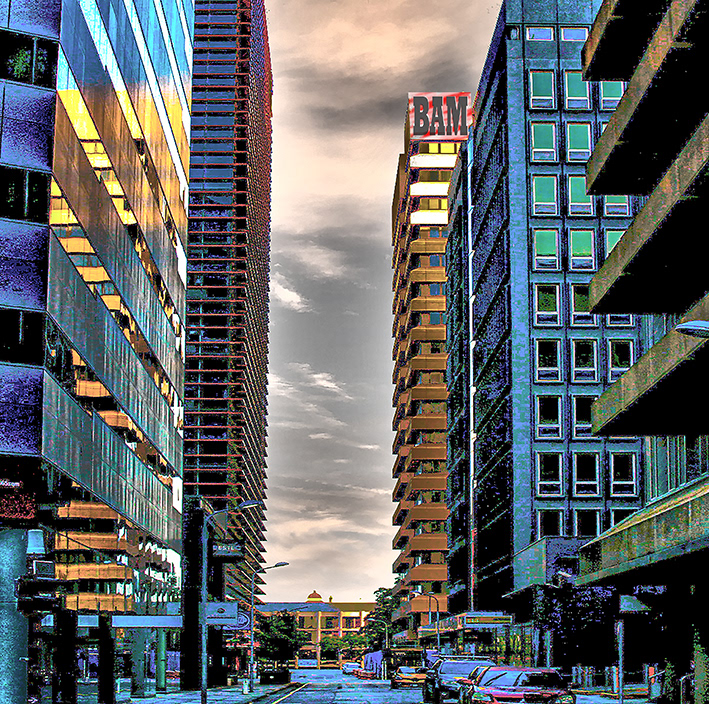
“Echo District”
Medium: Digital photograph or high-res pigment print on pearl paper
Dimensions: [Insert dimensions]
Edition: [Insert edition info]
Price: [Insert price]
Dimensions: [Insert dimensions]
Edition: [Insert edition info]
Price: [Insert price]
🖋️ Description
Echo District captures Adelaide’s urban quiet in crystalline detail—a city street suspended in time, flanked by modern facades and washed in muted light. The composition is a study in spatial narrative: architectural symmetry, the ghostly presence of parked cars, and the looming “BAM” signage that recurs as a thematic echo across the collection. The partly cloudy sky offers atmospheric contrast—framing the buildings with both grandeur and transience.
This piece documents the pause between movement—where infrastructure, identity, and emotion gather invisibly.
💬 Critique
In Echo District, Fin Rice distills stillness into spectacle. The balance between contemporary design and nostalgic ambiance evokes both progress and longing. The absence of motion becomes a motif itself: a meditation on urban solitude. The image’s linear depth and subtle reflections offer an almost cinematic texture—less documentary, more dream-sequence. The “BAM” emblem acts as mnemonic thread, stitching memory to motif across the LOOKUP ADELAIDE series.
This work stands as an anchor—calm but charged—for collectors seeking spatial intimacy wrapped in visionary framing.
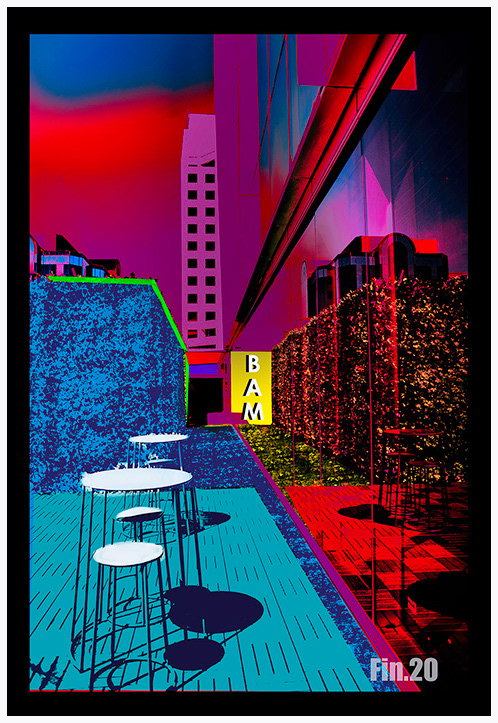
“ATMOSPHERE”
Medium: Digitally altered photograph or archival pigment print with gloss overlay
Dimensions: [Insert dimensions]
Edition: [Insert edition info]
Price: [Insert price]
Dimensions: [Insert dimensions]
Edition: [Insert edition info]
Price: [Insert price]
🖋️ Description
Mirror Grove invites contemplation within an urban retreat—a corridor of curated stillness where tables and stools line a pathway flanked by nature’s encroaching calm. The image’s right wall reflects a second layer of foliage, duplicating serenity while distorting scale. The bold color shifts—electric blues, neon reds, synthetic greens—lift the composition from realism into a liminal dream state. Background accents like the "BAM" signage subtly echo previous works, connecting place to narrative.
The piece considers reflection not only as visual device but as metaphor for identity, memory, and temporality in a city defined by motion.
💬 Critique
In Mirror Grove, Fin Rice leans fully into surreal architectural poetics. The duality created by the glass wall functions as both mirror and veil—splitting perception, multiplying potential. The use of artificial saturation enhances emotional contrast: solitude against saturation, structure against sprawl. The red stool becomes a punctuation mark in an otherwise tranquil visual sentence.
This image deepens the series’ evolving discourse on Adelaide as mythos—one framed by transition, infrastructure, and human pause. Mirror Grove serves as emotional ballast for the collection, grounding the urban sublime in meditative realism.
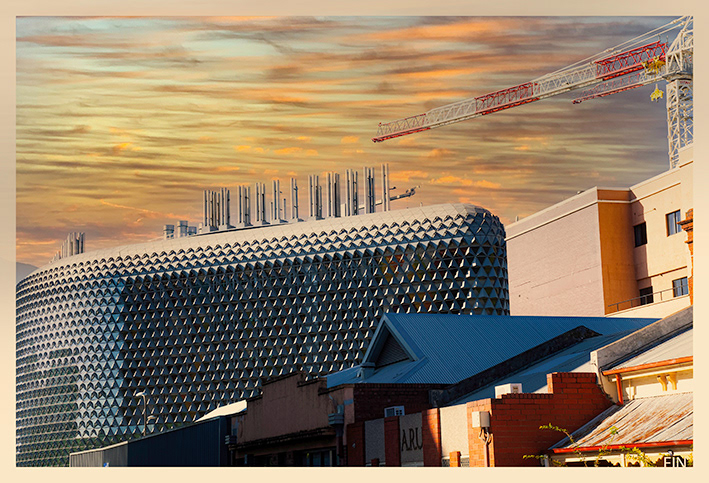
“Diamond Echelon”
Medium: Digital photograph or metallic pigment print on textured paper
Dimensions: [Insert dimensions]
Edition: [Insert edition info]
Price: [Insert price]
Dimensions: [Insert dimensions]
Edition: [Insert edition info]
Price: [Insert price]
🖋️ Description
A kaleidoscopic gesture toward Adelaide’s architectural future—Diamond Echelon is a study in repetition, elevation, and material wonder. The image centers a soaring modern facade whose diamond-patterned skin glistens against a backdrop of brick traditions and industrial progress. Below, the grounded textures of older buildings—including a cobalt-roofed brick structure—establish a visual dialectic between permanence and possibility. A hovering crane punctuates the skyline like a brushstroke of ambition.
The twilight glow imbues the entire composition with an atmosphere of poetic transition—where past meets progress beneath the Adelaide sun.
💬 Critique
This work amplifies Fin Rice’s thematic tension between utopian futurism and civic memory. The building’s geometric skin serves both aesthetic and allegorical functions—suggesting coded language, protective armor, or aspirational shimmer. The crane isn't just incidental; it anchors the image as a symbol of transformation-in-motion. There's precision in the palette and symmetry in the chaos—hallmarks of Fin's curatorial vision.
Diamond Echelon deepens the LOOKUP ADELAIDE series by introducing modular myth—a narrative of emergent identity etched in steel and sunset.
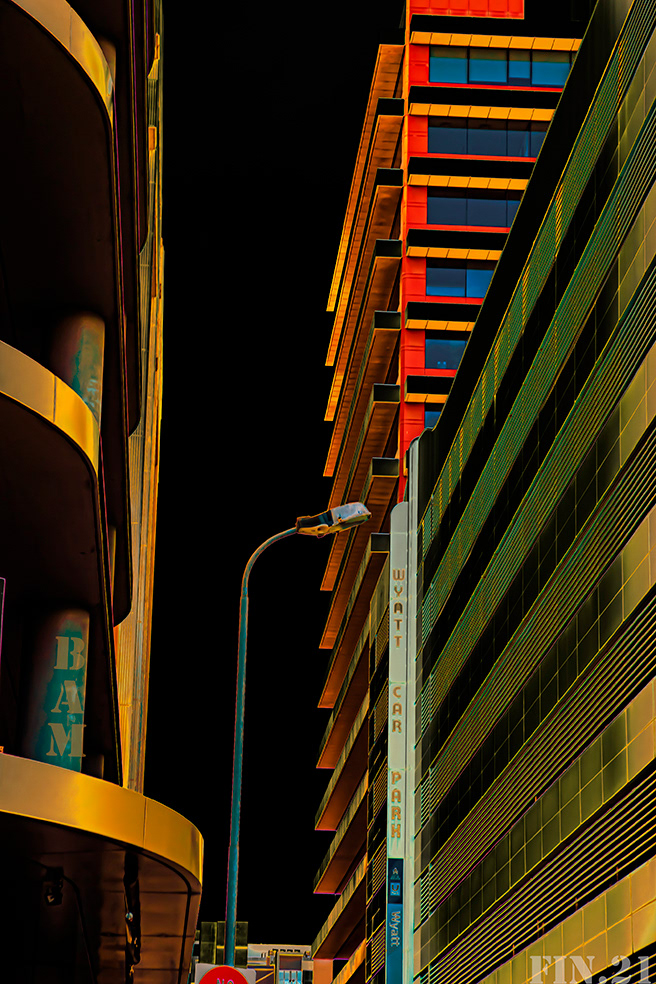
“Vertical Memory”
Medium: Digital photograph or pigment print on glossy archival paper
Dimensions: [Insert dimensions]
Edition: [Insert edition info]
Price: [Insert price]
Dimensions: [Insert dimensions]
Edition: [Insert edition info]
Price: [Insert price]
🖋️ Description
A nocturnal city fragment distilled into lucid geometry—Vertical Memory captures the psychological weight of signage, structure, and steel. The composition is dominated by two distinctly labeled façades—“BAM” and “WYATT CAR PARK”—which act as urban signifiers in the subconscious map of Adelaide’s civic rhythm. Bathed in ambient shadows and soft reflections, the image explores how built environments quietly archive culture, commerce, and collective identity.
💬 Critique
Fin Rice's lens remains lyrical even in low light. There's a haunting simplicity to this piece—the signage as textural memory, the dark sky as narrative void. The streetlight subtly punctuates the scene, offering a moment of spatial orientation while emphasizing emotional distance. Rather than glorify architecture, Vertical Memory meditates on its myth: the stories buildings carry long after their designers fade. This work deepens the visual language of the LOOKUP ADELAIDE series by anchoring futuristic optimism to a present-day melancholia.
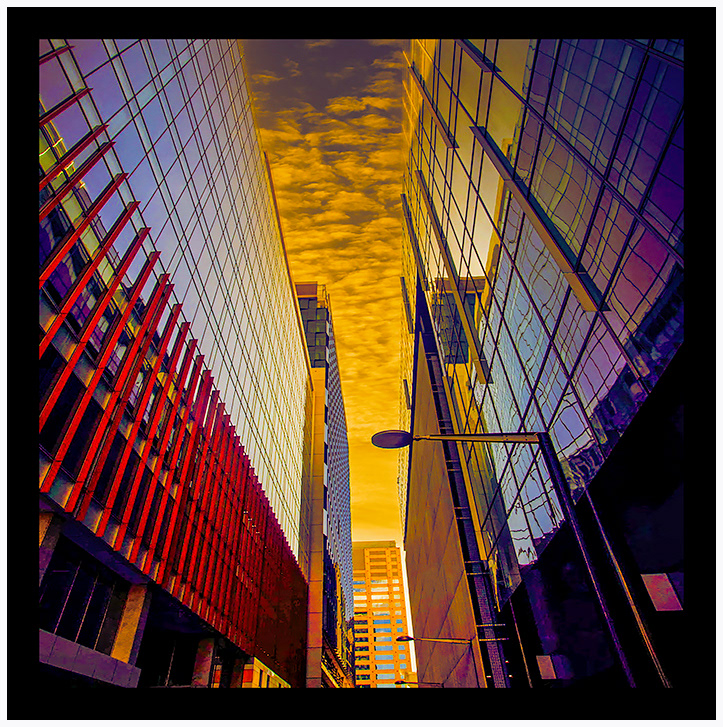
“Between Suns”
Medium: Digital photograph or archival pigment print on metallic paper
Dimensions: [Insert size]
Edition: [Insert edition, e.g. 1/10 or Open]
Price: [Insert price]
Dimensions: [Insert size]
Edition: [Insert edition, e.g. 1/10 or Open]
Price: [Insert price]
🖋️ Description
Between Suns captures the liminal tension of dusk within an urban canyon—where towering facades seem to conspire with the setting sky. A radiant yellow-orange horizon pulses between two mirrored glass structures, their surface reflections refracting a chaotic elegance. The lone red-accented building becomes a visual metronome, holding rhythm in a landscape that appears to bend time.
This artwork speaks to the temporality of space: a brief window where architectural grandeur and natural drama collide in radiant harmony.
💬 Critique
What distinguishes this work is its emotive use of color and framing. The architectural symmetry provides a grounding framework, while the saturated, almost artificial sunset provokes a dreamlike quality. Fin Rice continues to elevate urban photography into myth-making—the red vertical accents serving as an alchemical flare amidst steel and shadow. There’s cinematic restraint here, making it ideal for collectors seeking modernist serenity with undertones of futurism.
Between Suns perfectly complements the tone of LOOKUP ADELAIDE, mirroring the city’s tension between history and innovation.
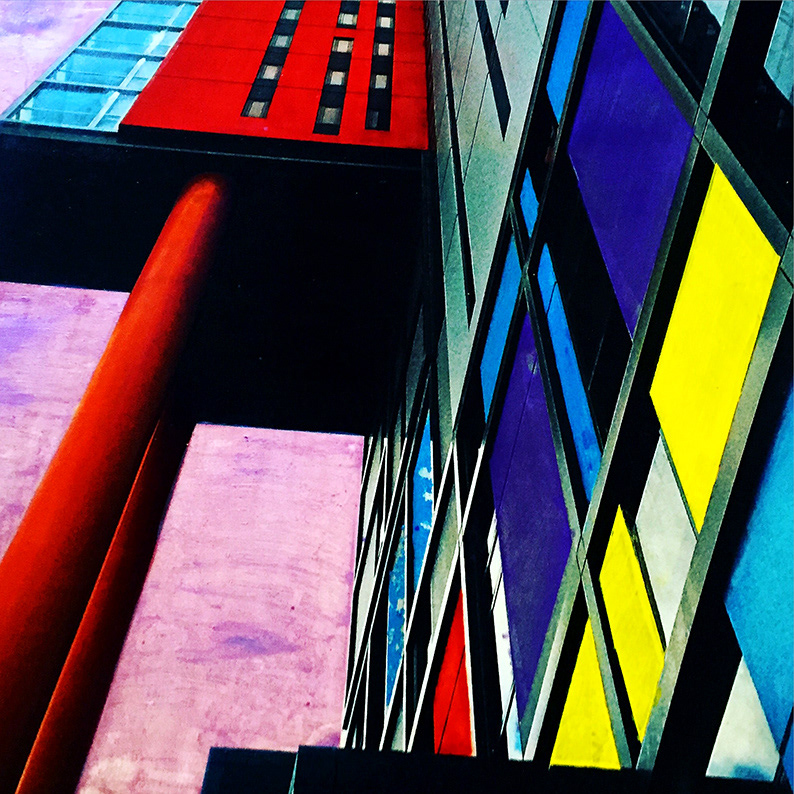
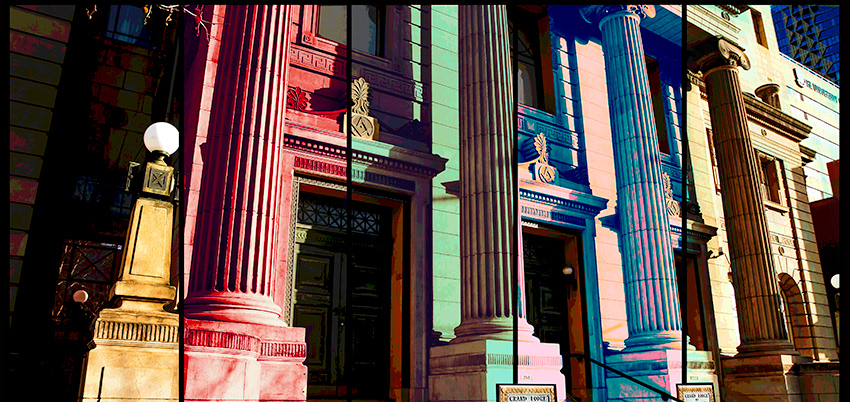
Artwork Installation
Artist: Fin Rice
Project Title: Grand entrance
Location: The Westin Adelaide
Dimensions: 5 panels, total size 2500mm x 1200mm
Date: August 2025
Project Title: Grand entrance
Location: The Westin Adelaide
Dimensions: 5 panels, total size 2500mm x 1200mm
Date: August 2025
✨ Concept Overview
Civic Chromatics is a five-panel, light-reactive artwork inspired by the architectural gravitas of Adelaide’s Grand Lodge. Through layered photographic treatments and bespoke material finishes, the work transforms with ambient light—offering hotel guests a dynamic encounter with the city’s legacy. Each panel acts as a movement in a visual symphony, echoing The Westin’s commitment to timeless elegance and elevated guest experiences.
🎨 Medium Options & Pricing Tiers
Option
Description
Estimated Cost (AUD)
“Ascendant Facade”
Medium: Digital photograph or mixed media print (please confirm the medium)
Dimensions: [Insert size]
Edition: [Insert edition info if limited, e.g. 1/20]
Price: [Insert price]
Dimensions: [Insert size]
Edition: [Insert edition info if limited, e.g. 1/20]
Price: [Insert price]
🖋️ Description
A vivid composition captured from a low, reverent angle that transforms architecture into a mythic monolith. Ascendant Facade channels a futuristic optimism—where geometry, color, and light converge to evoke a utopian skyline. The candy-toned grid of red, blue, yellow, and violet reimagines the built environment as a curated canvas, inviting viewers to see civic space not as static shelter, but as evolving art.
💬 Critique
This piece exemplifies Fin Rice’s signature ability to fuse luxury aesthetics with urban futurism. The saturated palette is bold without being garish—anchored by a commanding red column that both supports and seduces. The composition’s upward gaze lends an aspirational energy, echoing the ethos of LOOKUP ADELAIDE as a celebration of elevation—social, architectural, spiritual. There’s a striking tension between structural order and chromatic playfulness, making this a standout piece for collectors drawn to innovation and optimism.